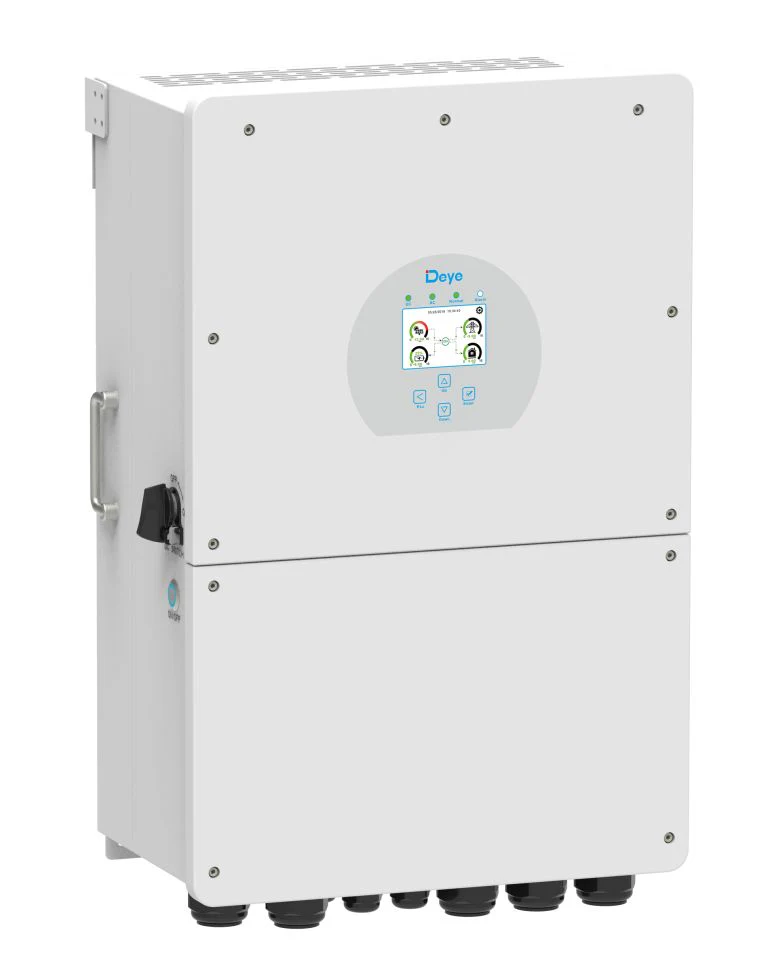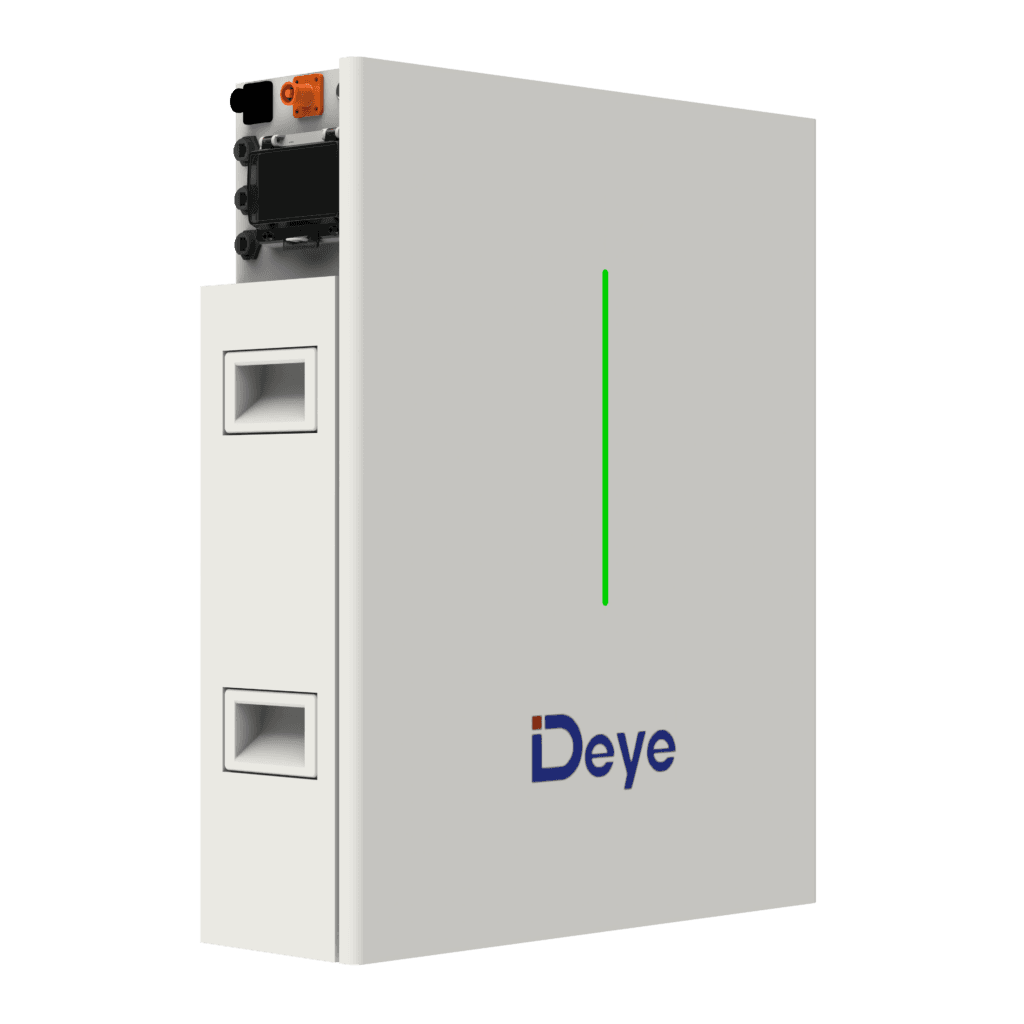
News Lithium Battery-school
Used LiFePO4 Cells Sold as New: The 2026 Second-Life Battery Problem

Q. Is the B-grade and used-cell problem still real in 2026?
A. YES. The risk is lower than it was a few years ago, but the problem has not disappeared. It has changed.

New LiFePO4 cell prices have fallen. Manufacturing quality has improved. Large manufacturers are producing more cells, better traceability is coming, and genuine new cells are easier to buy than they once were.

At the same time, the first enormous wave of electric vehicles, buses, trucks and commercial battery packs is getting older. Packs only a few years old are being damaged, written off, dismantled, tested and split into modules and individual cells. Some of those cells are perfectly suitable for an honest second-life application.

But some are being cleaned, rewrapped, relabelled and sold into another supply chain without the buyer being told that they are used.

SECOND-LIFE CELLS ARE NOT THE PROBLEM.

SELLING SECOND-LIFE CELLS AS NEW IS THE PROBLEM.

This article is not an attack on battery recycling. Proper reuse is good engineering and good environmental practice. It is also not a claim that every low-cost battery contains used cells. The point is simple: buyers must be told what they are buying, and claims such as new, Grade A, matched and automotive grade must be supported by real evidence.

What Has Changed Since the Original QR-Code Problem?

In the earlier article, The LiFePO4 QR Code B-to-A-Grade Problem, I explained why a QR code does not authenticate a cell. A QR code is data. It can be copied, printed, engraved or replaced.

In 2026 the bigger question is no longer only, “Was this B-grade cell made to look like A-grade?”

The new question is: “Was this cell already inside another battery?”

The International Energy Agency’s 2026 battery analysis says flows of used and end-of-life EV batteries are beginning to increase and used-battery prices have fallen sharply. The same report says China hosts more than 85% of global battery-recycling capacity. That does not mean 85% of used cells are being misrepresented. It means an enormous dismantling, reuse and recycling industry now exists around these batteries.

China introduced stronger rules from 1 April 2026, including a digital identity for EV power batteries and a national traceability system. The Chinese Government said the volume of retired batteries is growing significantly. A national lifecycle traceability platform now aims to follow batteries from production and installation through use, retirement and recycling.

Governments do not build national tracking systems for an imaginary product flow.

First, Stop Mixing Up Four Different Things

TermWhat it should meanWhat the buyer must be told
New cellUnused cell supplied through a traceable manufacturing and distribution chain.Manufacturer, model, production batch, test data and warranty source.
B-grade or factory-second cellA new cell that did not meet one or more first-grade production or matching criteria.That it is B grade, why it was rejected if known, and what testing has been completed.
Second-life or repurposed cellA cell that has already been used in a vehicle, module or another battery and is being used again.Its previous use, test method, measured state of health, limitations and second-life warranty.
Recycled materialLithium, copper, aluminium or other materials recovered and processed for manufacturing again.This is material recovery—not the same thing as selling an intact used cell.

A used cell can be better than a poor new cell. A properly tested automotive cell at 85% state of health may be excellent for a low-rate, stationary project. But it is still used. Its value, warranty, expected life and suitable application are different.

What I Have Personally Seen

I have watched hundreds and probably thousands of videos on Chinese social-media platforms showing businesses that specialise in this work.

  • Complete EV and commercial battery packs arriving on pallets.
  • Packs opened and modules separated.
  • Cells removed, cleaned and tested.
  • Old insulation, films, busbars and labels removed.
  • New wraps, terminal covers and labels fitted.
  • Cells sorted into different piles according to voltage, capacity or what the workshop believes it can sell them for.
  • Modules and cells advertised into completely different markets.

Recycling and repurposing businesses are not hiding the fact that they do this work. Many are proud of it. It is a large and legitimate industry when the product remains identified as used or repurposed.

The issue is what happens further down the sales chain. A video cannot prove where every cell eventually goes, and I will not pretend that it can. But once a cell has been cleaned, wrapped and separated from its original BMS data and pack identity, the next buyer may have no simple way to know its history.

A 2026 report based on a Yicai investigation described an unlicensed workshop where retired packs were dismantled, cells were tested and higher-capacity cells were re-filmed for resale into two-wheelers, power banks and energy-storage products. Read the reported investigation into China’s informal battery-recycling market. Caixin separately reported in June 2026 that less than 30% of retired power batteries were being collected through formal channels. These are reported estimates, not a measurement of every battery or seller.

Why a Used Cell Can Look Brand New

A prismatic cell is an aluminium can with terminals, a vent, a plastic top and a thin outer film. Most of what a buyer sees can be cleaned or replaced.

  1. The old pack is tested as a complete unit.
  2. The pack is dismantled into modules or cells.
  3. Obvious failures are separated from cells that still hold useful capacity.
  4. Residue, adhesive and old film are removed.
  5. Terminals can be cleaned or resurfaced and new covers fitted.
  6. A new wrap, label or QR mark gives the cell a uniform appearance.
  7. The cells are boxed with new busbars and sold into another market.

None of this changes what is inside the can. It does not put the lithium back. It does not undo heat exposure. It does not remove calendar ageing, high-current use, deep discharge, overcharge, vibration, compression damage or years of self-discharge history.

A NEW WRAP IS NOT A NEW CELL.

A NEW QR CODE IS NOT A NEW CELL.

A VOLTAGE OF 3.29V IS NOT A STATE-OF-HEALTH TEST.

Why the QR Code Still Does Not Save You

A QR code may tell you what the code claims the cell is. It may include a manufacturer identifier, model and production date. That can be useful for detecting an obvious mismatch.

It cannot tell you:

  • whether the mark is original;
  • whether the cell spent three years inside a bus or commercial battery;
  • how many amp-hours it can deliver now;
  • its self-discharge rate;
  • its DC internal resistance at a controlled state of charge and temperature;
  • whether it was exposed to excessive heat or damaging voltage limits; or
  • whether sixteen cells came from the same original batch, or even the same pack.

If you want the background, read our LiFePO4 QR vendor-code guide and the original explanation of why QR codes do not verify authenticity.

The Technical Problem Is Cell History and Cell Mismatch

Second-life engineering is not just “charge it and see if it reaches 3.65V.”

A peer-reviewed study of cells harvested from a retired LiFePO4 hybrid-vehicle pack found high state-of-health variation and mismatch within modules. Depending on the acceptance criteria, the proportion considered suitable for reuse changed significantly. That is the entire problem in one result: the answer depends on what was measured and what standard was applied.

Another second-life assessment of commercial LFP batteries retired from EVs evaluated capacity, impedance, balance state and consistency. Research using 920 retired-LFP datasets was needed to develop a faster method of estimating residual capacity. If a simple voltage check or QR scan were enough, this research would not be necessary.

UL’s standard for repurposing batteries makes the same point in practical language. UL 1974 covers examination, BMS-data analysis, disassembly, sorting, grading, rejection procedures, markings and instructions. Proper repurposing is a process, not a sticker.

One Weak Cell Still Controls the Whole Series Pack

Let us use a current 16-cell, 51.2V battery example.

  • 15 cells can deliver 314Ah.
  • One used or damaged cell can deliver only 240Ah.
  • The cells are in series.

Theoretical nominal energy with properly matched 314Ah cells:

16 × 3.2V × 314Ah = 16.08kWh

Energy limited by the 240Ah cell:

16 × 3.2V × 240Ah = 12.29kWh

That single weak cell can remove about 23.6% of the usable capacity before allowing for inverter losses, BMS limits and reserve settings. It may also reach the charge or discharge limit first, causing the BMS to disconnect the entire battery.

This is why a pack can appear normal at rest, charge to the expected voltage, and still perform badly under load.

Is a Properly Disclosed Second-Life Battery Bad?

NO.

A proper second-life battery may offer excellent value. Retired EV batteries can retain substantial usable capacity. The IEA, NREL, CATL, UL and many researchers are all investigating or supporting reuse because the idea is technically valid.

A legitimate second-life product should be sold as second-life.

It should have traceable origin, a defined screening and rejection process, measured state-of-health data, an application-appropriate design, a realistic warranty and a clear future recycling pathway.

CATL says traceability makes second life and recycling more viable, and describes battery passports as a way to retain lifecycle identity. Its formal battery-health service uses extensive online and offline inspections. See CATL’s circularity and traceability overview and its battery inspection and lifecycle service.

The honest second-life seller is not the enemy here. In many cases that seller is doing more testing and providing more information than a seller hiding behind the words “A Grade.”

How to Reduce the Risk Before You Buy

1. Ask who supplied the cells

“Direct from the factory” is not a document. Ask for the legal supplier name, invoice trail, manufacturer batch information and who will honour the warranty in Australia.

2. Ask whether the cells have ever been installed

Do not ask only whether they are “new.” Ask whether they have ever been installed in a pack, vehicle, test system, demonstration unit or another product.

3. Ask for the original factory data—not a seller spreadsheet

A spreadsheet can be copied just like a QR code. The value comes from a traceable connection between the manufacturer, the batch, the individual cells and the business accepting responsibility for the claim.

4. Demand test conditions

  • Capacity in amp-hours and watt-hours.
  • Charge and discharge current.
  • Upper and lower voltage limits.
  • Cell temperature during testing.
  • DC internal resistance measured at the same state of charge and temperature.
  • Self-discharge observation period.
  • Acceptance and rejection limits.

5. Look for physical evidence

  • Uneven or freshly replaced wraps.
  • Adhesive residue or marks where old separators were attached.
  • Scratched terminals or signs of previous busbar contact.
  • Sanded, polished or resurfaced terminal faces.
  • Inconsistent vents, terminal covers, heights, weights or case finish.
  • QR codes with different depth, alignment, font or surface finish.
  • Swelling, dents, corrosion or electrolyte residue.

Physical clues can raise questions, but they are not a complete state-of-health test. A carefully refurbished cell may look perfect, and a genuine new cell can have minor cosmetic marks.

6. Compare the price with reality

New-cell prices have fallen, so a low price is not automatic proof of fraud. But a claimed premium, fully matched, automotive-grade product still needs a supply chain and testing process capable of producing that result. If the price cannot pay for the product, dangerous-goods transport, GST, testing, warranty and local support, ask which part is missing.

7. Buy from someone who will still answer the phone

The most useful certificate is worthless if nobody accepts responsibility when one cell develops high self-discharge six months later.

For more background on how we describe cell quality, see our separate LiFePO4 battery-grades guide and the earlier report on B-grade EVE QR markings.

What Australian Sellers and Buyers Should Know

The ACCC says claims about a product’s quality, history and whether it is new must be accurate and based on reasonable grounds. It also says silence can be misleading when important information is withheld. Read the ACCC’s guidance on false or misleading claims.

This is not theoretical. The ACCC previously took action involving electronics advertised as new when they were refurbished or made with used parts. See the ACCC’s refurbished-electronics enforcement example.

Battery safety is also more than chemistry. The ACCC’s lithium-ion battery safety guide tells consumers to buy from reputable suppliers and not use dented, swollen, leaking, overheated or damaged batteries. Australia’s battery-reuse industry is legitimate and growing, but used batteries need proper systems. The 2026 ABRI and Standards Australia transport guidance exists because used lithium batteries require specific handling, packaging, labelling and risk controls.

This article provides general information, not legal advice. The principle is still plain enough: if a product is used, say it is used.

The Bottom Line

The risk of receiving old stock or obvious factory rejects may be lower than it was several years ago because genuine new LFP cells are cheaper and easier to source.

But another supply is growing at the same time: cells recovered from EVs, buses, commercial storage systems, damaged packs, insurance write-offs and early battery projects.

Many of those cells still have useful life. They should be tested, graded, matched and sold honestly for an appropriate application.

USED IS NOT A DIRTY WORD.
UNDISCLOSED IS THE DIRTY WORD.

Do not pay new-cell money for an unknown history. Do not accept a QR scan as proof. Ask for evidence, test data, traceability and somebody in Australia who will stand behind the product.

Sources and Further Reading

How these sources are ranked: official and peer-reviewed sources support factual and technical claims. Investigations describe current market behaviour. Forum posts are individual reports and discussions; they are useful for recognising patterns but are not treated as independently verified proof against a seller.

Tier 1 — Official, primary and standards sources

  1. IEA — Global EV Outlook 2026: Electric vehicle batteries
  2. IEA — Battery Circularity (2026)
  3. Government of China — management of used NEV power batteries
  4. China MIIT — power-battery recycling and utilisation measures
  5. China SASAC — national battery traceability platform
  6. UL Solutions — UL 1974 and repurposed batteries
  7. CATL — battery recycling and closed-loop utilisation
  8. CATL — traceability, battery passports and circularity
  9. CATL — formal battery-health assessment and lifecycle service
  10. ACCC — false or misleading claims
  11. ACCC Product Safety — selling second-hand products
  12. ACCC Product Safety — lithium-ion battery guide
  13. CSIRO/ACCC — Lithium-ion battery safety report
  14. ABRI — Used Lithium Batteries safety guidance (2026)

Tier 2 — Peer-reviewed and institutional research

  1. Statistical state-of-health assessment of LFP cells from a retired vehicle pack
  2. Second-Life Assessment of Commercial LiFePO4 Batteries Retired from EVs
  3. State-of-health estimation of second-life LiFePO4 batteries
  4. Rapid residual-capacity estimation using 920 retired-LFP datasets
  5. NREL — A Second Life for Electric Vehicle Batteries
  6. Health diagnosis and recuperation of aged lithium-ion batteries
  7. UTS — state-of-health estimation for second-life batteries
  8. Formal and informal EV-battery recycling channels (2026)

Tier 3 — Current reporting and investigations

  1. Caixin — China’s retired-battery wave and illegal recycling crackdown
  2. CarNewsChina/Yicai — reported investigation of an unlicensed dismantling workshop
  3. Caixin — safety and testing concerns for retired batteries in energy storage
  4. SCMP — China’s retired-battery circular economy

Tier 4 — Specialist testing and buyer resources

  1. EVreporter — spotting counterfeit LFP cells
  2. Akkudoktor — documented inspection of B-grade cells
  3. Tüftler und Heimwerker — tested cells carrying a B mark
  4. Power Forum — high-current automotive-grade cell comparison
  5. Wistek — decoding EVE QR serial numbers

Tier 5 — Community reports and discussion

  1. DIY Solar Power Forum — Second Life Lithium Batteries
  2. DIY Solar Power Forum — buyer discussion involving claimed re-lasered cells
  3. DIY Solar Power Forum — second-life CALB cells reportedly represented as new
  4. DIY Solar Power Forum — battery disassembly and capacity report
  5. DIY Solar Power Forum — cells advertised as new/original that did not test accordingly
  6. DIY Solar Power Forum — recovery of cells from an older EV pack
  7. Reddit SolarDIY — listing changed from new to refurbished after purchase
  8. Reddit SolarDIY — openly sold used CATL battery pack discussion
  9. Reddit SolarDIY — buyer discussion about Grade A and Grade B cells

Published in 2026. This article distinguishes verified technical information, reported market estimates and the author’s own observations. External forum links are supplied for further reading and do not constitute an endorsement of every statement made by their users.
Blog Lithium Battery-school News
Why the Deye RW-F16 Is Not Suitable for Most Australian Homes

The Deye RW-F16 is a 51.2V, 16kWh lithium iron phosphate battery. On paper, its capacity and price may look attractive. But a battery is not suitable for an Australian home simply because it uses LiFePO4 cells or has a circuit breaker and battery-management system.

As at 17 August 2026, the RW-F16 does not appear on the official Clean Energy Council approved-battery list. Deye’s own product page lists its certifications as UN38.3, CE and CB—not Australian approval or certification to SA TS 5398.

UN38.3 is primarily a transport-safety standard, while CE marking relates to the European market. Neither replaces the product assessment and installation requirements applicable in Australia.

View Deye’s RW-F16 specifications or check the official CEC approved-battery data.

For the overwhelming majority of Australian homeowners, that makes the RW-F16 an unsuitable choice at present.

Why the approved-battery list matters

To qualify for Australia’s Cheaper Home Batteries Program, a battery must be on the CEC approved-battery list, comply with AS/NZS 5139 and applicable state or territory electrical-safety laws, and be installed by an appropriately accredited installer.

An unlisted battery will not qualify for the federal incentive and may also be rejected by installers, networks, government programs or other parties that require approved equipment. The Clean Energy Regulator publishes the current solar-battery eligibility requirements.

Certifications are not just paperwork

Standards such as IEC 62619 and UL 1973 examine important aspects of stationary-battery safety, including abnormal operating conditions, protection systems and the battery’s response to foreseeable faults.

They should not, however, be treated as interchangeable badges or described as a universal requirement that every Australian battery must hold simultaneously. The important question is whether the exact model has independently verified evidence of compliance through an accepted Australian pathway and is listed for its intended application.

It is also more accurate to talk about a CEC approved-product listing than a generic “CEC certificate”. The listing relates to the exact model and its supporting compliance evidence.

SA TS 5398 is changing the Australian market

Australia is now transitioning to SA TS 5398: Electrical Energy Storage Equipment – Safety Requirements.

  • New applications can presently be assessed under SA TS 5398 or the transitional Best Practice Guide.
  • From 1 January 2027, new applications will only be accepted with SA TS 5398 certification.
  • Remaining listings approved under the old guide will expire no later than 31 December 2027.

Other regulators, networks and programs may adopt SA TS 5398 sooner. The Clean Energy Council’s transition timetable should be checked before a battery is purchased or specified.

The electrical and fire risks are real

Every battery carries risk. Every electrical system carries risk. That is precisely why Australia licenses electrical workers and requires electrical equipment and installations to meet minimum standards.

A 51.2V, 314Ah battery can deliver an enormous amount of fault current. Poorly selected cables, loose connections, unsuitable terminals, inadequate fault-current protection or incorrectly coordinated fuses and circuit breakers can produce extreme heat, arcing, fire or explosion.

A battery-management system is not a substitute for correctly engineered cables, isolation, overcurrent protection and installation practices.

This is not an allegation that every unlisted battery will catch fire, nor that this particular Deye model is inherently defective. It means Australian consumers presently lack the complete, locally recognised approval pathway that should be expected before placing a 16kWh energy-storage device in or beside a home.

Queensland’s Electrical Safety Office warns that incorrect battery installation can cause electric shock, fire, flash burns, explosion and exposure to hazardous chemicals. It also notes that arc-flash temperatures can exceed 12,000°C. See its battery energy storage system safety guidance.

Fire and insurance exposure

A non-compliant product or installation can also create serious insurance complications. It does not automatically void every policy, because coverage depends on the policy wording and the cause of a loss.

However, after a fire, an insurer may investigate whether the equipment was approved, whether the electrical work was lawful, whether relevant standards and manufacturer instructions were followed, and whether required information was disclosed.

That is not a position a homeowner wants to argue after a catastrophic fire.

What Australian buyers should do

The sensible approach is straightforward: choose the exact battery model from the current CEC approved list, confirm the evidence supporting its listing and future SA TS 5398 status, and have the complete system designed and installed by properly licensed and accredited professionals.

Until the Deye RW-F16 obtains the necessary recognised approvals and appears on the Australian approved-product list, it is not a responsible recommendation for most Australian households.

A lower purchase price is not a saving if it comes at the expense of eligibility, insurability, compliance or safety.

This article provides general information, not electrical, legal or insurance advice. Requirements and approved-product listings can change. Check the current rules and consult appropriately licensed professionals before buying or installing a battery system.

Blog Lithium Battery-school
Ultimate DIY LiFePO4 Battery Build Guide: 12V, 24V and 48V
The complete planning, assembly and commissioning guide

Build a 12.8V, 25.6V or 51.2V LiFePO4 battery with EVE MB31 314Ah cells

This guide shows how to choose the right pack voltage, match the BMS, inspect and restrain the cells, verify every connection and commission the finished battery without using the BMS as the normal operating control.

View EVE MB31 cells
View the JK DIY cabinet

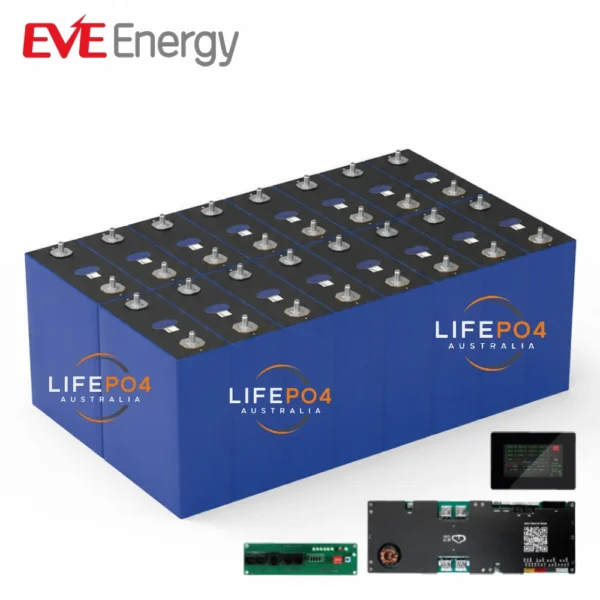
Sixteen EVE MB31 cells make a 51.2V, 314Ah battery storing just over 16kWh. Eight make an 8kWh 24V-class pack, while four make a 4kWh 12V-class pack. The cells are the same, but the current, BMS, copper, protection and sensible inverter size are very different.

Read this before touching a busbar

A large LiFePO4 pack can deliver destructive fault current even when its nominal voltage is below 60V. Cell terminals remain live. A BMS, open switch or removed fuse does not make the cell string electrically dead.

This article is educational and does not replace the EVE, JK, inverter, fuse, enclosure or installation instructions. In Queensland, the Electrical Safety Office says a licensed electrician should install a battery energy storage system, including a custom-made battery bank. Fixed wiring, inverter connection, grid connection, switchboard work and final BESS commissioning belong with appropriately licensed people. A DIY battery may also be unsuitable for a grid-connected installation, approved-product requirement, rebate, warranty or insurer.

What this guide covers

  1. Choosing 12V, 24V or 48V
  2. Why use EVE MB31 cells?
  3. Choosing the correct JK BMS
  4. Parts and tools
  5. Incoming cell inspection
  6. Top-balancing decisions
  7. Mechanical assembly
  8. BMS sense-lead verification
  9. Fuse, isolation and pre-charge
  10. Conservative JK settings
  11. Deye, Victron and Growatt
  12. First power-up and commissioning
  13. Parallel battery packs
  14. Maintenance and documentation

1. Choose voltage from current, not habit

The correct place to start is the largest continuous inverter load, expected surge, lowest normal battery voltage, inverter efficiency and allowable voltage drop. Do not start with “I have always used 12V.”

The approximate battery current is:

DC current = AC load watts / (battery voltage x inverter efficiency)

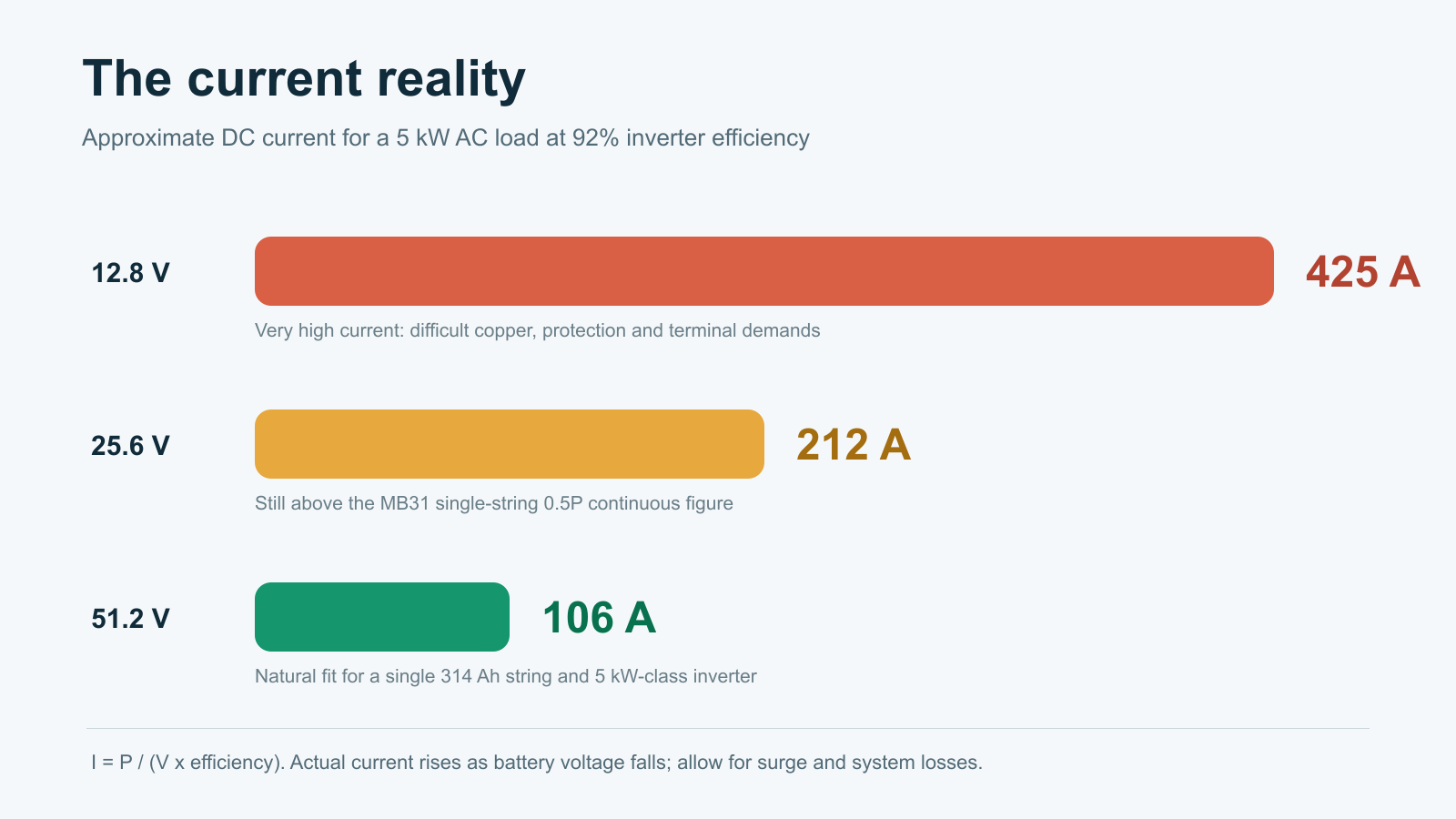
At 92% inverter efficiency, a 5kW load requires approximately 425A from a 12.8V pack, 212A from a 25.6V pack and 106A from a 51.2V pack. Actual current rises as battery voltage falls, and surge, inverter self-consumption and conductor losses add more.

Comparison of current required for a 5kW inverter load at 12.8V, 25.6V and 51.2V
The same inverter load becomes much easier to manage as system voltage rises.
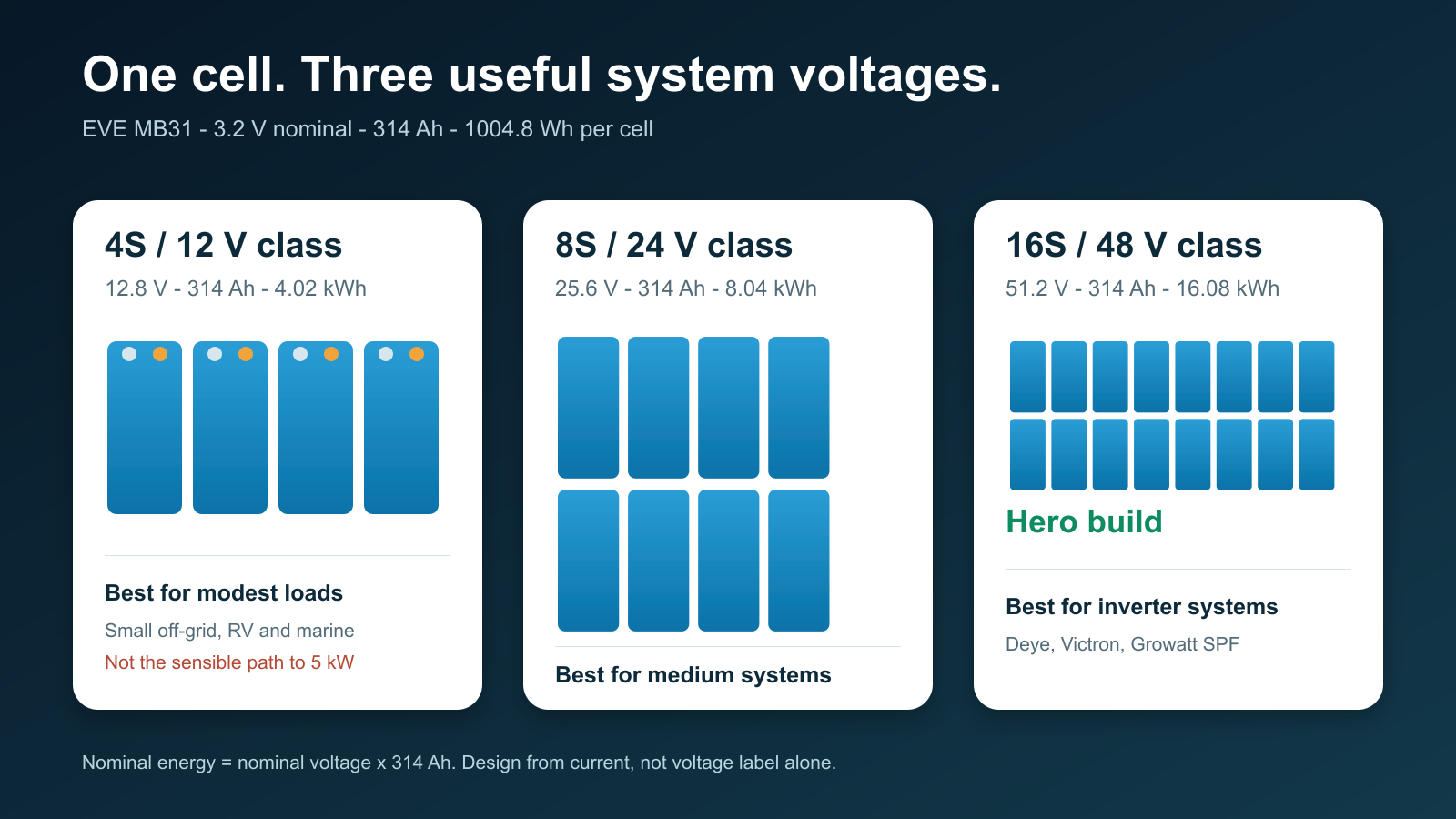
4S

12.8V / 4.02kWh

Best for modest RV, marine and small off-grid loads. A single MB31 string is not a sensible route to a continuous 3-5kW inverter.

8S

25.6V / 8.04kWh

A practical middle ground for medium off-grid systems and roughly 2-3kW inverter loads when the complete current design supports it.

16S

51.2V / 16.08kWh

The hero build for home storage and modern inverter systems. It naturally suits a 5kW-class Deye, Victron or Growatt installation.

EVE MB31 314Ah cells configured as 4S, 8S and 16S LiFePO4 battery packs
Nominal energy is nominal voltage multiplied by 314Ah. The enclosure, BMS, protection and copper add substantial weight.
Important cell limit: the reviewed MB31 specification lists 0.5P maximum continuous charge and discharge power at 25°C. For a 314Ah, 3.2V cell, this corresponds to about 157A and 502W per cell under those conditions. A 200A BMS does not upgrade the cell, cable, terminal, busbar or fuse.

2. Why the EVE MB31 314Ah?

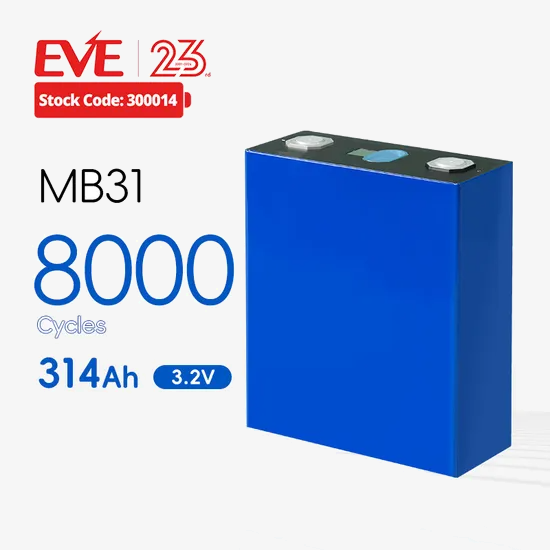
The MB31 is a strong all-round energy-storage cell. EVE lists 314Ah nominal capacity, 3.2V nominal voltage, 1004.8Wh nominal energy, approximately 5.6kg weight and 0.5P/0.5P standard charge/discharge capability.

Its greatest DIY advantage is not only capacity. The 280-314Ah prismatic-cell format has a mature ecosystem of enclosures, busbars, insulation, restraint systems and BMS hardware. That makes a 16-cell, 16kWh pack easier to support than many newer oversized cell formats.

For a broader comparison, read our EVE MB31 vs LF334 vs REPT 345Ah decision guide.

3. Match the BMS to the actual pack

The BMS must match the chemistry, series count, normal current, surge behaviour, temperature requirements and inverter communication method.

PackJK selectionImportant limitation
4S / 12.8VA genuine 4S-capable JK modelThe reviewed JK PB1/PB2 16S family does not cover 4S. See our JK 4-8S first-start guide.
8S / 25.6VA correctly rated 8S JK, or a compatible PB model after firmware/protocol verificationThe reviewed PB manual covers 7-16S electrically, but inverter communication at 24V still needs confirmation for the exact hardware.
16S / 51.2VJK PB inverter BMS matched to the required currentConfirm hardware revision, firmware, CAN/RS485 protocol and pinout for the actual inverter.

Never choose a BMS only because its headline current rating matches the inverter. A 200A BMS can still be the wrong choice if the cell, terminal, conductor, busbar, enclosure or fuse cannot safely support the intended current.

4. Parts and tools

Cells, BMS and monitoring

  • 4, 8 or 16 traceable EVE MB31 314Ah cells
  • JK BMS matched to the exact series count, current and communication requirement
  • All specified cell and BMS/MOS temperature sensors
  • Compatible JK display/interface board where required
  • Verified CAN or RS485 cable built from the exact two product pinouts

Mechanical assembly and insulation

  • Rigid enclosure with service access and protected conductor entries
  • Engineered restraint with flat end plates
  • Cell-to-cell insulation and a non-conductive base
  • Terminal and busbar covers
  • Strain relief, abrasion protection and secure BMS mounting

The reviewed EVE specification lists a recommended cell compression force of 3000-7000N and an instantaneous maximum of 10000N. This is force across the cell face, not threaded-rod torque. Do not invent a bolt torque without an engineered clamp geometry and measurement method.

Power path and tools

  • Busbars and terminal hardware suited to the actual cell variant
  • DC-rated fuse with suitable voltage rating, interrupt rating and time-current behaviour
  • Load-rated DC disconnect where required by the design
  • Conductors, lugs and supports sized for the installation method
  • Pre-charge resistor and switching method designed for the inverter input capacitance
  • CAT-rated multimeter, insulated probes and insulated tools
  • Calibrated torque wrench or screwdriver
  • Proper lug crimper and cable cutter
  • Thermal camera for staged-load commissioning

EVE specifies a maximum pole torque of 6N·m in the reviewed MB31 datasheet. Confirm that value against the actual terminal variant, adapters and fasteners supplied. Use a calibrated tool and record the final result.

5. Inspect the cells before assembly

Do not assemble first and discover a problem later. Record the supplier, batch/QR information, physical condition, resting voltage and consistently measured internal resistance for every cell. Capacity-test if that is part of the acceptance plan.

Quarantine any cell with a dent, swelling, leak, corroded or damaged terminal, abnormal voltage or unexplained measurement outlier. A severely over-discharged cell should not be “recovered” as part of a public tutorial.

6. Top balancing: choose a controlled method

Top balancing is a commissioning process, not a ritual that must be repeated routinely. Two defensible approaches are common:

  1. Parallel top balance before assembly: bring the cells to the same upper state of charge with a current-limited bench supply, verified polarity, temperature monitoring and continuous supervision.
  2. Assemble and commission slowly: construct the series pack, verify every sense connection, charge at low controlled current and allow the active balancer to correct the upper-curve spread.

Do not use a “set the supply and walk away” method. The process needs current limiting, supervision, a clear termination criterion and respect for EVE’s 3.65V absolute charge limit. For a dedicated walkthrough, see How to Top Balance LiFePO4.

7. Mechanical assembly

  1. Prepare a clean, dry, non-conductive bench and remove jewellery.
  2. Confirm cell orientation against a printed series map.
  3. Install cell-to-cell insulation before fitting busbars.
  4. Place cells into the restraint system without lifting from the terminals.
  5. Apply controlled, even restraint within the manufacturer’s force limits.
  6. Install one busbar at a time while neighbouring terminals stay covered.
  7. Use only an approved method to prepare mating surfaces.
  8. Tighten with the correct sequence and calibrated torque tool.
  9. Apply a torque mark and replace the terminal cover immediately.
  10. Compare measured total series voltage with the sum of the individual cells.

Never rest the BMS, tools, fasteners or loose busbars on exposed cells.

8. Verify every BMS sense lead before connection

A misplaced balance lead can damage the BMS or create a short through the harness. Wire colour alone is not proof.

  1. Leave the BMS sense connector unplugged.
  2. Attach the harness to the cell string in the exact order shown in the manual.
  3. Measure each adjacent step at the unplugged connector: B0-B1, B1-B2 and onward should each show one cell voltage with correct polarity.
  4. Measure cumulatively from B0 to every successive pin. Voltage should rise by one cell at each step.
  5. Stop if any step is negative, zero or close to two cell voltages.
  6. Verify B-, P-, display, communication and temperature connections.
  7. Only insert the sense connector after an independent recheck.

9. The BMS is not the fuse

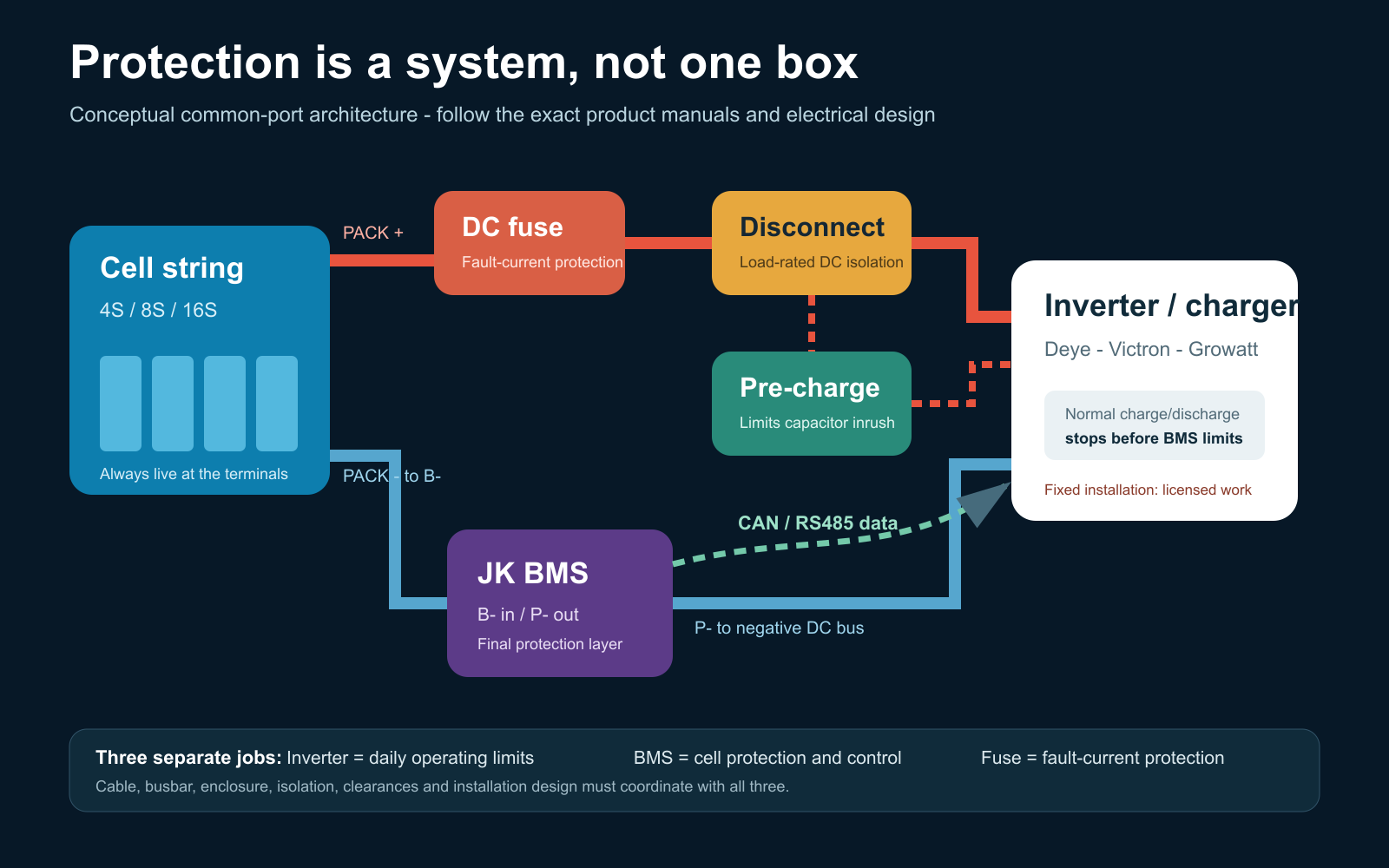
Conceptual LiFePO4 battery system showing cell string, BMS, fuse, disconnect, pre-charge and inverter
The inverter, BMS and fuse perform different jobs and must be coordinated with the rest of the design.

In a common-port MOSFET arrangement, cell-string negative connects to BMS B-, and BMS P- connects to the negative DC bus. Cell-string positive goes through the engineered positive protection and isolation path to the DC bus. Follow the exact JK manual for the hardware being used.

The fuse protects against fault current. It requires an adequate DC voltage rating, interrupt capacity and time-current relationship with the conductors and equipment. A pre-charge circuit limits inverter-capacitor inrush before the main path is closed. Read our discussion of 48V battery circuit breakers and Class T fuses.

An RJ45 connector does not guarantee an Ethernet pinout. Verify both ends of every JK-to-inverter communication cable and continuity-test it before connection.

10. Conservative JK settings for an MB31 pack

The best settings make the inverter stop normal operation first, keep the BMS as the last-resort guardrail and leave the fuse to clear serious fault current.

FunctionStarting valuePurpose
ChemistryLiFePO4Select before entering other values.
Cell count4, 8 or 16 as physically builtVerify from the harness and cumulative voltage.
Capacity314Ah or measured usable capacityEstablishes the coulomb-counter baseline.
Balance startAbout 3.40V/cellBalances on the upper curve rather than chasing mid-curve load sag.
Balance delta10-15mVAvoids hunting over tiny dynamic differences.
Controlled charge ceiling3.55V/cellLeaves margin below EVE’s 3.65V maximum.
Cell OVPAbout 3.60VLast-resort high-cell protection.
OVP recoveryAbout 3.45VProvides useful hysteresis.
SOC 100%3.50V/cellSynchronises the fuel gauge; it is not the charge cutoff.
Float / maintenance3.40V/cell if requiredAvoids holding the pack at its charge ceiling.
Cell UVP2.80V/cellHard BMS cutoff. Do not design routine cycling to 2.5V.
UVP recoveryAbout 3.00-3.05V/cellCoordinate with restart behaviour.
Charge low-temperature stop0°CMatches the lower end of EVE’s listed charge range.
Charge low-temperature recovery3-5°CPrevents cycling at freezing point.
Emergency modeOFFIt overrides normal protections and is not an operating mode.

Pack-voltage equivalents

PackCharge at 3.55V/cell100% sync at 3.50V/cellFloat at 3.40V/cellBMS UVP at 2.80V/cell
4S14.2V14.0V13.6V11.2V
8S28.4V28.0V27.2V22.4V
16S56.8V56.0V54.4V44.8V
Normal low-voltage operation: set the inverter’s routine low-SOC or low-voltage stop above 2.80V/cell, allowing for voltage sag at the design load. The 2.80V JK value is a hard last-resort cutoff, not the normal end of every cycle.

Do not simply enter the BMS’s maximum current as the charge/discharge limit. The operational current must respect the MB31 continuous limit, conductor and busbar ampacity, terminal temperature, fuse coordination and inverter behaviour. Over-current delays, short-circuit delay and smart-sleep behaviour must be verified against the exact JK firmware.

LiFePO4 does not need lead-acid-style float charging. If an inverter requires a float field, 3.40V/cell is a conservative maintenance value for this project. See our separate LiFePO4 float-voltage guide.

11. Deye, Victron and Growatt SPF integration

Closed-loop CAN or RS485 communication can allow the BMS to report SOC, alarms, requested charge voltage, charge-current limit and discharge-current limit. It does not remove the need for safe fallback settings.

Deye / SunSynk

  • Record the full JK and Deye model, hardware revision and firmware.
  • Verify CAN versus RS485 and both connector pinouts.
  • Select the matching JK inverter protocol and lithium/BMS mode.
  • Confirm SOC, requested voltage, current limits and alarms on both devices.
  • Disconnect communication in a controlled test and prove the intended fallback/fault response.

Victron

A Victron system may use a GX device, DVCC and compatible CAN-bus integration, or it may run open-loop. Do not assume native support until the exact JK firmware/protocol and Victron architecture have been tested. Existing site references include connecting a JK inverter BMS to Victron and the Victron Multi RS 48/6000 JK CAN example.

Growatt SPF

Growatt SPF is a family, not one universal protocol. Confirm the full inverter model and firmware, CAN/RS485 requirement, battery protocol, pinout, lithium-menu selection and safe open-loop fallback values.

12. First power-up and commissioning

Before energising

  • Cell model, quantity and polarity match the drawing.
  • No damaged or quarantined cell is installed.
  • Restraint and insulation are complete.
  • Every busbar and terminal is torqued, marked and covered.
  • Every adjacent and cumulative sense voltage is correct.
  • B-/P-, fuse, disconnect, conductor and pre-charge designs have been checked.
  • Temperature probes are installed at representative locations.
  • The inverter is isolated from AC, grid and PV as required by its shutdown procedure.

Controlled commissioning sequence

  1. Wake the BMS without the inverter load and compare every cell reading with the multimeter.
  2. Check all temperature sensors and alarm states.
  3. Verify charge/discharge switching and the configured limits.
  4. Pre-charge the inverter using the designed method.
  5. Close the main DC path only after the voltage difference has fallen to the design criterion.
  6. Begin at low power and compare BMS, external meter and inverter readings.
  7. Increase load in planned steps while recording cell delta, voltage drop and temperatures.
  8. Thermally inspect terminals, busbars, BMS and conductors after a meaningful load soak.

Stop for a hot connection, rising cell temperature, swelling, abnormal smell or sound, unstable voltage, unexplained cell divergence or a mismatch between instruments. Do not deliberately short the pack or force cells beyond safe limits to “test” protections for a video.

13. Parallel packs need separate protection

Parallel packs are separate energy sources. Each pack needs a compatible BMS and normally its own branch fuse and isolation, connected to an engineered common bus.

  • Match chemistry, series count and operating voltage.
  • Bring pack voltages close before connection.
  • Use an engineered current-sharing/busbar arrangement.
  • Configure unique BMS addresses where required.
  • Confirm how total charge and discharge limits reach the inverter.
  • Prove that one isolated pack cannot overload the remaining pack.

Never connect packs at significantly different voltages and expect the BMS to control equalisation current.

14. A good battery finishes with documentation

A battery is not finished merely because it turns on. Keep a permanent pack record containing:

  • one-line diagram and cell-series map
  • cell and BMS datasheets
  • final settings and firmware versions
  • cell inspection, torque and thermal-test records
  • fuse, disconnect, conductor and pre-charge details
  • shutdown, restart and emergency procedures
  • SDS location, maintenance schedule and alarm meanings

Future checks should review enclosure condition, moisture or pests, event logs, cell-delta trends, terminal condition and temperature under a known load. Do not casually retorque live terminals.

The build philosophy in one minute

  1. Choose voltage from current and inverter power.
  2. Keep normal continuous current within the cell and complete-system limits.
  3. Inspect and document every cell before assembly.
  4. Restrain, insulate, torque and cover the pack correctly.
  5. Verify every balance lead with a meter before connecting the BMS.
  6. Make the inverter stop normal operation before the BMS guardrails.
  7. Use 3.55V/cell charge, 3.50V/cell SOC sync, 3.40V/cell float if required and 2.80V/cell only as the hard low-voltage cutoff.
  8. Commission in controlled stages and record the thermal result.

Technical references

For the Australian installation boundary, also read Safe Installation of LiFePO4 Batteries in Australia.

Lithium Battery-school Blog
EVE MB31 vs EVE LF334 vs REPT 345Ah: Which LiFePO4 Cell Should You Choose?

LiFePO4 cell buyer’s guide · updated 2026

Choose the cell for the job—not the biggest Ah number.

EVE MB31, EVE LF334 and REPT 345Ah can all build an excellent battery. The right choice comes down to the balance between stored energy, current demand, pack voltage and how hard the battery will work.

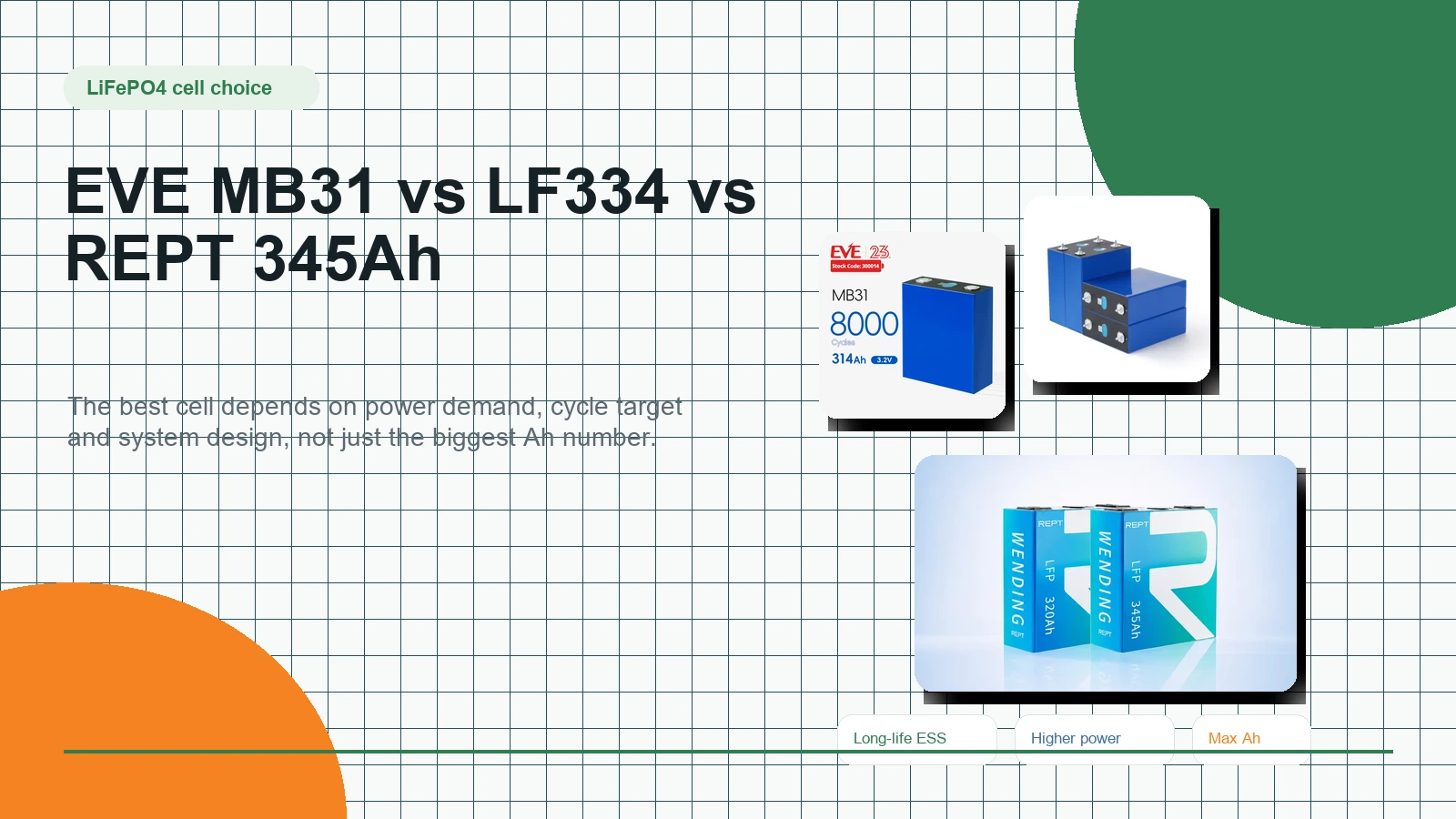
EVE MB31, EVE LF334 and REPT 345Ah LiFePO4 cells compared by capacity, power and storage use case
3 good cells. Three different strengths.
314 AhEVE MB31 · balanced long-life ESS choice
334 AhEVE LF334 · higher-output option worth considering
345 AhREPT CB84 · maximum energy for gentler storage duty

The quick answer

Start with the way the battery will work.

Capacity matters, but the battery’s voltage, inverter size and expected current decide whether that capacity can be used comfortably.

1

EVE MB31

The safest all-round recommendation for home solar, off-grid and daily-cycling ESS builds with moderate current demand.

Choose it when: proven storage duty and a balanced design matter most.

2

EVE LF334

The cell to look at when the pack needs more current headroom. It is especially relevant for demanding 12V and 24V builds, mobile power and larger inverter loads.

Choose it when: output capability matters as much as stored energy.

3

REPT 345Ah

The most stored energy per cell in this comparison, well suited to large banks and longer-duration storage designed around a gentler discharge rate.

Choose it when: maximum capacity and value matter more than high current from one string.

Side-by-side comparison

Similar size class. Different design priorities.

Use this as a buying map, then confirm the exact continuous-current, pulse-current, compression and cycle-test conditions for the batch being supplied.

CellNominal energy per cellApprox. 16S energyBest fitMain caution
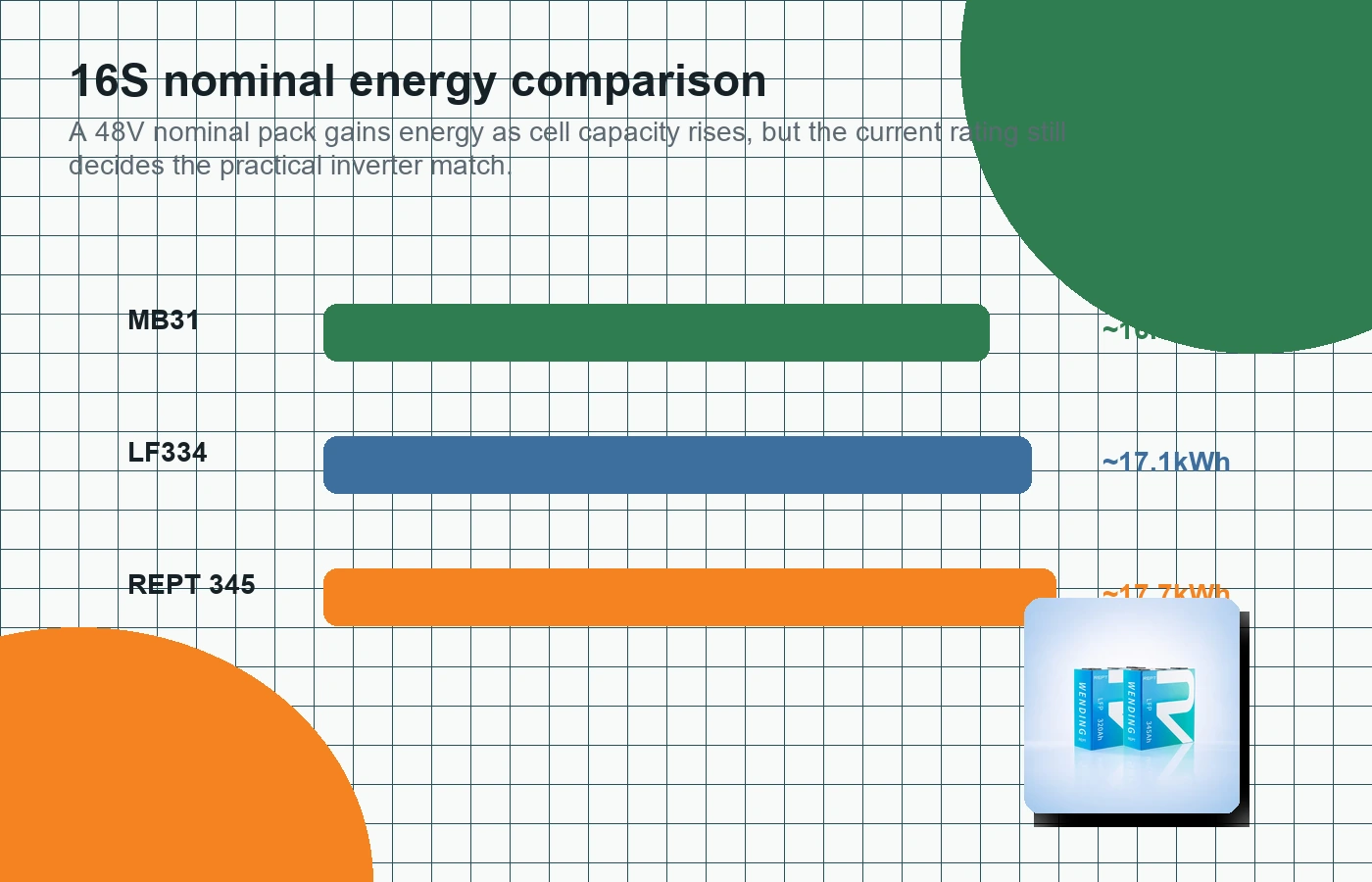
EVE MB31 314Ahabout 1.00 kWhabout 16.1 kWhLong-life ESS, home solar, off-grid and commercial storageNot the first choice for very high current from a small pack
EVE LF334 334Ahabout 1.07 kWhabout 17.1 kWhHigher-output 12V, 24V and 48V builds, RV, marine and mobile powerVerify continuous versus pulse ratings against the exact batch datasheet
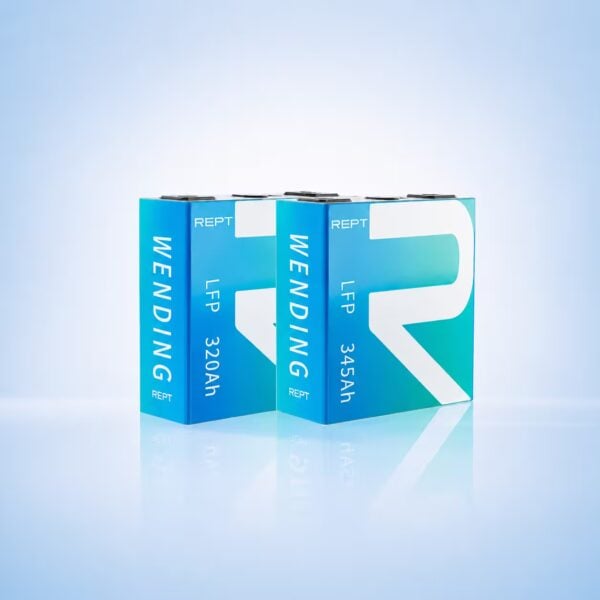
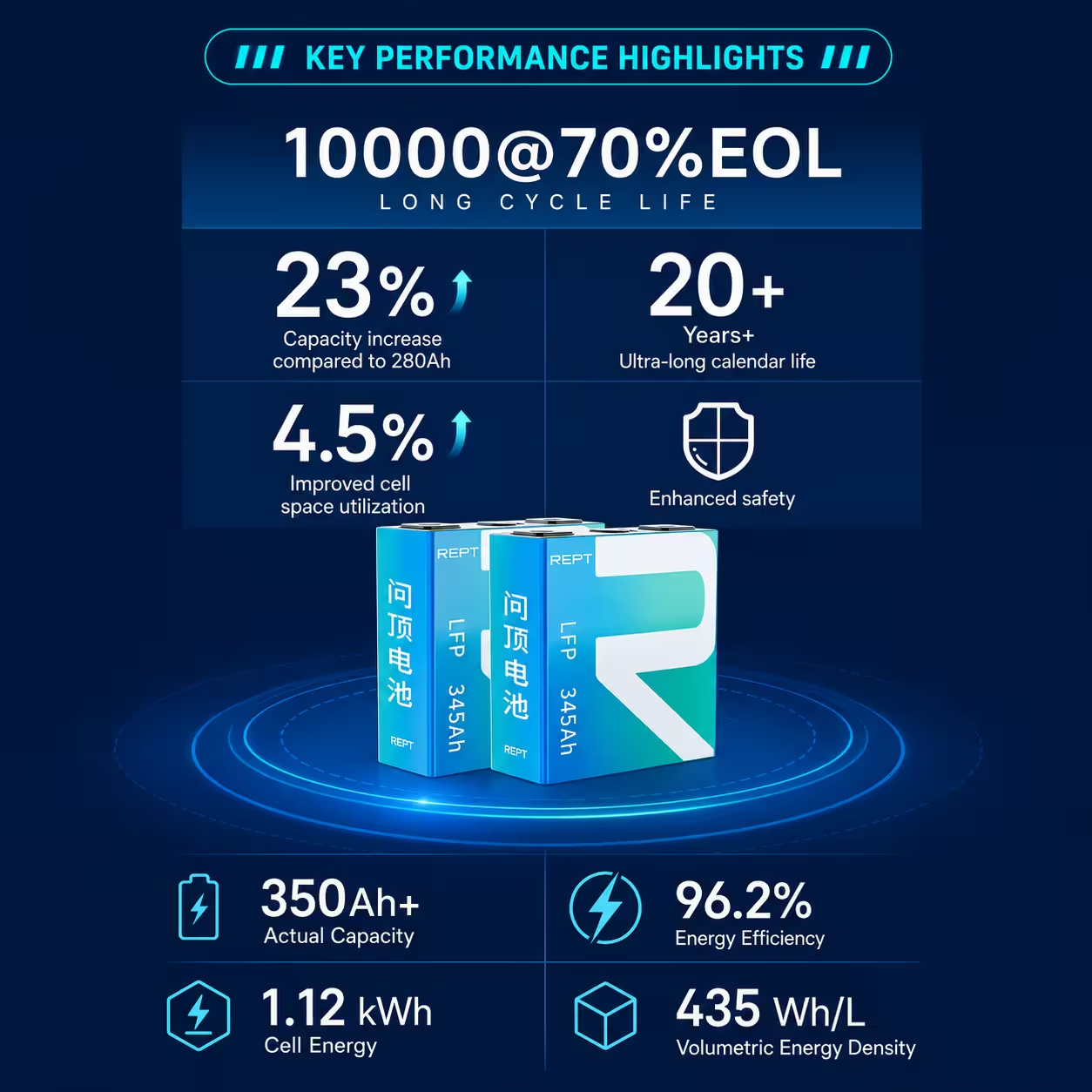
REPT 345Ah CB84about 1.10 kWhabout 17.7 kWhLarge solar banks, long-duration backup and lower-rate ESSOne small string may not suit a large inverter running continuously
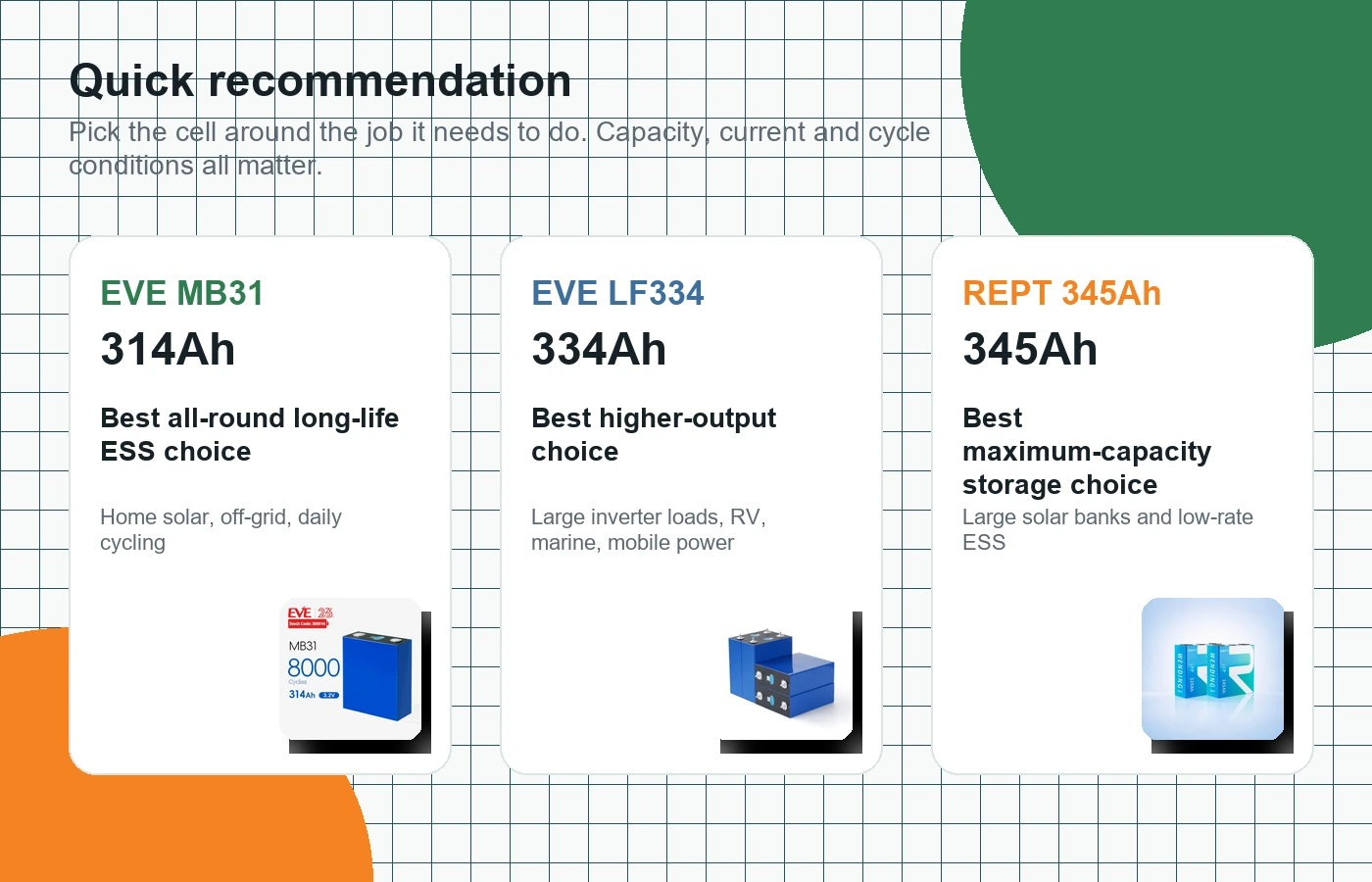
Quick recommendation cards for EVE MB31, EVE LF334 and REPT 345Ah LiFePO4 cells
MB31 is the balanced storage choice, LF334 adds power headroom, and REPT 345Ah maximises energy per cell.

Why Ah alone is misleading

A bigger fuel tank does not automatically mean a stronger engine.

Ah tells you how much charge a cell stores. It does not tell you how quickly the cell should deliver that charge, how much heat the pack will create, or whether the BMS, busbars and cabling can support the load.

Pack voltage changes everything

A 3000W inverter on 12V can draw well over 230A before losses. At 48V, the same power needs roughly one quarter of the current.

C-rate needs context

Standard, continuous and pulse ratings are not interchangeable. Use the exact supplied-cell datasheet when setting charge, discharge and BMS limits.

The whole pack carries the load

Cell rating is only one limit. BMS current, connections, busbars, cable size, compression, cooling and inverter surge behaviour all matter.

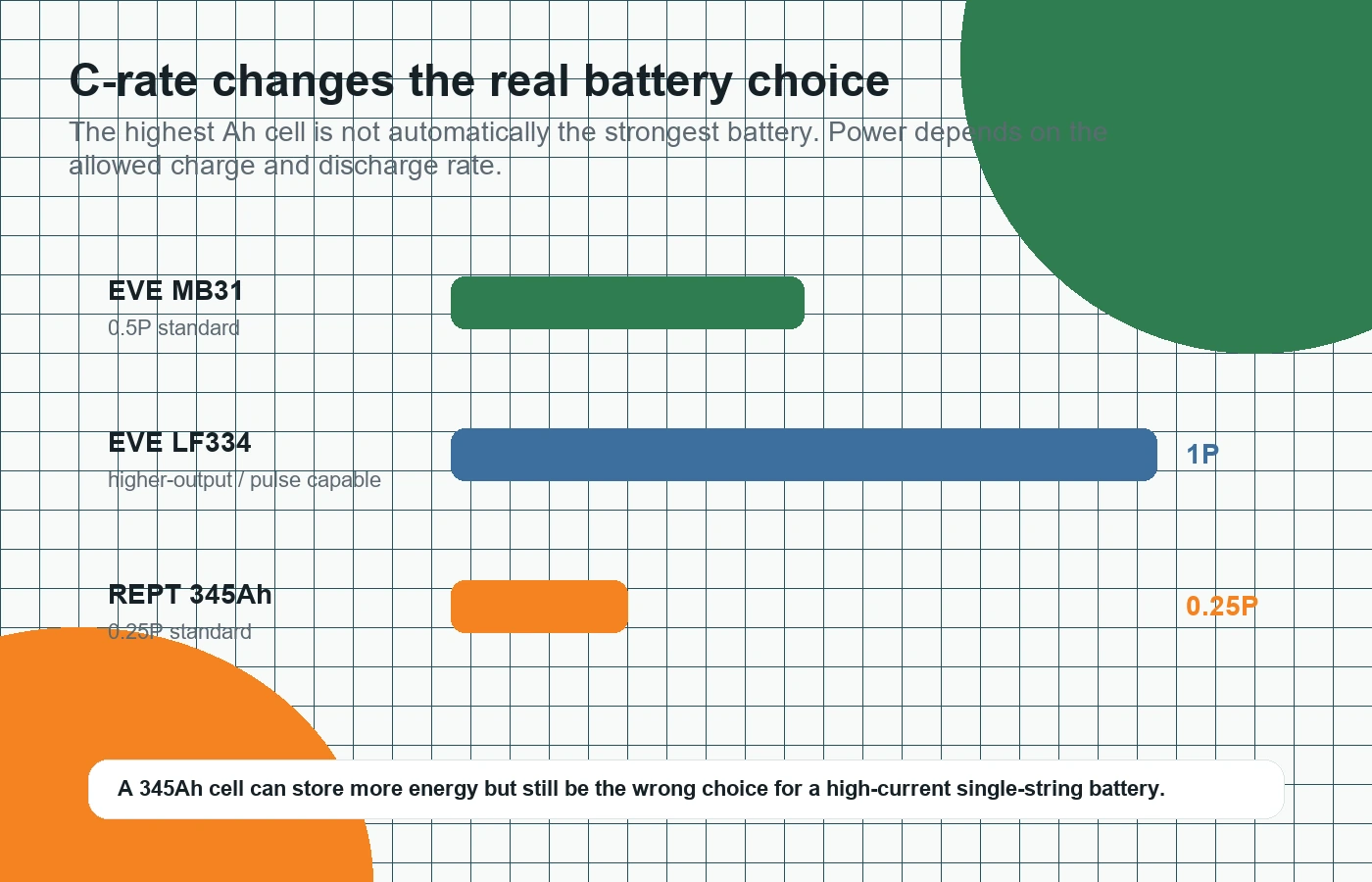
C-rate chart comparing EVE MB31, EVE LF334 and REPT 345Ah LiFePO4 cells
C-rate changes the practical battery choice. More Ah does not always mean more usable inverter power.

Why LF334 deserves a closer look

Current headroom can be worth more than a headline cycle number.

The LF334 is easy to overlook if you compare only ESS cycle claims or cost per Ah. Its real appeal is a more power-oriented role: high-load 12V systems, mobile and marine builds, and batteries expected to support larger inverters from a single string.

That does not make it automatically better than MB31. It makes it better suited to a different duty cycle. If a conservative ESS cell leaves too little margin at the current your build requires, LF334 is genuinely worth considering.

LF334 makes sense when…

the battery voltage is low, inverter load is high, surge performance matters, or you want more current headroom without adding parallel strings.

Keep the claim honest

A high pulse figure must not be presented as a continuous rating. Confirm the exact supplied batch and design the BMS and conductors around the verified limit.

16S nominal energy comparison for EVE MB31, EVE LF334 and REPT 345Ah LiFePO4 cells

Choose by system

12V, 24V and 48V can change the answer.

The same inverter power creates very different current at different battery voltages. That is why a power-oriented cell can be valuable in a compact 12V build, while a moderate-rate ESS cell becomes much more practical in a 48V pack.

12V

High current

Large inverters can demand hundreds of amps. LF334 deserves serious consideration, along with carefully sized BMS, busbars and cabling.

24V

Middle ground

Current is more manageable, but mobile and inverter-heavy systems can still benefit from added output headroom.

48V

Storage friendly

Lower current for the same power makes MB31 and REPT-style storage cells easier to use in appropriately sized banks.

Compare live products

Check the cells, stock and current pricing.

Product details below come directly from WooCommerce, so the links and current store information remain useful as the guide ages.

Before building: confirm the supplied batch datasheet and do not set charge or discharge limits from a general comparison article alone.

LiFePO4 cell finder

Choose by discharge time.

How quickly does the battery need to deliver its stored energy? Pick the closest duty class below: one hour for high power, two hours for balanced storage, or four-plus hours for a very large long-duration bank.

More power per cellMore runtime and capacity
1 hour
Around 1C duty
High current

Choose EVE LF334

For batteries that must deliver a lot of power from each cell string.

  • Large inverter loads
  • High-power 12V or 24V systems
  • Compact or single-string builds
View EVE LF334
2 hours
Around 0.5C duty
Balanced middle

Choose EVE MB31

For the many systems that sit between maximum power and maximum capacity.

  • General home and off-grid ESS
  • Moderate inverter demand
  • Balanced daily-cycling storage
View EVE MB31
4+ hours
Around 0.25C duty
Long-duration storage

Choose REPT 345Ah

For a very large battery designed around gentle current and maximum stored energy.

  • True off-grid living
  • Multi-day autonomy without sun
  • Large 48V or parallel-string banks
View REPT 345Ah

Important: “1 hour”, “2 hours” and “4 hours” describe the approximate discharge-rate class, not a promise that the battery stops after that time. A large REPT bank running lighter real-world loads can provide days of autonomy. Always confirm the exact supplied-cell datasheet and size the complete battery around inverter power, usable kWh, BMS, wiring and charging limits.

Still choosing between two cells?

Tell us the pack voltage, inverter size, target capacity and whether the battery is for mobile power, off-grid use or daily home storage. We can help narrow the choice before you order.

Technical notes

This page is practical buying guidance based on the current EVE MB31, EVE LF334 and REPT 345Ah product information and the distinction between energy-focused ESS duty and higher-output battery duty. Approximate kWh figures use 3.2V nominal voltage and are not usable-energy guarantees. Always confirm continuous current, pulse current, compression, operating temperature and cycle-test conditions against the exact datasheet for the batch being supplied.

Blog
Can a Non-CEC Inverter Be Connected to the Australian Grid?

Australian grid connection guide

Can a non-CEC inverter be connected to the Australian grid?

For a normal grid-connected solar or battery system, you should assume the answer is no unless your electricity distributor gives written approval. In practice, Australian DNSPs usually require grid-connected inverters to be on the Clean Energy Council approved inverter list.

Grid-connected systems CEC inverter list DNSP approval Off-grid exception
General information only: this article is not legal or electrical advice. Rules change, and the final answer depends on your inverter model, state, distributor, connection type, export control requirements and installation design. Always confirm with the local DNSP and a suitably licensed electrician before buying equipment.

Grid-parallel

If the inverter can operate in parallel with the distribution grid, the distributor normally wants a CEC-listed inverter and the correct AS/NZS 4777.2 settings.

Off-grid

A true off-grid system that cannot parallel with the grid is different. CEC grid-listing may not be the same issue, but electrical safety and installation rules still apply.

Zero export

Zero export does not automatically make a system “not grid connected”. If it is connected in parallel with the grid, the DNSP can still require approval and compliant equipment.

The simple answer

The Clean Energy Council does not personally approve your grid connection. Your local electricity distributor, usually called the DNSP, controls the connection process.

However, the CEC approved inverter list is the main product list used across Australia to check whether an inverter has evidence of compliance with the relevant standards. That is why installers, retailers, rebate programs and distributor portals care so much about whether the inverter is CEC-listed.

So while the technical authority is the DNSP, the practical answer is simple: if the inverter is not on the CEC approved inverter list, most normal grid connection applications will be difficult or impossible.

Why “CEC approved” matters

AreaWhy it mattersWhat to check
DNSP connection approvalThe distributor needs to know the inverter can behave safely and correctly on the grid.CEC listing, AS/NZS 4777.2 compliance, regional settings and DNSP-specific conditions.
STCs and rebatesFinancial incentives often require approved components and compliant installation.Clean Energy Regulator and relevant state or rebate scheme rules.
Installer sign-offA licensed installer may not be willing or able to sign off a non-listed inverter for grid connection.Exact equipment model, wiring arrangement, commissioning requirements and certificates.
Future serviceabilityUnsupported or unlisted equipment can become a problem during warranty, inspections, insurance or sale of the property.Local support, documentation, firmware, distributor approval and compliance evidence.

What about a Victron Multi RS Solar?

A common example is the Victron Multi RS Solar. It is a capable product for the right application, especially off-grid or specialist systems, but that does not automatically mean it is suitable for Australian grid-parallel connection.

If the exact model is not on the CEC approved inverter list for grid connection, do not assume it can be connected to the grid. Treat it as an off-grid or specialist product unless the local DNSP and a qualified installer confirm otherwise in writing.

Important distinction: a high-quality inverter can still be the wrong product for a grid-connected Australian installation if it does not have the required Australian grid certification, listing or distributor approval.

When a non-CEC inverter may still be useful

  • True off-grid systems with no grid-parallel operation.
  • Generator-backed systems where the inverter is not connected to the distribution grid.
  • Specialist engineered systems with formal DNSP approval.
  • Research, testing or temporary setups that are not connected to the public grid.

When to avoid it

  • You want STCs, rebates or a standard grid application.
  • The system will export or can operate in parallel with the grid.
  • The installer cannot select the inverter in the DNSP portal.
  • You need a simple, insurable, supportable home battery installation.

If you still want to try

Some distributors may have a written-approval pathway for unusual equipment, but that is not the same as a general permission to install anything. You would normally need strong evidence, and approval should be sought before purchase.

  • Ask the DNSP whether they will assess a CEC-unlisted inverter proposal.
  • Ask what certification evidence they require, including AS/NZS 4777.2 evidence.
  • Confirm whether CSIP-AUS, dynamic export, emergency backstop or utility-server communication applies.
  • Get the answer in writing before spending money on the inverter.
  • Do not rely on “zero export” as a workaround unless the DNSP confirms the design is acceptable.

Frequently asked questions

Is the CEC the same as the grid connection authority?

No. The DNSP controls the grid connection process. The CEC approved inverter list is the practical product list used to show an inverter meets relevant standards and is acceptable for many connection and incentive processes.

Can I use a non-CEC inverter if I set it to zero export?

Not automatically. If the inverter is connected in parallel with the grid, your distributor may still treat it as a grid-connected inverter energy system and require approval, compliant settings and approved equipment.

Can I use a non-CEC inverter off-grid?

Possibly, if it is a true off-grid system and installed safely. That is a different question from connecting it to the public distribution grid. Electrical safety, battery standards, isolation, generator integration and local rules still matter.

Will I lose STCs or rebates with a non-CEC inverter?

You may. Many incentive pathways require approved components and compliant installation. Confirm with the Clean Energy Regulator, the rebate program and your installer before assuming the system qualifies.

Useful official references

Want a battery or inverter system that can actually be approved?

Tell us what you are trying to build. We can help separate off-grid equipment, grid-approved inverter choices, DNSP limits and rebate eligibility before you buy the wrong hardware.

Start a system enquiry
News Sodium Ion
Why Natron Energy Collapsed

What happens when mass manufacturing and scale disrupts new and sometimes better technology for niche applications

Inside the $1.4B Battery Dream That Died Overnight

Just one year after announcing a $1.4 billion sodium-ion battery gigafactory that promised 1,000 high-wage jobs in rural North Carolina, Natron Energy is gone.

On September 4, 2025, the 13-year-old California startup shut down all operations, laid off its entire workforce of ~95 employees, and abandoned plans for what was to be one of the largest sodium baed clean-energy investments in the USA

The news hit like a shockwave — not just for the workers in Michigan and California, but for state officials who had already approved $56.3 million in incentives (none of which were paid).

So what went wrong?

In this deep-dive investigation, we uncover the real reasons behind Natron’s collapse — from frozen investor payments and policy shifts to manufacturing economics and a fatal mismatch between innovation and market timing.


The Final Days: A Desperate Search for Cash

According to internal documents and interviews, Natron’s board made the final call on August 27, 2025: fundraising efforts had failed.

“Natron’s efforts to raise sufficient new funding were unsuccessful, having failed to result in sufficient funding proceeds to cover the required additional working capital and operational expenses.”
Elizabeth Shober, Head of Team & Talent, in letter to Michigan labor officials

The company had been in survival mode for months:

  • Existing investors — including Chevron, United Airlines Ventures, and Khosla Venturesfroze scheduled payments starting in June 2025.
  • A Series B round was pitched but never closed.
  • Debt financing talks collapsed.
  • Even a last-ditch asset sale (via California advisory firm Sherwood Partners) came too late.

By late August, Natron had only $25 million USD in booked orders — mostly for data center backup power — but couldn’t fulfill them. Certification delays (UL 1973) and the looming 60-day WARN Act layoff notice created a death spiral:
no delivery → no revenue → no investor confidence → no lifeline.

CEO Colin Wessells stepped down in December 2024 — citing the “all-consuming” burden of fundraising. His departure was an early warning sign.


The Cost Conundrum: BOM vs. Reality

Natron’s sodium-ion batteries were built on a compelling promise: cheaper, safer, more sustainable than lithium-ion.

Using Prussian blue electrodes and abundant materials like sodium, aluminum, iron, and manganese, the company avoided lithium, cobalt, and nickel entirely. No rare earths. No geopolitical risk.

ComponentNatron (Sodium-Ion)Lithium-Ion (LFP)
CathodePrussian blue (Fe, Mn, Na)Lithium iron phosphate
AnodeHard carbonGraphite
ElectrolyteSodium salt in organic solventLithium salt
Projected BOM Cost (2030)$10/kWh (grossly exaggerated)$40–60/kWh

But here’s the catch: low energy density (~50 Wh/L vs. 300 Wh/L for Li-ion) meant Natron’s batteries were only viable for power-dense applications like grid or data centre stabilization and or possibly fast-charging stations — not EVs or consumer devices. The reality was, they were heavy, and huge. And over time, the price of Lithium based batteries fell so quickly, that most technology has been put out of business.

China dominates battery manufacturing, overnight in december 2024, CATL announced a 50% price drop for LFP batteries at the cell level. From around $100 per kWh to $50 per kWh. This price is wholesale, without any retail margins, so its not the true cost, but it gives you an idea, of the power they can weild, this also affected many other chinese companies, such as Gotion, but this decision also completely wiped out all the planned factories across the globe, some in the USA, and some in Australia who had been budgeting for $100 a kWh, they now had no future.

China is not messing around, this is a fight that without mega Billions of dollars, supply chains and the highest level of automation, the competiting countries have no chance of getting off the ground.

And while long-term BOM costs looked promising, scaling manufacturing was brutally expensive:

  • Retrofitting the Michigan plant cost $40 million.
  • The North Carolina gigafactory was budgeted at $1.4 billion40x the Michigan site’s capacity.
  • Upfront system costs were higher than Li-ion initially, with savings only over 50,000+ cycles.

Even with $35/kWh IRA tax credits, the math didn’t work without massive volume — and volume required capital Natron no longer had.


Market Timing: The Lithium Price Crash

In 2022, lithium carbonate hit $80,000/ton. Sodium-ion looked like the future.

By 2025? Under $10,000/ton. A 70%+ collapse.

Suddenly, lithium iron phosphate (LFP) batteries — already dominant in China — became cheaper than ever. Data centers and utilities asked: Why switch to an unproven chemistry?

Natron’s niche advantage evaporated.


The Full Breakdown: Why Natron Failed

FactorImpactOutcome
Frozen Investor PaymentsChevron, United, Khosla halted funds in June 2025Cash runway ended
Policy ShiftReduced federal support under Trump admin; ARPA-E grants stalledLost goodwill funding
Certification DelaysUL 1973 blocked $25M in ordersNo revenue to show investors
Lithium Price Crash70% drop eroded cost edgeCustomers stayed with LFP
High CapEx for Low-Density Tech$1.4B factory for power-focused batteriesToo risky without scale
China Dominance~100% of global sodium-ion capacityU.S. startups outgunned

What’s Next for Sodium-Ion?

Natron’s collapse is not the end of sodium-ion technology.

Experts like those at Mana Battery call it “very specific to Natron” — citing execution missteps, niche focus, and bad timing. Others, like Bedrock Materials and Peak Energy, are still advancing sodium-ion with smaller, grid-focused strategies.

China already has over 10 GWh of sodium-ion capacity online. The chemistry works. The market exists.

But Natron’s story is a sobering reminder: in clean energy, innovation alone isn’t enough. You need capital, timing, policy, and customers — all aligned.

North Carolina’s Kingsboro megasite is back on the market.
State officials call it “one of the top megasites in the country.”
This was its second major flop in seven years.


Sources & Further Reading

  • WRAL News – Original closure announcement
  • Battery industry reports (2024–2025): Mana Battery, BloombergNEF, ARPA-E
  • Internal Natron documents via Michigan WARN Act filings
  • Interviews with former employees and industry analysts

News Blog
Differences in Internal Resistance between LFP manufacturers and cell models

Overview of LFP Prismatic 314Ah Cells

Lithium Iron Phosphate (LiFePO4 or LFP) prismatic cells in the ~314Ah capacity range are popular for energy storage systems (ESS), electric vehicles (EVs), and solar applications due to their safety, long cycle life (often 4,000–8,000+ cycles), and stable voltage plateau around 3.2V. These cells share similar dimensions (typically ~174mm x 72mm x 207mm) and chemistry but differ in design optimizations, leading to variations in performance metrics like internal resistance (IR).

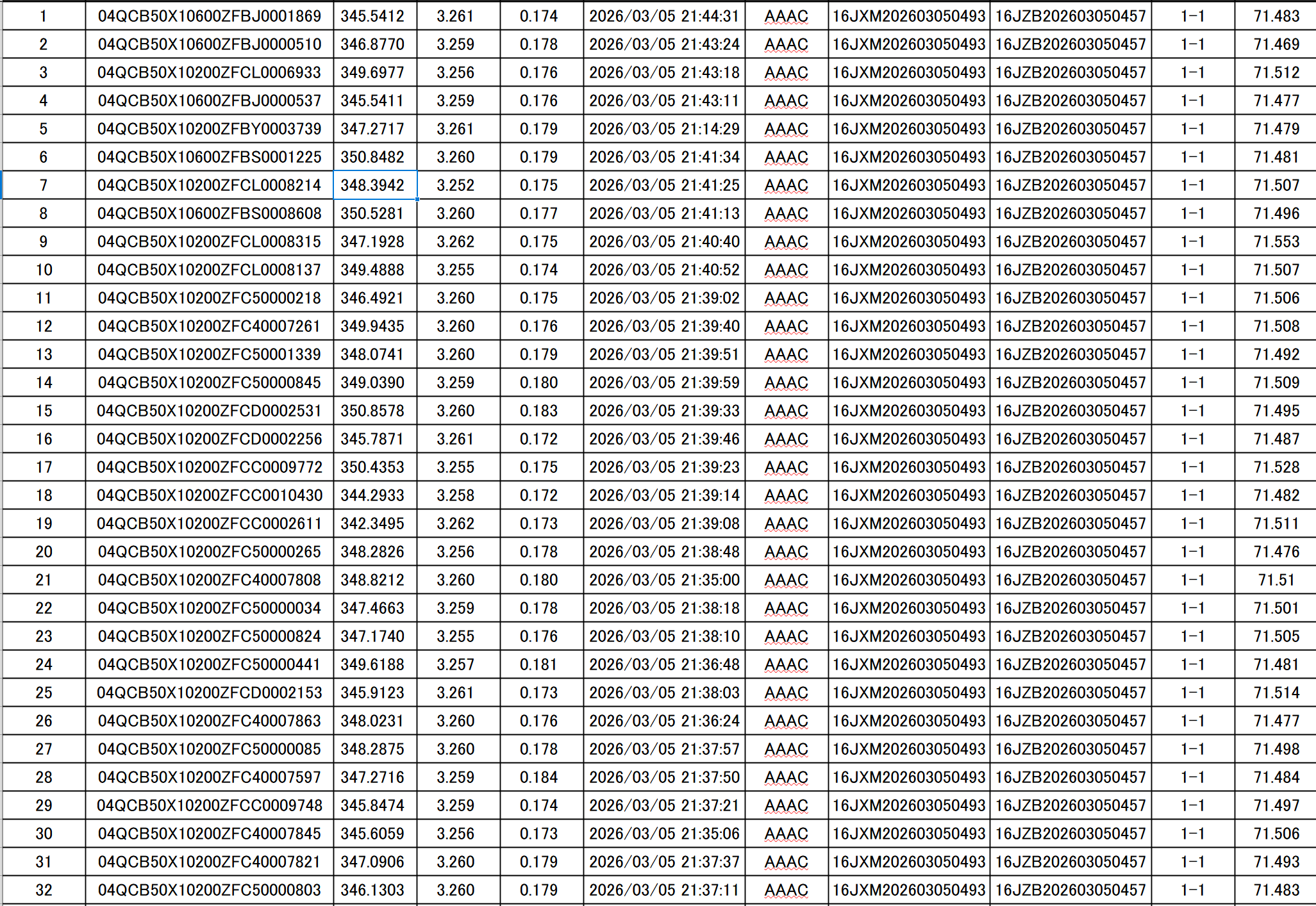
Observed IR values (EVE MB31 ~0.18 mΩ, LF304 ~0.15 mΩ, REPT ~0.23 mΩ) align closely with manufacturer specifications and real-world testing. Note that IR is typically measured as AC impedance at 1 kHz (per industry standards) and can vary ±0.05 mΩ due to factors like temperature, state of charge (SOC ~30–50% for fresh cells), and measurement tools. Lower IR generally means better efficiency (less heat, higher discharge rates), but all these values are low for 314Ah LFP cells, indicating high-quality Grade A (or HSEV/EV-grade) products.

Confirmed Internal Resistance Specs

Based on official datasheets and verified seller data:

Manufacturer/ModelNominal CapacityInitial IR (AC, 1 kHz)Typical Real-World RangeCycle Life (0.5C/0.5C)Key Notes
EVE MB31314Ah≤0.18 mΩ (±0.05 mΩ)0.16–0.23 mΩ≥8,000 cyclesNewer high-density evolution of EVE’s 304Ah line; optimized for ESS with low heat generation. Tested capacities often exceed 330Ah.
EVE LF304304Ah≤0.15 mΩ (±0.05 mΩ)0.14–0.20 mΩ≥4,000 cyclesOlder high-power model; slightly lower capacity but prioritized for EV/high-discharge apps. IR can appear lower due to thicker electrode coatings.
REPT (CB75/CB71)314Ah≤0.23 mΩ (±0.05 mΩ)0.20–0.25 mΩ≥8,000 cyclesFocuses on “Wending” tech for space efficiency; higher IR but excellent thermal stability and 95%+ efficiency at 0.5P discharge.

These values come from EVE and REPT official datasheets, with real-world ranges from independent tests (e.g., DIY solar forums and battery resellers). The LF304’s lower IR reflects its design for power delivery, while REPT’s slightly higher value trades off for enhanced safety and longevity in stationary storage.

Why Variations in Internal Resistance Between Manufacturers?

Internal resistance in LFP cells arises from ohmic (electrolyte/connector) and polarization (electrode/ion diffusion) components. While all LFP cells use the same base chemistry (LiFePO4 cathode, graphite anode, liquid electrolyte), manufacturers like EVE and REPT optimize differently, leading to IR differences of 0.03–0.08 mΩ. Here’s a breakdown of key factors:

  1. Electrode Design and Material Choices:
    • Particle Size and Coating Thickness: Finer cathode particles or thinner coatings (e.g., EVE LF304’s high-power focus) reduce ion diffusion paths, lowering polarization resistance (~0.10–0.15 mΩ contribution). REPT’s “double-high” solid-liquid interface uses coarser particles for stability, slightly raising IR but improving cycle life.
    • Tab Configuration: More/wider current collectors (tabs) shorten electron paths. EVE MB31 uses stacked/wound hybrids with more tabs, achieving ~0.18 mΩ. REPT’s top-to-bottom “Wending” tech maximizes space but can add ~0.05 mΩ due to longer internal paths.
  2. Manufacturing Processes and Quality Control:
    • Assembly Uniformity: Variations in electrode alignment, electrolyte filling, or welding introduce inconsistencies. EVE’s highly automated lines yield tighter IR tolerances (±0.05 mΩ), while REPT emphasizes safety testing, which may allow a broader range.
    • Grade and Sorting: All are Grade A, but “HSEV” (high-safety EV) variants (common for these) are sorted for low IR. Subtle batch differences (e.g., electrolyte additives for thermal runaway prevention) can shift IR by 10–20%.
  3. Optimization Trade-Offs for Application:
    • Power vs. Energy Focus: LF304 (EVE) targets EVs with high C-rates (up to 1C continuous), needing ultra-low IR for minimal voltage sag. MB31 balances ESS longevity. REPT prioritizes stationary storage, where higher IR is acceptable for better abuse tolerance (e.g., overcharge resistance up to 270°C).
    • Energy Density Enhancements: Higher-density cells (e.g., MB31’s 173 Wh/kg) pack more active material, potentially increasing resistance slightly if not offset by innovations like REPT’s 7%+ space utilization boost.
  4. Measurement and Environmental Factors:
    • Test Conditions: Specs use fresh cells at 25°C and ~30% SOC. Real measurements (e.g., your 0.23 mΩ for REPT) may vary with tools—use a 1 kHz AC meter for accuracy. Temperature swings (±10°C) can change IR by 20%.
    • Aging and Degradation: IR rises ~50–150% over life (faster in LFP than NMC), but your values suggest new cells.

Overall, these variations (20–50% relative difference) are normal and don’t indicate defects— they’re engineered for specific strengths. For ESS, REPT’s higher IR means ~2–5% more heat at 0.5C but superior safety. EVE’s lower IR suits high-draw apps like inverters.

Recommendations

  • Matching Cells: For packs, match IR within 0.05 mΩ to avoid imbalances (use a calibrated meter like YR1035+).
  • Testing: Discharge at 0.2C to verify capacity (>310Ah expected) and monitor IR over cycles.
  • Sources: Download full datasheets from EVE/REPT sites or resellers like GobelPower for curves. For comparisons, check ECO Teardown’s aggregated specs.

Conclusion

Not all LFP cells are made equally, they are optimised for slightly different applications. We choose the best balance and allow you to make a decision based on these factors.

In most cases, using EVE or REPT for the high majority of cases, will make little difference, but for small 12v inverter applications attached to a 3000w Inverter, EVE LF304 might be most suitable if you are looking for high power continuous applications, Either way its likely you will see thousands of cycles .

In reality, most people size their battery appropriately if budget allows, we would recommend 2 x 12v 314ah batteries for those looking to pull 3000w regularly, this might be for cooking, microwaves or even small Air conditioning systems.

News Blog
Who is Deye?

Who is Deye? And what makes them special?

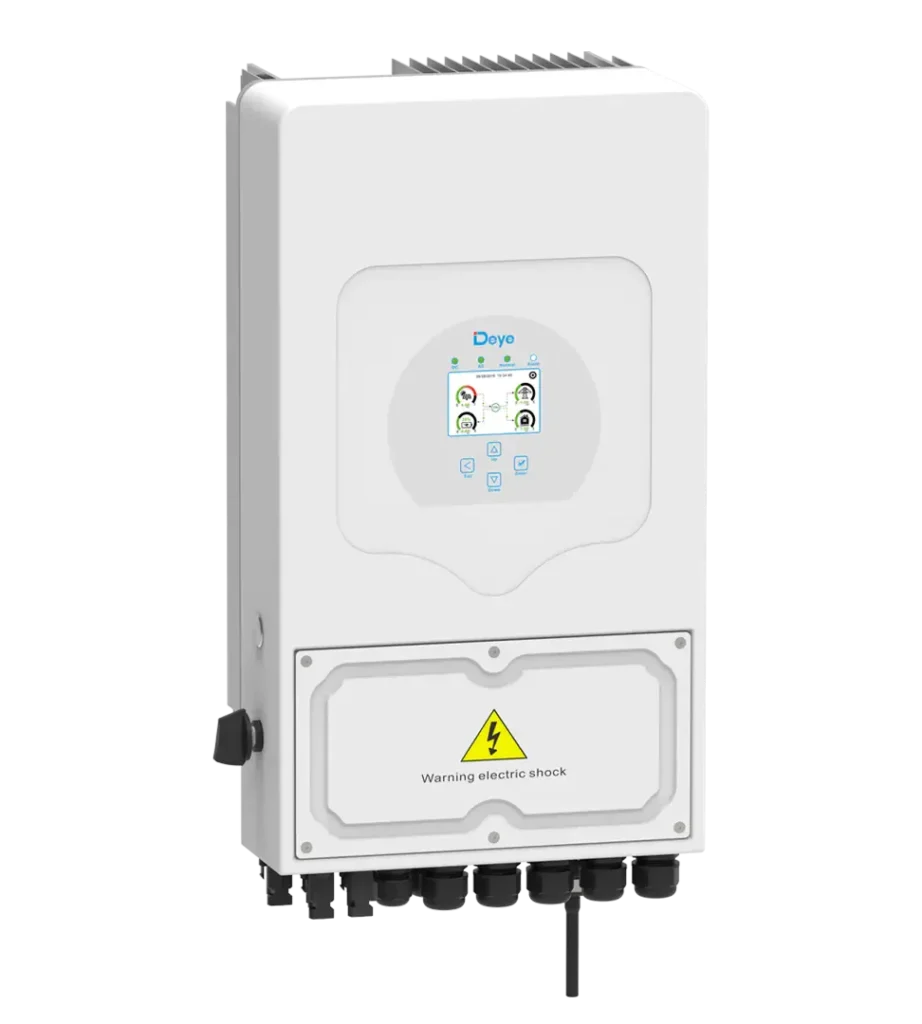
Deye is a leading manufacturer of high quality renewable energy solutions, they really have taken the market by storm in the last 5 years in Australia. The products we absolutely love here in at LiFePO4 Australia is the range of SUN Hybrid Inverters. Starting at just 5000W single phase 48v LV right up to the 16kW single phase LV model which really is groundbreaking.

Deye also makes products for SunSynk and Sol-Ark, along with NoArk who has the products in Australia.

Origins, corporate structure & listing

Deye grew out of Ningbo Deye Technology, a diversified appliance and climate-tech manufacturer founded in 1990 in Ningbo, Zhejiang. In 2007 it spun up Ningbo Deye Inverter Technology to focus on PV power electronics and later energy storage (ESS).

What Deye builds: the product families

1) SUN-series hybrid inverters (residential & C&I)

  • Single-phase 48 V (LV): e.g., SUN-5-16K-SG0(x)LP1-AU variants
  • Three-phase 48 V (LV): SUN-5/6/8/10/12K-SG04LP3-AU for Australia
  • Three-phase high-voltage (HV): Various models from 5K up to 100K

Single Phase Hybrid LV (48v Battery)

Big Residential Hybrid LV Inverters

Three Phase Hybrid LV (48v Battery)

Batteries

  • Rack – IEC listed (good when no rebates are applicable
  • Stack – CEC approved (rebates)
  • Wall Mount CEC approved (rebates)

Recommended products

Deye is a vertically-integrated Chinese manufacturer that evolved from climate appliances into a full-stack PV-plus-storage supplier. The SUN-series hybrids earned a following by combining feature-dense controls (parallel/off-grid/AC-couple/genset support) with 48 V battery friendliness and region-specific compliance. For Australian projects in 2025, the critical checks are: current AS/NZS 4777.2 Amd 2 compliance, presence on CEC/CER-maintained approved lists, and battery-BMS compatibility per the latest Deye tables. That diligence preserves rebate eligibility, simplifies commissioning, and ensures the hardware behaves exactly as your design expects.

Who is Deye?

Worlds Largest Single Phase Low Voltage Hybrid Inverter

X