EVE MB31 vs EVE LF334 vs REPT 345Ah: Which LFP Cell Should You Choose?
Not all LiFePO4 battery cells are the same. Two cells can both be “LFP” and still be designed for very different use cases. Capacity, cycle life, current rating, internal resistance, compression requirement, formation process, electrolyte additives, electrode design, and intended application all affect how a cell behaves in the real world.
That is why it is not enough to say, “It is LFP, so it should last X cycles.” LFP is a chemistry family. The exact cell variant matters.
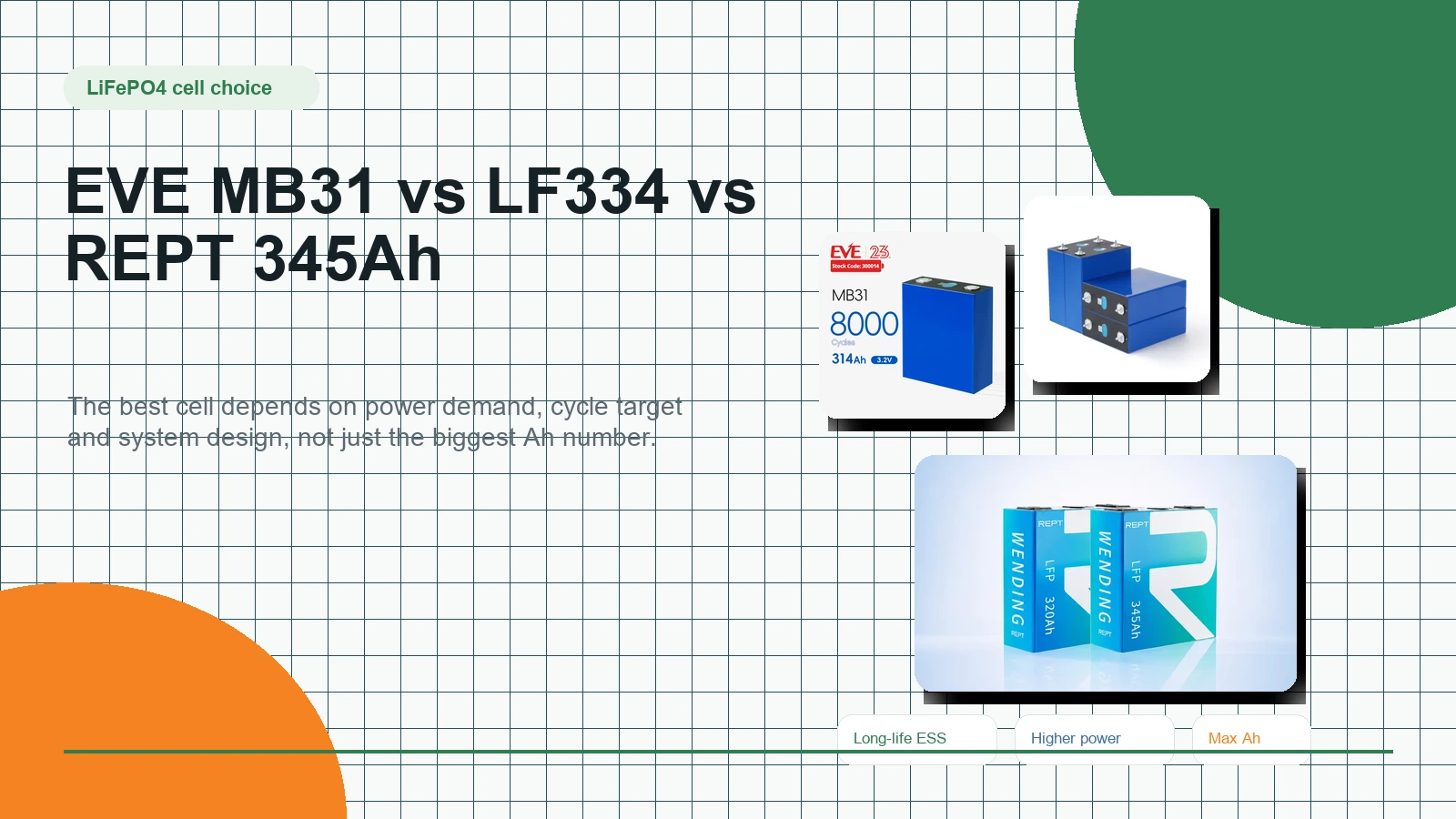
In this comparison, we look at three high-capacity prismatic LFP cells:
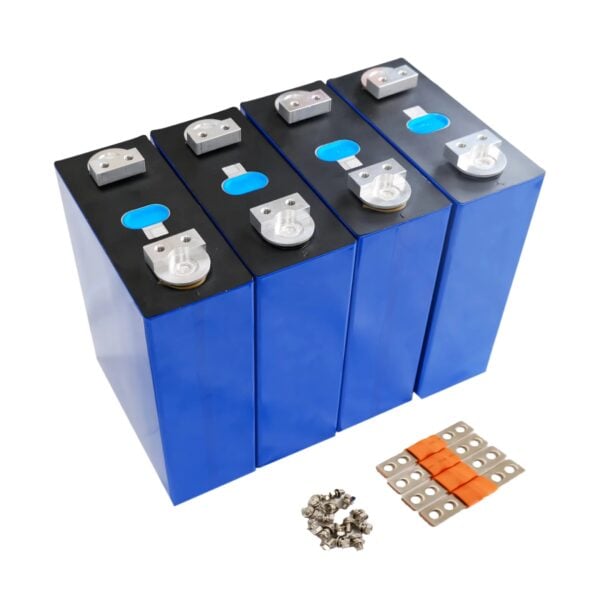
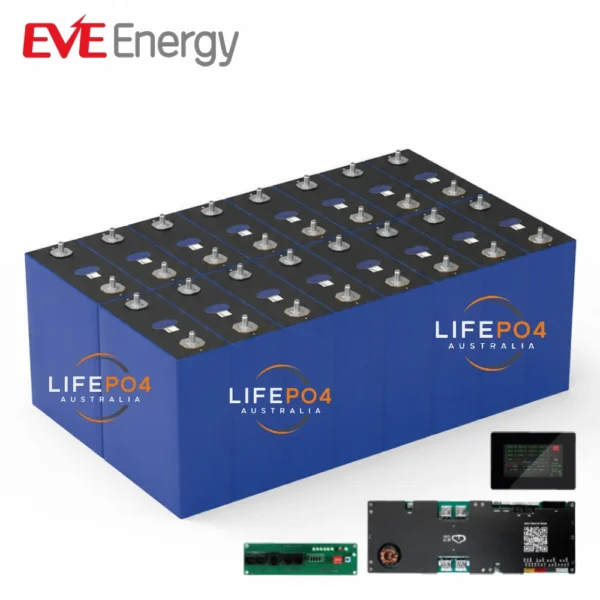
EVE MB31 314Ah EVE LF334 334Ah REPT 345Ah CB84
Each one can be an excellent choice, but they suit different systems.
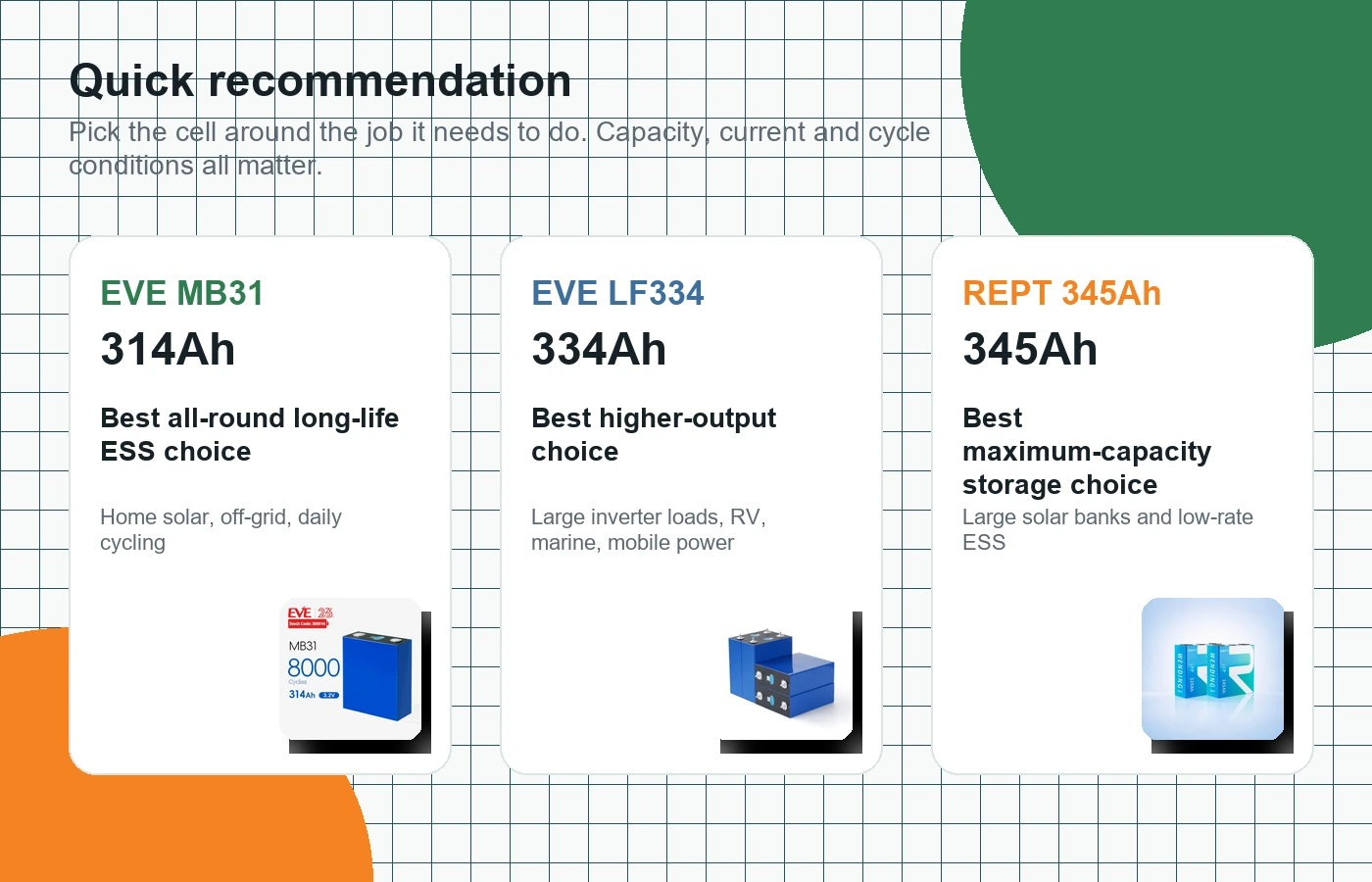
Quick Recommendation
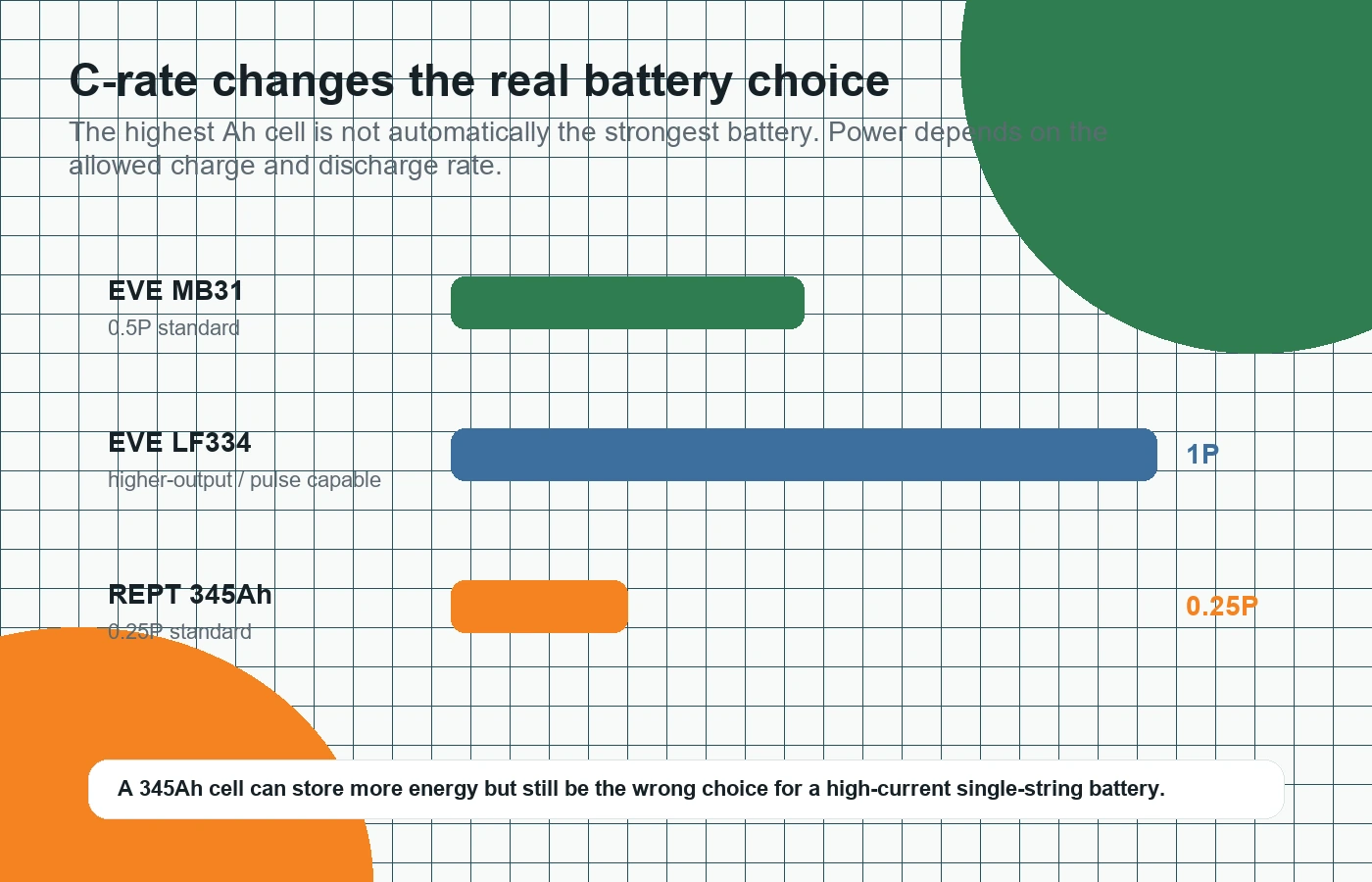
Choose the EVE MB31 if you want the safest all-round ESS choice: long cycle life, proven 314Ah format, moderate charge/discharge rate, and strong suitability for residential, off-grid, telecom, commercial, and utility energy storage. EVE’s official MB31 page lists 314Ah capacity, 3.2V nominal voltage, 8000 nominal cycles, and 0.5P/0.5P charge/discharge power, with applications including commercial, industrial, utility, telecom, and residential ESS. (evemall.eu)
Choose the EVE LF334 if you want more usable capacity and stronger power capability in a similar footprint. It is the better choice for high-demand 12V, 24V, and 48V systems where inverter surge, high current loads, or faster charge/discharge capability matter. Public listings commonly show 334Ah, 4000 cycles to 80% capacity, and up to 3C discharge capability, though the exact continuous-versus-pulse rating should always be confirmed against the batch datasheet. (NKON)
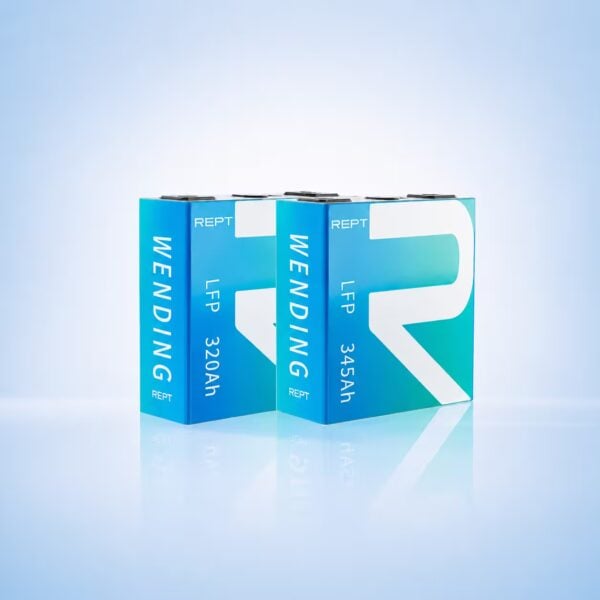
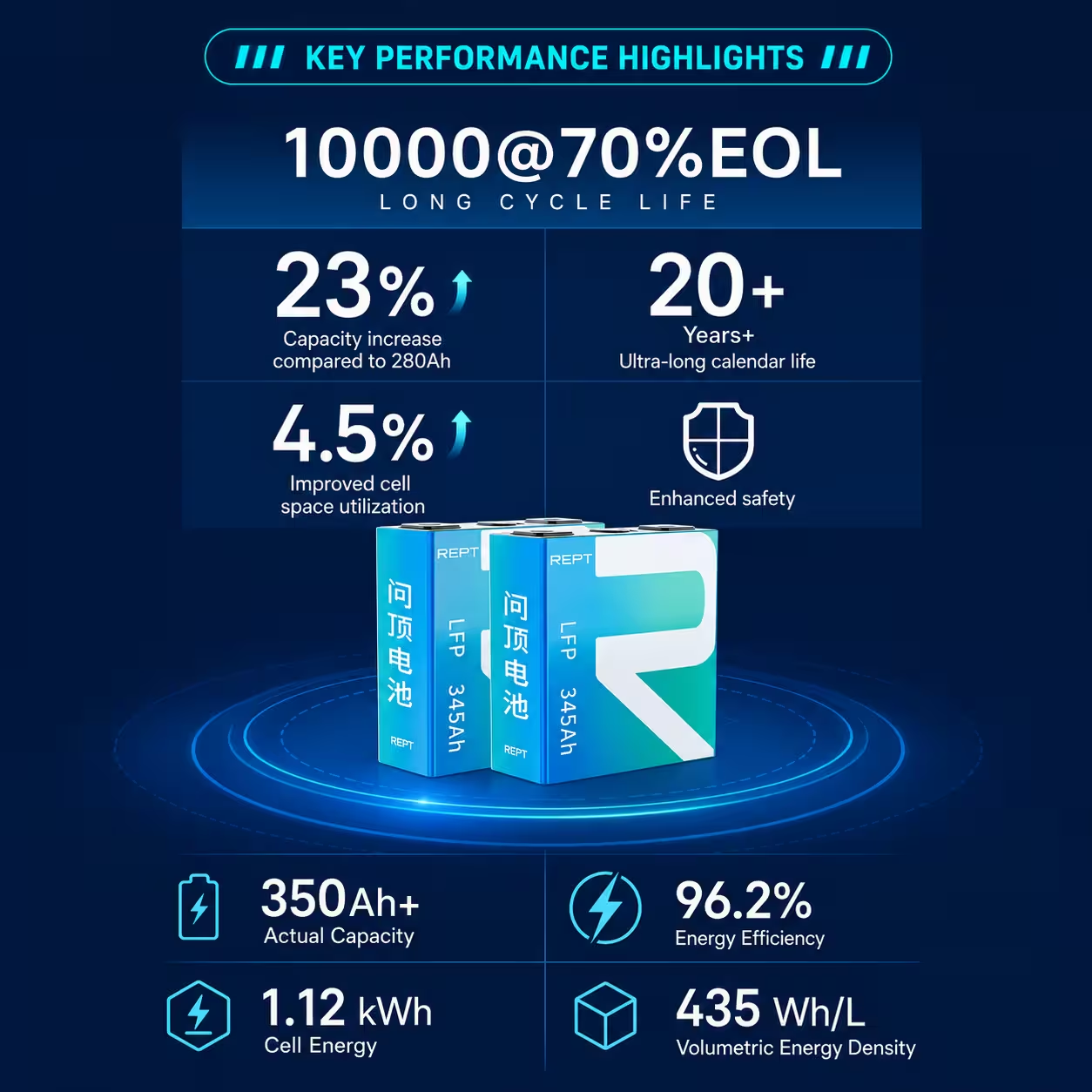
Choose the REPT 345Ah if you want maximum capacity per cell for a low-to-moderate power ESS system. It is ideal for large solar storage, off-grid battery banks, long-duration backup, and systems where the discharge current is relatively gentle. The REPT CB84 datasheet lists 345Ah, 3.2V, 1104Wh nominal energy, 0.25P standard charge/discharge, and 8000 cycles to 70% SOH at 25°C under 0.25P/0.25P cycling. (Shopline)
Comparison Table
| Cell | Nominal Capacity | Nominal Energy | Best Use Case | Cycle Rating | Rate Character |
|---|---|---|---|---|---|
| EVE MB31 | 314Ah | ~1005Wh | Long-life ESS, solar, residential/off-grid, commercial storage | 8000 cycles to 70% SOH under 25°C 0.5P/0.5P conditions | Moderate power, 0.5P standard |
| EVE LF334 | 334Ah | ~1075Wh | Higher-power DIY packs, RV, marine, mobile power, larger inverter systems | Commonly listed around 4000 cycles to 80% capacity | Higher power; verify continuous vs pulse rating |
| REPT 345Ah CB84 | 345Ah | 1104Wh | Maximum energy storage, low-rate ESS, large solar banks | 8000 cycles to 70% SOH at 25°C under 0.25P/0.25P | Conservative standard rate, 0.25P standard |
The main lesson is simple: the biggest Ah number is not automatically the best cell. The correct choice depends on how much power the battery needs to deliver, how fast it needs to charge, how long you expect it to cycle, and how hard the system will be used.
Why Cell Variant Matters, Even Inside LFP
LFP cells share the same broad cathode chemistry, but that does not mean they have the same internal design. Manufacturers tune cells for different priorities: long cycle life, high energy density, high power output, low impedance, low swelling, lower cost, faster charging, or better thermal stability.
A cell optimized for ESS usually prioritizes long-term stability, lower side reactions, predictable swelling behavior, and long cycle/calendar life. A cell optimized for power applications may prioritize lower internal resistance, better high-current delivery, improved heat handling, and stronger pulse performance.
Battery formation also matters. Formation is not just a factory charge cycle; it activates the cell and helps establish protective interphase layers. Research reviews describe formation as a production step that can significantly affect capacity, power capability, lifetime, and safety, and note that material design, cell design, pressure, wetting, temperature, and process conditions all interact. (RSC Publishing)
Cycle life is affected by several degradation mechanisms, including loss of lithium inventory, loss of active material, impedance growth, SEI growth, lithium plating, and electrode particle damage. These mechanisms do not occur equally in every cell design, which is why two LFP cells can have very different cycle ratings and current limits. (RSC Publishing)
Cell 1: EVE MB31 314Ah
The EVE MB31 is the best choice for customers who want a proven, long-life energy storage cell rather than the highest possible current output.
It is a 314Ah, 3.2V prismatic LFP cell designed around ESS applications. EVE lists the MB31 as a commercial, industrial, utility, telecom, and residential ESS cell, with 0.5P/0.5P standard charge/discharge power. (evemall.eu)
The MB31’s headline strength is its cycle-life positioning. EVE’s product page describes the MB31 as “up to 8000 cycles; 70% SOH” under 25°C 0.5P/0.5P conditions. (evemall.eu)
This makes the MB31 a very strong option for:
- Home solar storage
- Off-grid battery banks
- 48V server-rack style systems
- Commercial and industrial ESS
- Telecom backup
- Long-duration daily cycling
- Customers who value long service life over maximum current output
The MB31 is not necessarily the best cell for every high-current application. Its 0.5P rating is perfectly suitable for many ESS systems, but if someone wants a small 12V pack running a large inverter, or a high-power mobile application with big surge loads, the LF334 may be the better match.
MB31 in plain English
The MB31 is the “long-life ESS workhorse.” It is the cell to choose when the customer wants a dependable battery bank that cycles every day without being pushed hard. It is not the most aggressive power cell, but that is exactly why it makes sense for many solar and storage systems.
Cell 2: EVE LF334 334Ah
The EVE LF334 is the higher-capacity, higher-power option. It gives more Ah than the MB31 and is better suited to systems where current delivery matters.
Public LF334 listings describe it as a 334Ah LiFePO4 cell with approximately 1075Wh nominal energy, and some listings show real-world batch averages above the nominal rating. One listing describes 334Ah nominal capacity, 3.22V nominal voltage, and 1075.48Wh nominal energy. (LiFePo4 Australia)
The LF334 is often discussed as a stronger power cell than the MB31. Public listings show maximum discharge capability up to 3C, while also listing 4000 cycles to 80% capacity. (NKON)
However, this is where the wording matters. Some public information describes standard discharge as 0.5C and maximum instantaneous discharge as up to 3C for 30 seconds. (LiFePo4 Australia)
That means LF334 should be advertised carefully. It is fair to describe it as a higher-power cell, but unless the exact datasheet for your batch states that 2C or 3C is continuous, the safer wording is:
“Higher-power capable, with up to 3C pulse discharge depending on datasheet conditions.”
The LF334 is a good choice for:
- High-power 12V builds
- RV and caravan systems with large inverters
- Marine systems
- Mobile power systems
- EV conversions or traction-style use cases
- Large 24V and 48V inverter systems
- Customers who want more capacity than MB31 and stronger current capability
- Applications where 4000 cycles to 80% SOH is acceptable
LF334 in plain English
The LF334 is the “higher-output” option. It stores more energy than the MB31 and is better suited to customers who may run higher inverter loads or need stronger surge capability. The trade-off is that its commonly published cycle rating is lower than the MB31’s headline ESS cycle rating, and its high-current claims must be matched to the correct datasheet conditions.
Cell 3: REPT 345Ah CB84
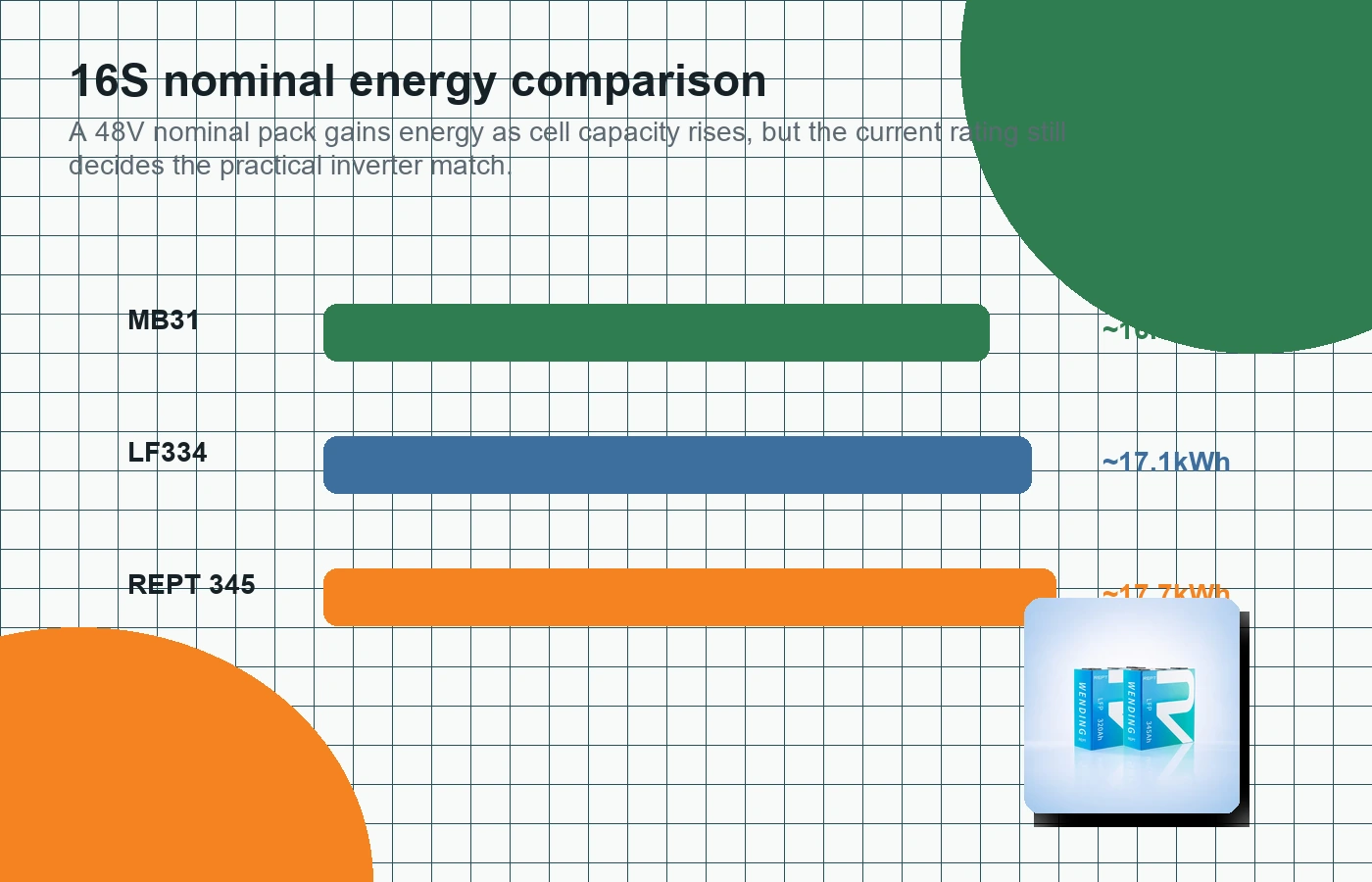
The REPT 345Ah is the largest-capacity cell in this comparison. At 345Ah and 3.2V, it stores approximately 1104Wh per cell, which means a 16-cell 48V nominal pack is around 17.7kWh before system losses. The REPT datasheet lists 345Ah nominal capacity, 3.2V nominal voltage, and 1104Wh nominal energy. (Shopline)
Its main attraction is capacity. For customers building a large energy storage bank, the REPT 345Ah can reduce the number of parallel strings needed compared with lower-capacity cells.
The important limitation is current rate. The datasheet lists 0.25P standard charging and 0.25P standard discharging. It also shows 8000 cycles to 70% SOH at 25°C under 0.25P/0.25P cycling. (Shopline)
Some REPT datasheet information also shows 0.5P maximum continuous charge/discharge power at 25°C, but for conservative customer guidance, 0.25P should be treated as the standard design point unless the supplied datasheet, warranty, BMS, busbars, compression fixture, and thermal design all support higher operation. (Shopline)
The REPT 345Ah is a good choice for:
- Large off-grid solar banks
- Home ESS with moderate inverter loads
- Long-duration backup systems
- Energy-focused builds rather than power-focused builds
- Customers who want maximum Ah per cell
- Systems designed around lower C-rate operation
- Parallel battery banks where current is shared across multiple strings
It is not the best choice for a single-string high-current system. For example, a single 16S REPT 345Ah pack at 0.25P is roughly a 4.4kW-class standard-rate battery. That can be excellent for gentle ESS operation, but it is not ideal for a customer expecting one battery string to support a large inverter continuously at high load.
REPT 345Ah in plain English
The REPT 345Ah is the “big capacity, gentle discharge” option. It is excellent when the goal is maximum stored energy, but it should not be chosen purely because it has the highest Ah rating. It is best when the system is designed around lower current per cell.
Power Comparison: Why Ah Is Not Everything
A common mistake is comparing only Ah:
- MB31: 314Ah
- LF334: 334Ah
- REPT: 345Ah
On capacity alone, the REPT looks like the winner. But battery selection is not only about capacity. It is also about how much power the cell can safely deliver.
Approximate single-string 16S figures:
| Cell | 16S Nominal Energy | Conservative Standard Power |
|---|---|---|
| EVE MB31 314Ah | ~16.1kWh | ~8.0kW at 0.5P |
| EVE LF334 334Ah | ~17.1–17.2kWh | Depends on datasheet; potentially much higher than MB31 if 1C continuous is allowed |
| REPT 345Ah | ~17.7kWh | ~4.4kW at 0.25P standard |
This is why a 345Ah cell can be the best choice for a large low-rate storage bank, while a 334Ah cell can be the better choice for a high-power inverter build.
For 12V systems, this matters even more. A 3000W inverter on a 12V battery can draw well over 230A before losses. That is a heavy current load for a single string. In that type of system, LF334 may make more sense than REPT 345Ah, or the customer may need parallel strings.
For 48V systems, the current is much lower for the same power, so MB31 and REPT become more practical. But even then, a 5kW inverter can still exceed the conservative 0.25P standard rate of a single REPT string once inverter losses and surge are considered.
Cycle Life: Do Not Compare the Numbers Blindly
Cycle-life ratings are only meaningful when the test conditions are known.
A cell rated for 8000 cycles to 70% SOH is not directly comparable with a cell rated for 4000 cycles to 80% SOH. The endpoint is different. The current rate may be different. The temperature may be different. The compression force may be different. The charge/discharge profile may be different.
That matters because cycle life depends heavily on how the cell is used. Higher current, higher temperature, poor compression, charging at low temperature, repeated high SOC storage, poor balancing, and weak thermal management can all reduce practical service life.
For this comparison:
- The MB31 is the best long-cycle ESS option.
- The LF334 is the best higher-power option.
- The REPT 345Ah is the best high-capacity low-rate storage option.
There is no single “best” cell. There is only the best cell for the application.
Which Cell Should You Buy?
Choose EVE MB31 if you want long-life solar storage
The MB31 is the best general recommendation for most home ESS and off-grid users. It has strong cycle-life positioning, good current capability for normal storage use, and a well-established application fit.
Best for:
- Daily solar cycling
- Residential ESS
- Off-grid homes
- 48V battery banks
- Long service life
- Moderate inverter loads
- Customers who want a proven ESS cell
Avoid it if:
- You need very high current from a small pack
- You are building a high-power mobile system
- You need the absolute highest Ah per cell
Choose EVE LF334 if you need more power
The LF334 is the better fit when the system may demand high current. It is especially attractive for mobile applications, RVs, marine builds, and high-output inverter systems where a conservative ESS cell may feel limiting.
Best for:
- High-power DIY builds
- Large 12V systems
- RV and marine inverters
- Mobile work vans
- Fast charge/discharge applications
- Customers who want more punch than MB31
- Applications where 4000 cycles to 80% SOH is acceptable
Avoid it if:
- The customer only cares about maximum cycle life
- The system is low-power and does not need the extra output capability
- The datasheet does not confirm the continuous current rating being advertised
Choose REPT 345Ah if you want maximum capacity
The REPT 345Ah is best when the goal is a large, efficient, low-rate storage bank. It is an excellent choice for customers who want more kWh and are not trying to pull huge current from one string.
Best for:
- Large solar storage
- Off-grid battery banks
- Low-to-moderate current ESS
- Long-duration backup
- Parallel battery systems
- Customers who want maximum Ah per cell
Avoid it if:
- You need high current from one string
- You are running a large inverter from a small 12V or 24V pack
- You want the highest power capability per cell
- The system cannot be designed around the conservative 0.25P standard rate
Final Verdict
The EVE MB31 is the best all-round long-life ESS cell. It is the one to choose for most customers who want reliable solar storage and long daily cycling.
The EVE LF334 is the best high-power choice. It gives more capacity than the MB31 and is better suited to demanding inverter loads, mobile applications, and customers who need stronger charge/discharge capability.
The REPT 345Ah is the best high-capacity storage choice. It gives the most energy per cell, but it should be used in systems designed around lower current per cell.
The correct question is not “which cell has the biggest Ah rating?” The correct question is:
How much energy do you need, how much power do you need, and how hard will the battery be cycled?
Once you answer that, the right cell becomes much clearer.
Sources
- MB31-Prismatic LiFePO4 Battery Cells-EVE Energy
- Eve LF334 – 334Ah – LiFePO4 3.2V – Single stud – Grade A-
- 2MW/2.65MWh厢式储能系统
- Lithium-ion battery cell formation: status and future directions towards a knowledge-based process design – Energy & Environmental Science (RSC Publishing) DOI:10.1039/D3EE03559J
- Lithium-ion battery degradation: how to model it – Physical Chemistry Chemical Physics (RSC Publishing) DOI:10.1039/D2CP00417H
- EVE LF334 LITHIUM IRON PHOSPHASE IEC 62619 MSDS UN38.3 » LiFePo4 Australia