Sodium Ion
What is a Sodium Aluminum Battery?

Sodium-aluminum batteries, also known as sodium-ion batteries, are a type of rechargeable battery that uses sodium ions to store and release energy. These batteries are similar in structure to lithium-ion batteries, but they use sodium ions instead of lithium ions.

One of the main advantages of sodium-aluminum batteries is that they use abundant, low-cost materials, making them potentially cheaper than lithium-ion batteries. Sodium and aluminum are both widely available, with sodium being the sixth most abundant element on Earth and aluminum being the most abundant metal. Sodium-aluminum batteries have a higher energy density than some other types of batteries, such as lead-acid batteries. This means they can store more energy in the same amount of space.

However, sodium-aluminum batteries are still in the early stages of development, and there are some challenges that need to be overcome before they can be widely used. One of the main challenges is that sodium ions are larger than lithium ions, so it can be more difficult to move them through the battery’s electrolyte. This can result in lower power and energy density compared to lithium-ion batteries. Additionally, the use of aluminum can cause the battery to swell and degrade over time, reducing its lifespan.

Breakthrough News 2023

US researchers have designed a molten salt that could potentially reach an energy density of up to 100 Wh/kg at a cost of $7.02/ kWh. The battery uses an aluminum cathode that charges quickly and reportedly enables a longer-duration discharge. Based on an anode made of molten sodium (Na) and a cathode made of aluminum (Al) and sodium tetrachloroaluminate (NaAlCl4).

They described the novel battery as a low-cost, grid-scale solution for long-duration renewable energy storage and said the use of NaAlCl4 offers extra accessible capacity hidden in acidic chloroaluminate. They said the proposed battery chemistry relies on the sixth and second most abundant elements on Earth.

This enables higher specific capacity and average discharge voltages than previous Na-Al batteries, utilizing two distinct cell reaction mechanisms in one battery,” the researchers said, noting that this second reaction, on top of the neutral molten salt reaction, is the crucial factor for the device’s higher voltage and capacity. “Specifically, after 345 charge/discharge cycles at high current, this acidic reaction mechanism retained 82.8 percent of peak charge capacity

In a nitrogen-filled glovebox, the researchers constructed Na-Al full cells in a discharged state, which they sealed hermetically using stainless steel endcaps and eight screws tightened in a star pattern. The solid-state electrolyte of the battery permits only sodium to move through during the charging process. The flat cell design of the system allows for a thicker cathode to increase the cell’s capacity. The researchers utilized this design to showcase a triple capacity cell that was capable of sustaining a discharge for 28.2 hours under laboratory conditions.

The research team discovered that the battery can achieve a high areal capacity cell of 138.5 mAh cm−2, even when subjected to a high current density of 4.67 mA cm−2. They anticipate that the battery could potentially have an energy density of up to 100 Wh/kg, with a low cost of $7.02 kWh. Another advantage of the new battery design is that it eliminates the need for scarce and expensive nickel, while maintaining battery performance. According to Li, the aluminum cathode charges quickly, which is essential for enabling longer discharge duration. The team presented their battery technology in a recently published article in Energy Storage Materials titled “Unlocking the NaCl-AlCl3 phase diagram for low-cost, long-duration Na-Al batteries.” The researchers believe that the new molten salt battery design can charge and discharge faster than traditional high-temperature sodium batteries, operate at a lower temperature, and maintain excellent energy storage capacity.
News Blog
Who is Energy Renaissance?

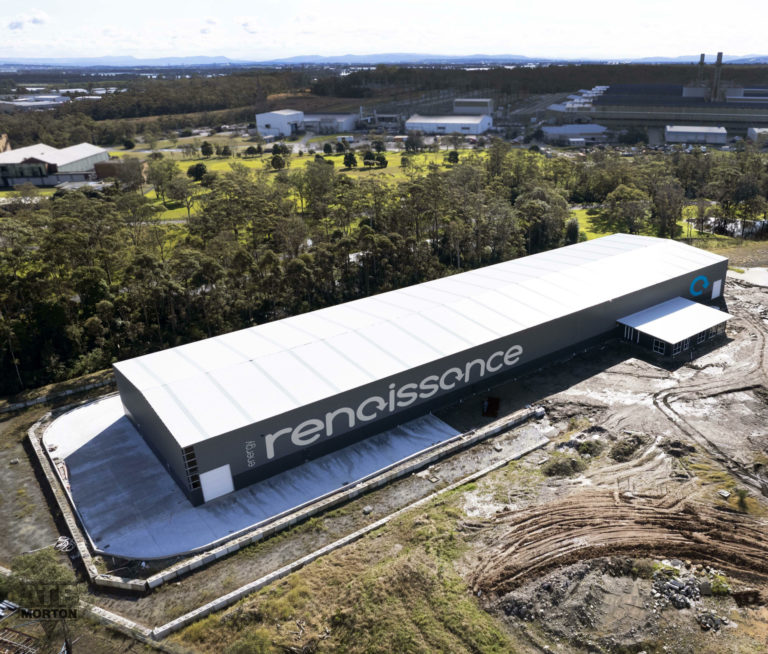
Energy Renaissance is Australia’s first lithium-ion battery manufacturer and they produce batteries that are safe, affordable and optimised for hot climates at Tomago, NSW. They are building an exciting future where the world is powered by clean, stored energy everywhere – right here in Australia. They work with CSIRO as our research collaborator and Cadenza Innovation as our technology partner. Energy Renaissance will advance local battery manufacturing capabilities, create jobs in Australia and build significant economic benefits for our lithium-ion battery materials industry through a local supply chain. More than half of the batteries will be exported to Asia and when its production facility is operating at capacity, Energy Renaissance will be able to make enough batteries to power every public school, hospital, fire station, SES unit and new homes built in Australia.

[embedyt] https://www.youtube.com/watch?v=F-Iysy6CmyY[/embedyt]

Energy Renaissance is developing Australia’s first advanced lithium-ion battery Gigafactory. 

Driving sustainable economic development and creating jobs in regional Australia. For every employee they hire, Energy Renaissance has the potential to create five jobs in upstream industries.

A look at the current product available by energy renaissance

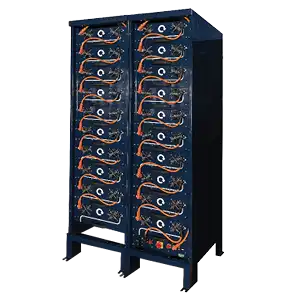
renaissance superRack™ twin

pre-configured higher voltage multi rack system with unique ship-in-rack capability

The Renaissance superRack™  twin has been designed from the ground up for faster, simpler, safer implementation and maintenance. Ideally suited for commercial, agricultural and utility scale applications.

The superRack™ Twin design makes it easy to address a wide range of power and energy applications. Scaling is simple with multi rack systems that are pre-configured and with our unique ship-in-rack capability this means faster, easier and more cost effective installation.

  • Powered by cybersecure Renaissance superBMS™ and supported by cybersecure Renaissance superEMS™
  • 10-year performance warranty
  • High energy density kWh/㎥
  • Real time monitoring and reporting down to the minute via the Energy Renaissance portal, accessible from any internet connected device
  • Air cooled for safety and reliability
  • Transportable; packs designed to be transported in rack to site
renaissance superRack twin 2

You can find more on there website here

Lithium Battery-school
How does charging differ between LiFePO4 batteries and lead-acid batteries?

How does the charging process differ between LiFePO4 batteries and lead-acid batteries?

The charging process for LiFePO4 batteries and lead-acid batteries is different in several key ways.

LiFePO4 batteries are typically charged using a constant voltage charging method, where the voltage is held at a constant level until the current drops to a certain level. This helps to prevent overcharging and extend the life of the battery.

In contrast, lead-acid batteries are often charged using a constant current charging method, where the current is held at a constant level until the voltage reaches a certain level. This method is less precise and can result in overcharging and shorter battery life.

Additionally, LiFePO4 batteries have a higher charging voltage and require a special charging profile to avoid damaging the cells. Lead-acid batteries have a lower charging voltage and can be charged using a standard charging profile.

It’s also worth noting that LiFePO4 batteries are more tolerant to overcharging compared to lead-acid batteries, and they have a lower risk of sulfation, which is a common problem with lead-acid batteries.

What is the ideal voltage to charge lifepo4?

The ideal voltage to charge a LiFePO4 battery varies depending on the specific battery and the manufacturer’s specifications, but a typical voltage range is between 3.5V to 3.65V per cell. For a 12V LiFePO4 battery, the charging voltage should be between 14v and 14.4v

It’s important to follow the manufacturer’s recommended charging voltage and to use a charger specifically designed for LiFePO4 batteries, as charging a LiFePO4 battery with the wrong voltage or using an inappropriate charger can result in reduced performance and shorter battery life.

LiFePO4 batteries require a multi-stage charging process that includes a constant voltage charge and a topping charge. The constant voltage charge is applied until the current drops to a certain level, at which point a float charge is applied to bring the voltage to the maximum level. The multi-stage charging process helps to prevent overcharging and extend the life of the battery. The float charge is a stage in the charging process for LiFePO4 batteries that occurs after the main constant voltage charge stage. During the float charge, the voltage is held at a slightly lower level than the maximum voltage to prevent overcharging and to ensure that the battery stays fully charged. The float charge serves several purposes. First, it helps to balance the voltage between the cells in the battery, ensuring that all cells are charged to the same level. Second, it helps to prevent overcharging, which can reduce the overall life of the battery. Finally, it helps to maintain the battery in a fully charged state, ready for use when needed.

The exact voltage and duration of the float charge will depend on the specific battery and the manufacturer’s specifications. It’s important to follow the manufacturer’s recommendations to ensure that the battery is charged correctly and to maximize the performance and lifespan.

Lithium Battery-school
Who is CATL?

CATL is the leading Lithium and as of 2023 Sodium-ion battery manufacturer in China and the World.

CATL (Contemporary Amperex Technology Limited) is a Chinese battery manufacturer that produces lithium-ion and as of 2023 sodium-ion batteries for electric vehicles (EVs) and energy storage systems. The company was founded in 2011 and has quickly become the leading EV battery manufacturer in the world. It supplies batteries to a number of major automakers, including Tesla, Volkswagen, BMW, and Toyota. CATL has also established a number of partnerships and collaborations with other companies in the EV and energy storage industries.

The company provides research and development, production, and sale of electric vehicle and energy storage battery systems. It also provides battery management systems, materials, battery cells, and battery recycling and reuse systems. These batteries are used in electric passenger vehicles, electric buses, electric trucks, and other special vehicles; and spare parts. The products of energy storage systems find their applications in renewable energy, communication base stations, grid frequency modulation, commercial and industrial buildings, and household energy storage. It also operates its business from Ningde, Fujian, China also has production in Germany, and overseas offices in Japan, France, and the USA regions.

LiFePo4 Video from CATL

Official CATL VIDEO

HOW China’s CATL makes its batteries

News Blog
Hithium 280ah 12000 cycle LFP cells used in 400MWh The largest standalone battery storage project in China

The 200MW/400MWh battery energy storage system (BESS) is live in Ningxia, China, equipped with Hithium lithium iron phosphate (LFP) cells.

Established 3 years ago in 2019 is already ramping up to a target of more than 135GWh of annual battery cell production capacity by 2025 for a total investment value of about US$4.71 billion.

The project was connected to the grid earlier this month, through a system integrator called ROBESTEC, about which little information appears publicly available. However, it is understood that although Hithium makes and provides complete BESS solutions as well as cells, in this case, it was the cell supplier.

200MW/400MWh HITHIUM LFP BESS in China

China 400MWh Hithium 12000 cycle LFP Battery 1

The facility stores energy at times of abundant generation from solar PV and wind, putting it into the grid during times of peak demand. It will also help regulate grid frequency.

If you are interested in these new 280AH cells, which Hithium and CATL currently can produce specifically for ESS use, let us know, as we have access to the cells when the demand is slightly lower. As these are actually in high demand for commercial applications, and they technically are hard to get for the DIY community.

it’s expected this giant LFP battery will cut CO2 emissions by 501,000 tons per year

Hithium specializes in the R&D, production, and sales of LFP energy storage batteries and systems. With strong customer orientation, they are committed to providing safe, efficient, clean, and sustainable energy storage solutions for the world. Hithium now has over 4400 employees globally including over 1000 R&D engineers with extensive experience in energy storage. With a planned 4.71 billion USD total investment and 1,400,000m2 factory space to achieve 135GWh production capacity of the energy storage battery in 2025.

Xiamen Haichen New Energy Lithium Battery
Hithium-280ah-LFP280 12000 Cycles Storage Grade
280ah capacity test
Hithium_280ah_test_results

We delivered these cells in 2022 to a few customers and currently have a small shipment arriving again in February 2023. As they are an unknown brand to many customers, we haven’t ordered large quantities, because many customers still want EVE, CATL, LiShen, CALB, and various other brands they have heard of. It’s just not a well-known brand,

In the past was a bad thing, But with this type of new technology, sometimes it’s a great thing to get in early while you can.

Lithium Battery-school
Pylontech First Gen 8 years old – Lifepo4 with bad cells – Repaired

Model – Extra 2000 – First generation Pylontech Lifepo4 Battery

Thanks to Nicolas for making this video of his First generation Lifepo4 Battery repair.

Here we see an old Pylontech battery with a capacity of only 10% original capacity, and over the course of 2 youtube videos, Nicolas is able to cut out a couple of bad pouch cells and restore the battery to approx 80% again.
Well done Nicholas


Nicholas Howell
Youtube subs – 1.61K subscribers

Part 1

Part 2

Lithium Battery-school Blog
What is the best way to prolong the lifespan of lifepo4 batteries?

There are several steps you can take to prolong the lifespan of Lifepo4 batteries, including the following:

  1. Store the batteries properly: Lifepo4 batteries should be stored in a cool, dry place at a temperature of around 15-20 degrees Celsius (60-68 degrees Fahrenheit). Avoid storing the batteries in extreme temperatures, as this can damage the cells and reduce their lifespan.
  2. Charge and discharge the batteries properly: Lifepo4 batteries should be charged and discharged within the recommended voltage range to ensure optimal performance and longevity. Overcharging or deep discharging the batteries can damage the cells and reduce their lifespan.
  3. Avoid exposing the batteries to high temperatures: Lifepo4 batteries are sensitive to high temperatures and can degrade quickly when exposed to them. Avoid exposing the batteries to high temperatures, such as by keeping them out of direct sunlight or away from heat sources.
  4. Use a battery management system (BMS): A BMS can help to optimize the charging and discharging of Lifepo4 batteries, protecting them from overcharging, deep discharging, and other factors that can damage the cells and reduce their lifespan.

By following these steps, you can help to prolong the life of your Lifepo4 batteries and ensure they perform at their best for as long as possible.

Bloating

Lifepo4 batteries, like all lithium-ion batteries, can expand or “bloat” when they are overcharged or charged too quickly. The specific voltage at which this can occur will depend on the specific chemistry and construction of the battery, as well as the charging conditions and other factors. In general, however, it is important to avoid overcharging Lifepo4 batteries and to charge them at a slow, steady rate to prevent bloating and other damage to the cells. Most Lifepo4 batteries are designed to be charged to a maximum voltage of around 3.65-3.7 volts per cell, and charging them above this level can cause bloating and other damage to the cells. It is important to refer to the manufacturer’s instructions for the specific charging voltage and charging rate for your Lifepo4 batteries.

REAL WORLD Cycle life

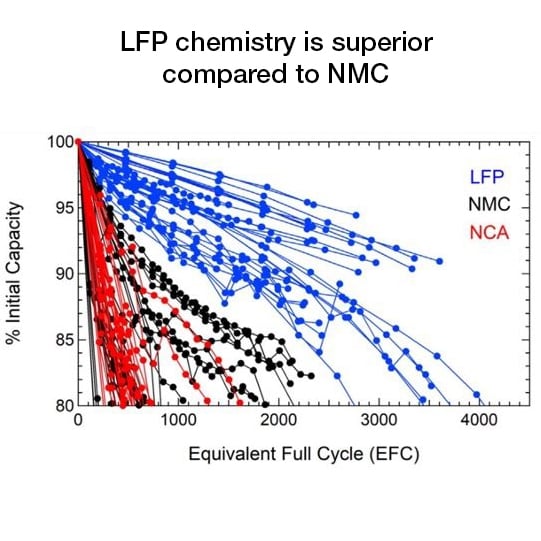
Good quality Lifepo4 cells should achieve about 4,000 or more deep discharge/charge cycles, averaging 1 cycle per day would allow for 11 years of use before a noticeable loss of capacity.

Shallow cycles are the best way to extend the lifespan, which means not going below about 30% of the remaining capacity. And not above 90% SOC. For use in residential and commercial purposes, We at LIFEPO4 Australia would recommend sizing and using your battery within these parameters.

10,000 shallow discharge/charge cycles would last around 13+ years.

LFP vs NMC lithium battery degradation-test-results
Its likely the LFP was shallow cycles at a low C rate such as below 0.2C
Lithium Battery-school
LIFEPO4 – Internal Resistance, capacity, and its Performance

Cell capacity is of limited use if a battery pack cannot deliver the stored energy effectively; a battery also needs low internal resistance. Measured in milliohms (mΩ), resistance is extremely important the higher the C rate of the battery; the lower the resistance, the less restriction the pack encounters. This is especially important in heavy loads such as power tools and electric powertrains. High resistance causes the battery to heat up and the voltage to drop under load, this is bad for the cell, and the battery, this is what causes degradation and aging, loss of performance, and ultimately EOL(end of life)

A grade (what we now call Automotive Grade) LiFePo4 has a very low internal resistance and the battery responds well to high-current bursts that last for a few seconds to a few minutes (see the individual cell specification sheet). Compared to LFP Lead acid and inherent sluggishness, however, lead acid does not perform well on a sustained high current discharge; the battery soon gets tired and needs rest to recover. LFP however, suffers much less, And A-grade LFP is sorted by the factory because it meets the manufacturer’s specifications. This tells the manufacturer a lot about the cell, its expected performance, and its lifespan.

LFP is highly efficient and can have different performance characteristics

If we look at the A-grade EVE LF280 cells we can see the performance and efficiency. Very high!!!
Discharge capacity/nominal
capacity×100%

A)0.33CA ≥100%
B)0.5CA ≥98%
C)1CA ≥97%

We need to compare Lead Acid again for learning purposes, Some sluggishness is apparent in all batteries at different degrees but it is especially pronounced with lead acid. This hints that power delivery is not based on internal resistance alone but also on the responsiveness of the chemistry, as well as temperature. In this respect, nickel- and lithium-based technologies are more responsive than lead acid.

The internal resistance of Lithium-based batteries also increases with use and aging but improvements have been made with electrolyte additives to keep the buildup of films on the electrodes under control. With all batteries, SoC affects the internal resistance. Lithium has higher resistance at full charge and also at end of discharge with a low resistance area in the middle. This is important to note, as when you are caring for the cells, you can very simply make the judgment that keeping your Lithium cells inside the 80% window is going to minimise degradation.

The 10%-80%-10% rule for Lithium is a good one to follow. This means try to keep you cells between 10% and 90% State of Charge.

A look at the Manufacturing Process

Lithium Battery-school News
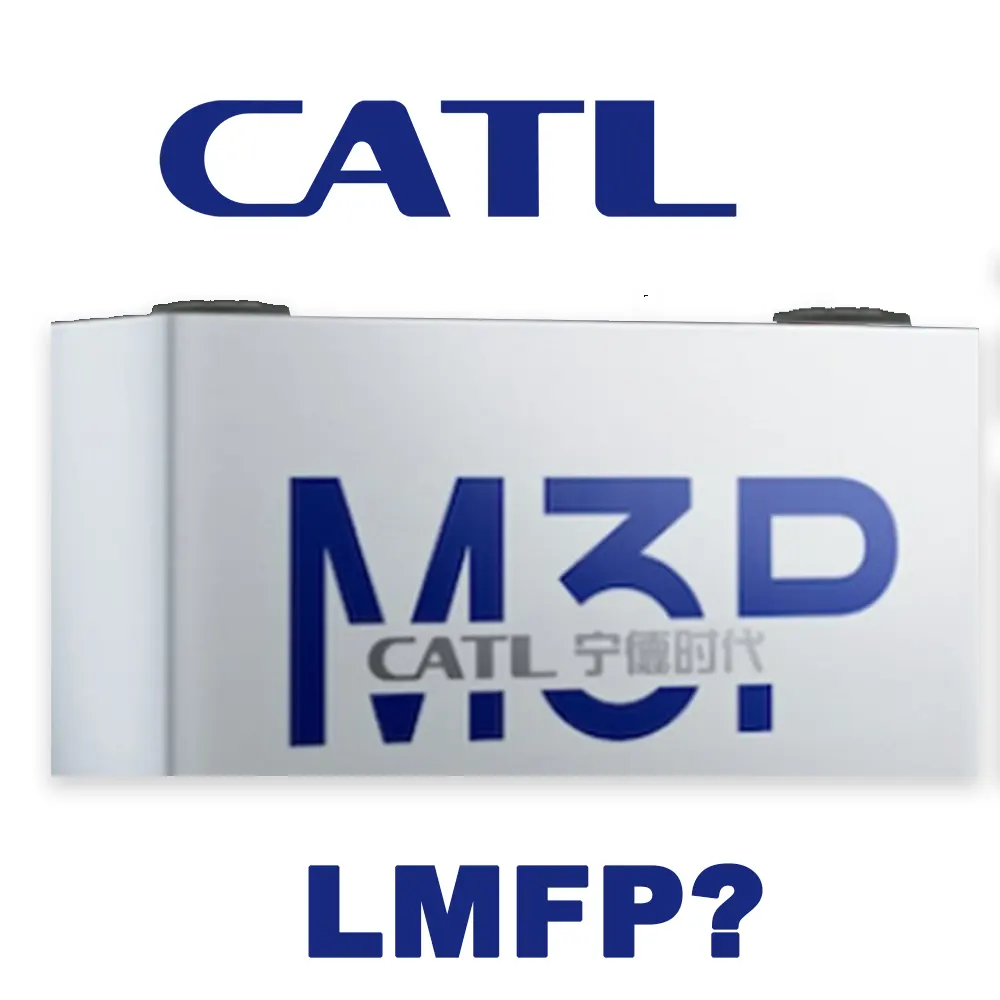
Next-Generation Automotive M3P Batteries by CATL

CATL, the world’s largest Lithium Battery Manufacturer, has recently announced a new battery type, with a modified version of the LMFP chemistry, LMFP stands for Lithium Maganese Ferro Phosphate, its very similar to the LFP (LiFePo4) chemistry only that the manganese allows for the voltage to rise from the 3.2 to around 4.1v, this means there is higher energy inside the same form factor or another way to say that is the higher energy density.

CATL doesn’t do things unless they are tested, thought out, and ready for mass production.

Why Voltage matters

My two cents, what do we know about voltage and the effect it has on every type of Lithium Battery cells?

We know that the lower the nominal and fully charged voltage the longer the lifespan, if you look at LTO (Lithium Titanium oxide aka Li2TiO3) the nominal voltage lies at 2.3v and the lifespan can reach 20000 cycles with the fully charged voltage at only 2.8v.

Or if we look at what’s called ternary lithium cells, such as NMC (Lithium Nickel Manganese Cobalt Oxide aka LiNiMnCoO2 and NCA (Lithium Nickel Cobalt Aluminum Oxide aka LiNiCoAlO2) chemistry, the ones currently used by most Tesla’s (excluding the Chinese made Tesla’s that are not performance models) the nominal voltage is 3.7, but the full charged voltage is 4.2v, which is high, and it’s known that higher voltages translate into lower lifespans, which is why LFP does pretty well and can reach 6000 or even 10,000 cycles if treated well. It is also reported that Tesla will be one of the largest customers of CATL for the new M3P battery, with reports that the Tesla Semi will also use them.

So with rumors of the new M3P battery being manufactured by CATL, what have they managed to do, that gives a lifespan similar to LFP but still with the higher operating voltage? At this point we don’t know, as the information is not known, at least from my research I can’t find any further details on what they have added to the chemistry to enable the lifespan such as LFP.

According to CNEVPost, the M3P cells use the same olivine structure as LFP batteries. However, they replace iron with magnesium, zinc, and aluminum. There is speculation as to whether the Chinese website meant manganese instead of magnesium, but the information has not been corrected according to Autoevolution, so we are left to speculation.

Official data shows that the energy density of the CATL (LiMnZnAl) batteries will be about 15-20% higher than that of the LFP types, which hovers around 210 kWh/kg. This is a huge increase, and it’s believed it’s at a similar cost as the LFP battery.

It is also reported that Sunwoda and Eve Energy are all in the early stages of producing LMFP, with samples already being delivered to their partners for testing.

At this stage, we believe at first it will be very hard to get your hands on these cells, so I would estimate 2024 or even 2025 before this cell could be used for energy storage like we do today with the LFP cells.

And we still believe that LFP will have a longer lifespan, simply because of the voltage. We also now recommend a 90% DOD charge profile. 2.8v bottom and 3.45v top for your battery pack. We also believe keeping the draw at under 0.5C is a really good idea if you are wanting to achieve the huge cycle numbers and still have a good battery a few years from now.

Sources
1. CATL Promises M3P Cells For 2023, But What Are They? – autoevolution
2. Tesla Model 3 With CATL’s M3P Battery to Launch in China, Offers Better Range, Lower Price – autoevolution
3. Rumor: China-Made Tesla Model 3 To Get CATL’s M3P Batteries (insideevs.com)
4. Tesla Semi Specs Change, Chinese Model 3 To Use CATL M3P Batteries – CleanTechnica
5. CATL to announce first vehicles to be powered by Qilin Battery on Aug 27 – CnEVPost


X