According to the rules of QR code parsing, we know that the first three characters represent the vendor code.
Many customers emailed us asking if we have a list of vendor codes. Because there are two cases that need to know the vendor code.
1, You do not know the manufacturer of the LiFePO4 battery cell you are using.
2, You want to confirm whether the LiFePO4 battery cell you received is the one you are targeting.
Unfortunately, there is no official list of LiFePO4 battery cell vendor code so far.
We have maintained the following vendor code list based on our past experience, and hope it can help you identify the manufacturer of the battery cell.
LiFePO4 Battery Cell Vendor Code List
Manufacturer
Vendor Code
CATL
001
EVE
02Y
EVE Power
04Q
REPT
081
Lishen
08B
Ganfeng
0AL
CALB
0B5
Although this list does not cover all, but most of the popular LiFePO4 battery cell manufacturers on the market are on the list.
So you can identify which manufacturer your battery cell comes from based on the first 3 characters of the QR code on your LiFePO4 battery cell.
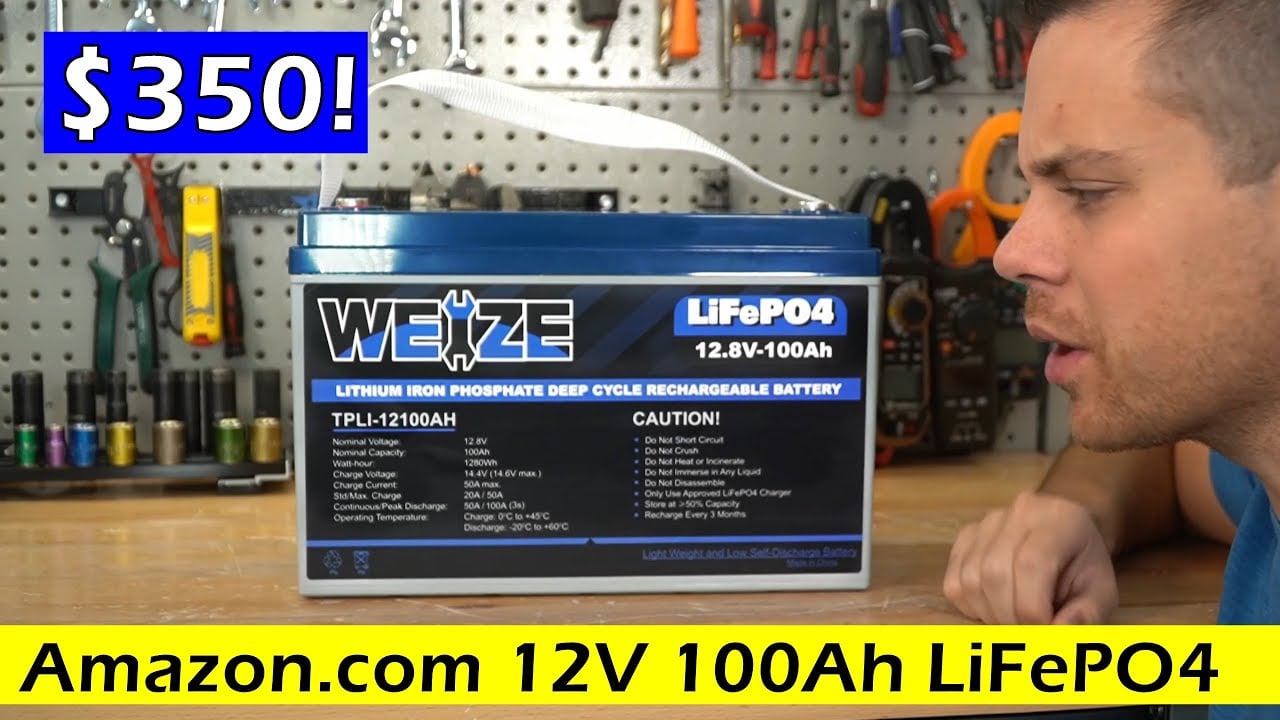
Recently we watched Will Prowse review a OEM battery that we can and have been able to source in small quantities for some time, one of our trusted suppliers sent us one of these Batteries for review last year, this battery is a made-to-specification battery by one of the largest LIFEPO4 drop-in replacement manufacturers in China. You probably have some questions you want to know the answer about China and the Lithium drop-in replacement industry, because its really hard to know who is making and selling what. And its an eye opening journey.
Over the past few years, a few of the OEM Battery suppliers have come up with some reliable and high quality drop-in replacements. This is one of the reasons Will has only recently discovered these better quality OEM batteries. Because they have been a work in progress, as each company gets a little better, so do the batteries they produce.
If you think, it’s actually in the best interest of both the consumer and the manufacturer to make a battery that does work and doesn’t fail. The competitive nature of business drives the improving product all the time.
We have been testing batteries like this since 2015. And they have been available in a similar form since about 2014 from these manufacturers.
What has happened is that the product has matured, they have got to the point where the BMS is very reliable, and the cells are better than what most people need.
To find out why we won’t be importing this Weize 12V 100Ah LiFePO4 Battery in bulk read along further
Questions
Q. Can we get this in 50ah, 100ah, and 200ah capacity from the same manufacturer? A. Yes, we can
Q. Will we be ordering these into stock? A. No, we won’t, because there are too many brands of 12v 100ah drop-in, already on the market, and we would prefer to only bring in products we love and recommend for our customers.
Q. How much would we charge for this? A. Not as much as you might think, being Amazon is very competitive, the price of this is $350-450USD.
Lets do some quick math. based on the 2 prices $350USD and $450USD.
As you can see, there is no real business case for importing these into Australia. In fact they are already here, just labelled with a different brand. I know these are here in the $600-1000 range already.
It does make you wonder, should you buy a $400 eBay battery or should you buy a $2000 Enerdrive? In my view, I would buy somewhere in the middle, but I also build my own batteries which I prefer, as I can choose which cells I use, and which BMS I use, and that is exactly why we at Lifepo4 Australia choose to use the EVE and Ganfeng lithium cells primarily, because they are both A grade products, and they both use Australian Lithium inside them.
I don’t know about you but if Victron would just release a 100ah battery for $600-800, they would destroy every other battery retailer in one go. As long as it had 4 Series and 4 parallel, with an easy to use management software for when it’s used in various configurations. Victron would absolutely own the market.
The time has come, when Lithium Batteries are starting to reverse the pricing trajectory, they have since the 1980s only ever become cheaper for ever increasing capacity of Batteries.
Now in 2021, the price trend is reversing. As you can see in this very well researched youtube channel by the Electric Viking. The price of Lithium Carbonate has increased by 170% this year alone. Sure other factors play a part, but since the price per KWH fell to under $100USD, the demand spiked and the amount of car manufacturers is also growing at a dramatic pace, my guess for the next 10 years is some ups and downs probably within 100-200% of current pricing. Meaning we will see prices for LFP Batteries around the $200USD a KWH in the DIY Market. For pre assembled professional CEC approved house batteries such as LG produces, the price per KWH will likely stay around $500 USD KWH plus Installation, which in Australia is extremely expensive due to our extremely high Labour costs.
Jiangxi Ganfeng LiEnergy Technology Co.,Ltd. (aka “Ganfeng LiEnergy” ), is a Chinese lithium battery manufacturer Ganfeng LiEnergy signed an agreement on September 1 to build the battery technology industrial park and an advanced battery R&D center in Chongqing’s Liangjiang New Area.
It is estimated the development will cost in excess of 5 Billion Yuan (CNY). Around 400 Million of which is to be used for R&D for Solid State technology.
The majority shareholder of Ganfeng LiEnergy is Ganfeng Lithium, one of the world’s top producers of the commodity used in electric vehicle batteries. Ganfeng Lithium is well known as a supplier of battery-grade lithium to clients including automakers like Tesla, BMW, and Volkswagen Group. They have offices in Australia along with 2 mines, that I am aware of at the time of writing.
According to an announcement Ganfeng Lithium issued in early August, Ganfeng LiEnergy will spend about 3 billion yuan ($463.851 million) on another 5 GWh battery plant in Ganfeng’s home province Jiangxi, which will be put into operation in October 2023.
1. China – CATL 2. South Korea – LG Chem 3. Japan – Panasonic
These 3 Brands enjoyed a combined EV battery market share of 68%, according to Goldman Sachs’ estimates in 2020/21 FY.
#1 CATL – Contemporary Amperex Technology Co. Limited, abbreviated as CATL, is a Chinese battery manufacturer and technology company founded in 2011 that specializes in the manufacturing of lithium-ion batteries for electric vehicles and energy storage systems, as well as battery management systems.
#2 LG Chem Ltd often referred to as LG Chemical, is the largest Korean chemical company is headquartered in Seoul, South Korea. first established as the Lucky Chemical Industrial Corporation, which manufactured cosmetics. It is now solely a business-to-business company.
#3 Panasonic – Famous around the world, a japanese conglomorate who has been enourmously successful for decades #5 BYD – The newest entrant here, Build YOUR DREAMS is an AMAZING COMPANY THAT IS GOING TO BE ONE OF THE LARGEST COMPANIES IN THE WORLD WITHIN 5-10 YEARS #4 CALB
LiFePO4 SOC, Voltage, Charging and Battery Care Guide
This is the practical guide to understanding LiFePO4 state of charge. Start with the basics if you just want the right settings. Open the intermediate sections if you are setting up solar, an inverter, a caravan, a 4WD or a 48 V battery bank. Open the nerd sections if you want the science behind why LiFePO4 is hard to read from voltage.
12.8 V / 25.6 V / 51.2 V systems SOC voltage charts Charge settings BMS and shunt setup Low-temperature charging Evidence and sources
Level 1: Basics
The Short Version
SOC means state of charge. It is the estimated percentage of usable battery capacity remaining.
Voltage is not a good fuel gauge. LiFePO4 voltage stays flat through much of the discharge curve.
Use real battery data for SOC. Direct battery-to-inverter communication is best where available. Use a shunt when the inverter/charger cannot get reliable SOC/current data from the battery system.
Do not charge below 0°C. Standard LiFePO4 cells can be permanently damaged by freezing-temperature charging.
Do not use equalisation. Lead-acid equalise/desulphation modes are not for LiFePO4.
Bad settings reduce life. Heat, over-voltage, deep discharge and long storage full or empty all matter.
Best everyday rule: for long life, use the battery mostly between about 10-90% SOC. If you have plenty of capacity, 20-80% is even gentler. You can still charge to 100% when you need the capacity or when the BMS needs time to balance cells.
What does SOC mean?
SOC means state of charge. A 100 Ah battery at 50% SOC should have roughly 50 Ah remaining. In real systems this is an estimate, not a perfect measurement.
SOC is affected by current measurement accuracy, battery capacity setting, charge efficiency, temperature, cell ageing and whether the monitor has recently synchronised at a true full charge.
Can I estimate SOC from voltage?
You can use voltage as a rough guide near full and near empty. In the middle, LiFePO4 voltage is too flat for accurate SOC. A battery at 13.2 V might be around the middle, but it could also be higher or lower depending on load, temperature, rest time and the exact cells.
Use voltage charts only when the battery has been resting with no charge or discharge. Under inverter load the voltage reads lower. While solar is charging it reads higher.
Simple LiFePO4 SOC Voltage Chart
This chart is for a rested battery. Treat it as a guide, not a precision instrument.
SOC
1 cell
12.8 V pack (4S)
25.6 V pack (8S)
51.2 V pack (16S)
How to read it
100%
3.40-3.45 V
13.6-13.8 V
27.2-27.6 V
54.4-55.2 V
Resting voltage after full charge. Charger voltage will be higher.
90%
3.37-3.40 V
13.5-13.6 V
27.0-27.2 V
53.9-54.4 V
Upper knee. Voltage becomes more useful.
80%
3.35-3.37 V
13.4-13.5 V
26.8-27.0 V
53.6-53.9 V
Good daily upper target for long life systems.
70%
3.33-3.35 V
13.3-13.4 V
26.6-26.8 V
53.3-53.6 V
Flat region. Do not expect precision.
60%
3.30-3.33 V
13.2-13.3 V
26.4-26.6 V
52.8-53.3 V
Flat region. Shunt/BMS needed.
50%
3.27-3.30 V
13.1-13.2 V
26.2-26.4 V
52.3-52.8 V
Middle of the plateau.
40%
3.25-3.27 V
13.0-13.1 V
26.0-26.2 V
52.0-52.3 V
Still not very accurate by voltage alone.
30%
3.22-3.25 V
12.9-13.0 V
25.8-26.0 V
51.5-52.0 V
Lower half of usable capacity.
20%
3.15-3.22 V
12.6-12.9 V
25.2-25.8 V
50.4-51.5 V
Lower knee begins.
10%
3.00-3.15 V
12.0-12.6 V
24.0-25.2 V
48.0-50.4 V
Recharge soon.
0%
2.50-2.80 V
10.0-11.2 V
20.0-22.4 V
40.0-44.8 V
Deeply discharged. Do not operate here normally.
Why are these voltage ranges instead of exact numbers?
Because voltage changes with cell model, temperature, load, rest time, BMS wiring, meter accuracy and battery age. Large battery banks also settle slowly. A voltage chart pretending to give exact SOC at every 0.01 V is misleading for LiFePO4.
Safe Starting Charge Settings
Setting
12.8 V battery
25.6 V battery
51.2 V battery
Absorption / charge voltage
14.2-14.4 V
28.4-28.8 V
56.8-57.6 V
Float / standby
13.5-13.6 V
27.0-27.2 V
54.0-54.4 V
Equalisation
Off
Off
Off
Temperature compensation
Off / 0 mV per °C
Off / 0 mV per °C
Off / 0 mV per °C
Low-temperature charge
Blocked below 0°C unless heated
Storage SOC
40-60%
40-60%
40-60%
Manufacturer settings win. If your battery manual or BMS supplier gives different values, use those values unless you have a specific engineering reason not to.
Level 2: Intermediate
Practical Setup and Troubleshooting
How should I set absorption voltage?
Most LiFePO4 cells have a maximum charge voltage around 3.65 V per cell. That equals 14.6 V for a 4S 12.8 V battery and 58.4 V for a 16S 51.2 V battery. You do not need to use the absolute maximum every day.
Daily charging at about 3.55-3.60 V per cell is usually enough for practical full capacity and is gentler. That is why many good system settings sit around 14.2-14.4 V for 12 V nominal systems and 56.8-57.6 V for 48 V nominal systems.
Victron’s lithium documentation lists 14.2 V absorption and 13.5 V float for 12.8 V lithium batteries, scaled to 28.4 V / 27 V and 56.8 V / 54 V for 24 V and 48 V systems.
How long should absorption be?
LiFePO4 does not need long lead-acid style absorption. Once the battery reaches absorption voltage and current tapers down, it is effectively full. Long high-voltage absorption mostly gives the BMS time to balance cells.
Daily cycling: short absorption is usually fine.
New battery or newly built DIY pack: allow enough time for balancing.
Cells drifting apart: occasional full charge can help the BMS rebalance.
Battery always held full: reduce high-voltage time where possible.
Should LiFePO4 float?
LiFePO4 does not need float to prevent sulphation like lead-acid. However, in a solar or inverter system, a modest float voltage can be useful because it carries house loads without repeatedly cycling the battery.
Use a conservative float: about 13.5 V for a 12.8 V system, 27.0 V for a 25.6 V system, or 54.0 V for a 51.2 V system, unless your battery manual says otherwise.
What charge current is safe?
Charge current is often described using C-rate. A 100 Ah battery charged at 50 A is charging at 0.5C. A 280 Ah cell charged at 140 A is also 0.5C.
Many LiFePO4 systems are happiest around 0.2C to 0.5C for routine charging. Some cells can accept more, but the BMS, cable size, fuse rating, charger, cell datasheet and temperature all have to support it.
Battery capacity
0.2C
0.5C
1.0C
100 Ah
20 A
50 A
100 A
200 Ah
40 A
100 A
200 A
280 Ah
56 A
140 A
280 A
314 Ah
63 A
157 A
314 A
How do I make SOC accurate?
Use a shunt or a BMS/inverter integration. Then configure it correctly.
Battery capacity: set the real usable Ah capacity.
Charged voltage: set close to your actual absorption voltage, not a random voltage chart number.
Tail current: set the current level where the battery is considered full. Common values are around 2-4% of capacity, but this depends on the battery and charger.
Charge efficiency: LiFePO4 is high efficiency, commonly around 98-99% in many monitors.
Peukert setting: much lower than lead-acid; often close to 1.03-1.05 depending on the monitor and battery.
Synchronise only after true full: do not let the monitor reset to 100% too early.
If your battery talks correctly to the inverter over CAN/RS485 and the inverter trusts that BMS data, an extra shunt is often unnecessary. A shunt is most useful for mixed systems, DIY batteries, parallel batteries without a single master BMS, or setups where loads/chargers bypass the inverter’s own current measurement.
What should the BMS do?
The BMS is essential, but it should be the last line of defence, not the daily control method. A good BMS monitors cell voltage, pack voltage, current and temperature. It should protect against over-charge, over-discharge, over-current, short circuit and unsafe temperature. It should also balance cells.
Your charger and inverter settings should normally keep the battery inside safe limits without constantly tripping the BMS.
What about low-temperature charging?
Do not charge standard LiFePO4 cells below 0°C. Low-temperature charging can cause lithium plating, permanent capacity loss and safety risk.
Some batteries include heaters and can warm themselves before accepting charge. That is different from simply forcing charge into a cold cell. If your system is in a cold location, make sure the BMS low-temperature charge cut-off is active and that solar/alternator chargers cannot bypass it.
Can I use an AGM or lead-acid charger?
Only if the voltage settings are suitable and equalisation/desulphation modes are disabled. Many lead-acid chargers are not suitable because they use automatic recovery, equalise or temperature compensation behaviour designed for lead-acid chemistry.
A charger with a LiFePO4 profile or custom voltage control is preferred.
Can I put 12 V lithium batteries in series?
Only if the manufacturer supports series connection. Multiple 12 V drop-in batteries in series each have their own internal BMS. If one battery disconnects first, the whole string can behave badly.
Use identical model, age and capacity batteries.
Fully charge each battery individually before series connection.
Check the manual for maximum series count.
Periodically rebalance or individually charge the batteries.
For serious 48 V systems, use a proper 48 V battery with one BMS designed for that voltage.
How should I store LiFePO4?
Store at about 40-60% SOC in a cool, dry place. Disconnect parasitic loads. Check voltage periodically. Bluetooth modules, BMS standby loads, inverters, DC-DC chargers and displays can slowly drain a battery over months.
What about DIY top balancing?
Large prismatic cells should start at similar SOC before being placed in series. Top balancing means bringing cells to the same upper voltage region before final assembly so one cell does not hit high-voltage cut-off before the others.
Do not parallel and charge bare cells unless you understand power supply current limits, busbar safety, fusing, insulation and short-circuit risk. Large LiFePO4 cells can deliver extreme fault current.
Common Symptoms
My battery says 13.2 V. Is it 50%?
Maybe, but do not rely on it. Around 13.2 V is in the flat region for a 12.8 V battery. Use a shunt or BMS SOC estimate and make sure it has been calibrated.
My SOC jumps from 80% to 100% suddenly. Why?
The monitor probably synchronised to 100% when its charged-voltage and tail-current conditions were met. If those settings are too easy to satisfy, the monitor will call the battery full too early.
My battery hits 100% but one cell is high. What now?
The cells are likely out of balance. Reduce charge voltage if the BMS is tripping, then allow controlled balancing at the top if the BMS supports it. For a DIY pack, check sense leads, busbars, cell matching and BMS balance current.
My inverter shuts down even though the battery says it has charge.
Possible causes include voltage sag under load, BMS low-voltage cut-off, undersized cables, loose lugs, weak cell group, incorrect inverter low-voltage setting or inaccurate SOC calibration.
Level 3: Battery nerd scientist
Why LiFePO4 SOC Is Technically Difficult
The OCV-SOC plateau problem
Open-circuit voltage (OCV) is the rested voltage of a cell with no current flowing. Many lithium chemistries have a sloped OCV-SOC curve. LiFePO4 is different: much of the usable range sits on a long, flat voltage plateau.
That plateau exists because the LiFePO4 cathode reaction is largely a two-phase transition between LiFePO4 and FePO4. Around the plateau, a small voltage change can represent a large SOC change. That makes voltage feedback weak in the middle of the battery’s range.
This is why research papers on LiFePO4 SOC estimation use methods such as extended Kalman filters, adaptive models, pseudo-OCV reconstruction and neural-network estimators rather than voltage lookup alone.
Hysteresis: why charge and discharge voltage differ
LiFePO4 exhibits voltage hysteresis. The voltage at a given SOC can be different depending on whether the battery was recently charging or discharging. This is one reason a battery can appear to “recover” voltage after a load is removed.
For real-world monitoring, hysteresis means a simple voltage chart can be wrong even after the current stops, especially if the battery has not rested long enough.
Coulomb counting and why it drifts
Coulomb counting integrates current over time. In plain English, it counts amp-hours in and out. It is the foundation of most good battery monitors.
But coulomb counting drifts because of current sensor offset, capacity setting error, battery ageing, charge efficiency assumptions and missed current paths. That is why monitors need synchronisation events at true full, and why a badly configured shunt can be worse than no shunt.
At low temperatures, lithium ions move more slowly through the electrolyte and into the graphite anode. If the battery is charged too hard or too cold, lithium can plate as metallic lithium instead of intercalating properly into the anode.
Lithium plating can reduce capacity, increase resistance and create safety concerns. Research from NREL, NASA-linked battery work and peer-reviewed electrochemical studies all identify low temperature and high charge rate as key plating risk factors.
Cycle life: what the datasheet really means
Cycle-life claims usually depend on controlled lab conditions: temperature, C-rate, depth of discharge, compression, voltage limits and end-of-life definition. A cell advertised for thousands of cycles is not promising those cycles under every installation condition.
Heat, high SOC storage, deep discharge, over-voltage, poor cell balance and high current all reduce real-world life. Conservative voltage settings and good thermal design often matter as much as the headline cycle-life number.
Cell compression, busbars and resistance
Large prismatic cells expand and contract during cycling. Some manufacturers specify fixture or compression conditions for testing. Poor busbar contact or uneven mechanical support can create extra resistance, heat and cell imbalance.
For DIY packs, equal-length links, clean terminals, correct torque, insulated tools, proper fusing and strain relief are not optional details. They are part of the battery system.
Final practical advice: use conservative charge settings, do not charge below freezing, keep batteries cool, use proper battery-to-inverter/BMS communication where available, add a shunt where the system has no reliable whole-system current measurement, let the BMS protect the system but do not rely on BMS cut-off for normal operation, and treat voltage charts as a rough map rather than a fuel gauge.