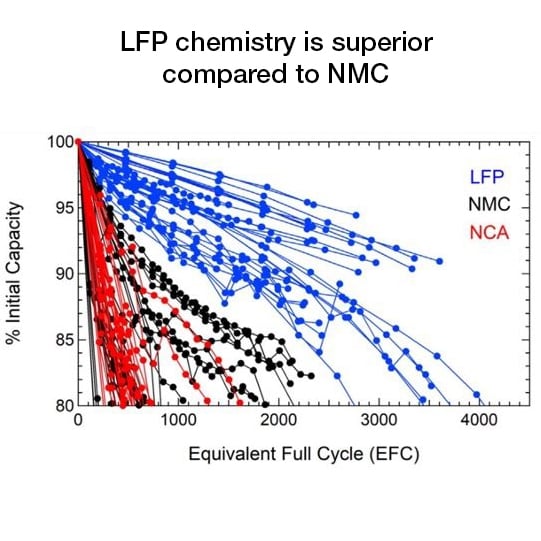
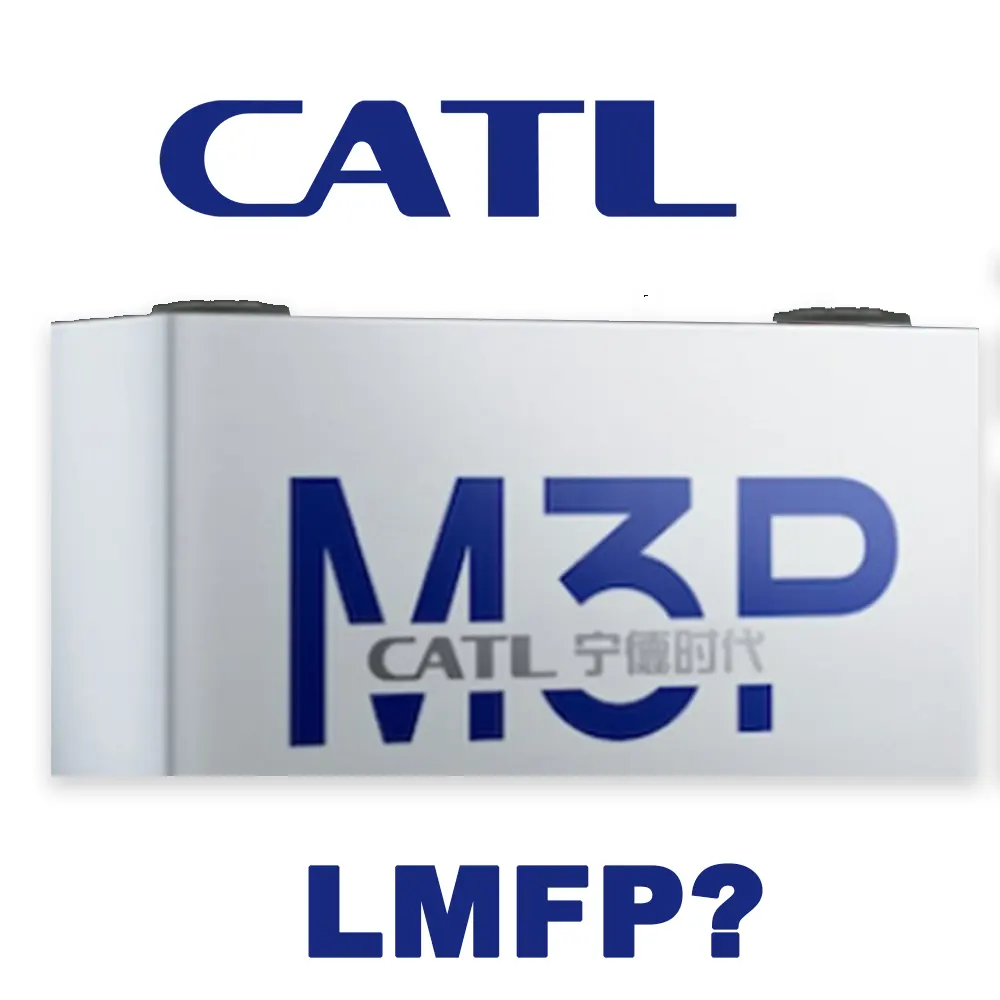
CATL, the world’s largest Lithium Battery Manufacturer, has recently announced a new battery type, with a modified version of the LMFP chemistry, LMFP stands for Lithium Maganese Ferro Phosphate, its very similar to the LFP (LiFePo4) chemistry only that the manganese allows for the voltage to rise from the 3.2 to around 4.1v, this means there is higher energy inside the same form factor or another way to say that is the higher energy density.
CATL doesn’t do things unless they are tested, thought out, and ready for mass production.
Why Voltage matters
My two cents, what do we know about voltage and the effect it has on every type of Lithium Battery cells?
We know that the lower the nominal and fully charged voltage the longer the lifespan, if you look at LTO (Lithium Titanium oxide aka Li2TiO3) the nominal voltage lies at 2.3v and the lifespan can reach 20000 cycles with the fully charged voltage at only 2.8v.
Or if we look at what’s called ternary lithium cells, such as NMC (Lithium Nickel Manganese Cobalt Oxide aka LiNiMnCoO2 and NCA (Lithium Nickel Cobalt Aluminum Oxide aka LiNiCoAlO2) chemistry, the ones currently used by most Tesla’s (excluding the Chinese made Tesla’s that are not performance models) the nominal voltage is 3.7, but the full charged voltage is 4.2v, which is high, and it’s known that higher voltages translate into lower lifespans, which is why LFP does pretty well and can reach 6000 or even 10,000 cycles if treated well. It is also reported that Tesla will be one of the largest customers of CATL for the new M3P battery, with reports that the Tesla Semi will also use them.
So with rumors of the new M3P battery being manufactured by CATL, what have they managed to do, that gives a lifespan similar to LFP but still with the higher operating voltage? At this point we don’t know, as the information is not known, at least from my research I can’t find any further details on what they have added to the chemistry to enable the lifespan such as LFP.
According to CNEVPost, the M3P cells use the same olivine structure as LFP batteries. However, they replace iron with magnesium, zinc, and aluminum. There is speculation as to whether the Chinese website meant manganese instead of magnesium, but the information has not been corrected according to Autoevolution, so we are left to speculation.
Official data shows that the energy density of the CATL (LiMnZnAl) batteries will be about 15-20% higher than that of the LFP types, which hovers around 210 kWh/kg. This is a huge increase, and it’s believed it’s at a similar cost as the LFP battery.
It is also reported that Sunwoda and Eve Energy are all in the early stages of producing LMFP, with samples already being delivered to their partners for testing.
At this stage, we believe at first it will be very hard to get your hands on these cells, so I would estimate 2024 or even 2025 before this cell could be used for energy storage like we do today with the LFP cells.
And we still believe that LFP will have a longer lifespan, simply because of the voltage. We also now recommend a 90% DOD charge profile. 2.8v bottom and 3.45v top for your battery pack. We also believe keeping the draw at under 0.5C is a really good idea if you are wanting to achieve the huge cycle numbers and still have a good battery a few years from now.
Sources
1. CATL Promises M3P Cells For 2023, But What Are They? – autoevolution
2. Tesla Model 3 With CATL’s M3P Battery to Launch in China, Offers Better Range, Lower Price – autoevolution
3. Rumor: China-Made Tesla Model 3 To Get CATL’s M3P Batteries (insideevs.com)
4. Tesla Semi Specs Change, Chinese Model 3 To Use CATL M3P Batteries – CleanTechnica
5. CATL to announce first vehicles to be powered by Qilin Battery on Aug 27 – CnEVPost