Lithium Battery-school
Pylontech First Gen 8 years old – Lifepo4 with bad cells – Repaired

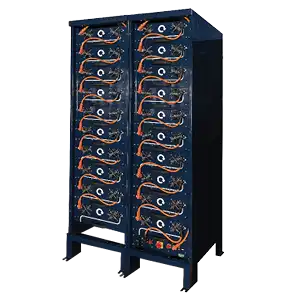
Model – Extra 2000 – First generation Pylontech Lifepo4 Battery

Thanks to Nicolas for making this video of his First generation Lifepo4 Battery repair.

Here we see an old Pylontech battery with a capacity of only 10% original capacity, and over the course of 2 youtube videos, Nicolas is able to cut out a couple of bad pouch cells and restore the battery to approx 80% again.
Well done Nicholas


Nicholas Howell
Youtube subs – 1.61K subscribers

Part 1

Part 2

Lithium Battery-school Blog
What is the best way to prolong the lifespan of lifepo4 batteries?

There are several steps you can take to prolong the lifespan of Lifepo4 batteries, including the following:

  1. Store the batteries properly: Lifepo4 batteries should be stored in a cool, dry place at a temperature of around 15-20 degrees Celsius (60-68 degrees Fahrenheit). Avoid storing the batteries in extreme temperatures, as this can damage the cells and reduce their lifespan.
  2. Charge and discharge the batteries properly: Lifepo4 batteries should be charged and discharged within the recommended voltage range to ensure optimal performance and longevity. Overcharging or deep discharging the batteries can damage the cells and reduce their lifespan.
  3. Avoid exposing the batteries to high temperatures: Lifepo4 batteries are sensitive to high temperatures and can degrade quickly when exposed to them. Avoid exposing the batteries to high temperatures, such as by keeping them out of direct sunlight or away from heat sources.
  4. Use a battery management system (BMS): A BMS can help to optimize the charging and discharging of Lifepo4 batteries, protecting them from overcharging, deep discharging, and other factors that can damage the cells and reduce their lifespan.

By following these steps, you can help to prolong the life of your Lifepo4 batteries and ensure they perform at their best for as long as possible.

Bloating

Lifepo4 batteries, like all lithium-ion batteries, can expand or “bloat” when they are overcharged or charged too quickly. The specific voltage at which this can occur will depend on the specific chemistry and construction of the battery, as well as the charging conditions and other factors. In general, however, it is important to avoid overcharging Lifepo4 batteries and to charge them at a slow, steady rate to prevent bloating and other damage to the cells. Most Lifepo4 batteries are designed to be charged to a maximum voltage of around 3.65-3.7 volts per cell, and charging them above this level can cause bloating and other damage to the cells. It is important to refer to the manufacturer’s instructions for the specific charging voltage and charging rate for your Lifepo4 batteries.

REAL WORLD Cycle life

Good quality Lifepo4 cells should achieve about 4,000 or more deep discharge/charge cycles, averaging 1 cycle per day would allow for 11 years of use before a noticeable loss of capacity.

Shallow cycles are the best way to extend the lifespan, which means not going below about 30% of the remaining capacity. And not above 90% SOC. For use in residential and commercial purposes, We at LIFEPO4 Australia would recommend sizing and using your battery within these parameters.

10,000 shallow discharge/charge cycles would last around 13+ years.

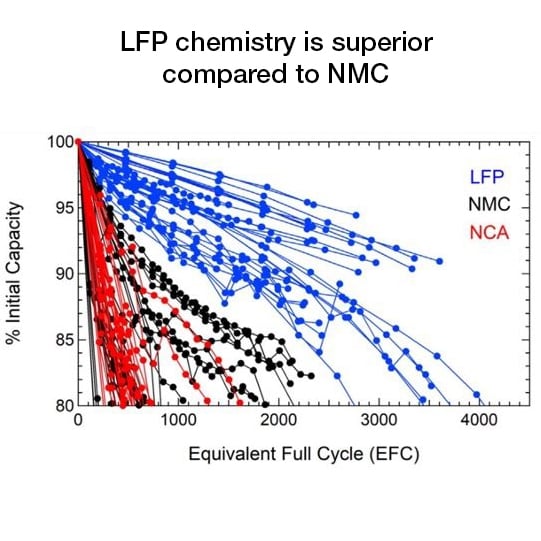
LFP vs NMC lithium battery degradation-test-results
Its likely the LFP was shallow cycles at a low C rate such as below 0.2C
Lithium Battery-school
LIFEPO4 – Internal Resistance, capacity, and its Performance

Cell capacity is of limited use if a battery pack cannot deliver the stored energy effectively; a battery also needs low internal resistance. Measured in milliohms (mΩ), resistance is extremely important the higher the C rate of the battery; the lower the resistance, the less restriction the pack encounters. This is especially important in heavy loads such as power tools and electric powertrains. High resistance causes the battery to heat up and the voltage to drop under load, this is bad for the cell, and the battery, this is what causes degradation and aging, loss of performance, and ultimately EOL(end of life)

A grade (what we now call Automotive Grade) LiFePo4 has a very low internal resistance and the battery responds well to high-current bursts that last for a few seconds to a few minutes (see the individual cell specification sheet). Compared to LFP Lead acid and inherent sluggishness, however, lead acid does not perform well on a sustained high current discharge; the battery soon gets tired and needs rest to recover. LFP however, suffers much less, And A-grade LFP is sorted by the factory because it meets the manufacturer’s specifications. This tells the manufacturer a lot about the cell, its expected performance, and its lifespan.

LFP is highly efficient and can have different performance characteristics

If we look at the A-grade EVE LF280 cells we can see the performance and efficiency. Very high!!!
Discharge capacity/nominal
capacity×100%

A)0.33CA ≥100%
B)0.5CA ≥98%
C)1CA ≥97%

We need to compare Lead Acid again for learning purposes, Some sluggishness is apparent in all batteries at different degrees but it is especially pronounced with lead acid. This hints that power delivery is not based on internal resistance alone but also on the responsiveness of the chemistry, as well as temperature. In this respect, nickel- and lithium-based technologies are more responsive than lead acid.

The internal resistance of Lithium-based batteries also increases with use and aging but improvements have been made with electrolyte additives to keep the buildup of films on the electrodes under control. With all batteries, SoC affects the internal resistance. Lithium has higher resistance at full charge and also at end of discharge with a low resistance area in the middle. This is important to note, as when you are caring for the cells, you can very simply make the judgment that keeping your Lithium cells inside the 80% window is going to minimise degradation.

The 10%-80%-10% rule for Lithium is a good one to follow. This means try to keep you cells between 10% and 90% State of Charge.

A look at the Manufacturing Process

Lithium Battery-school News
Next-Generation Automotive M3P Batteries by CATL

CATL, the world’s largest Lithium Battery Manufacturer, has recently announced a new battery type, with a modified version of the LMFP chemistry, LMFP stands for Lithium Maganese Ferro Phosphate, its very similar to the LFP (LiFePo4) chemistry only that the manganese allows for the voltage to rise from the 3.2 to around 4.1v, this means there is higher energy inside the same form factor or another way to say that is the higher energy density.

CATL doesn’t do things unless they are tested, thought out, and ready for mass production.

Why Voltage matters

My two cents, what do we know about voltage and the effect it has on every type of Lithium Battery cells?

We know that the lower the nominal and fully charged voltage the longer the lifespan, if you look at LTO (Lithium Titanium oxide aka Li2TiO3) the nominal voltage lies at 2.3v and the lifespan can reach 20000 cycles with the fully charged voltage at only 2.8v.

Or if we look at what’s called ternary lithium cells, such as NMC (Lithium Nickel Manganese Cobalt Oxide aka LiNiMnCoO2 and NCA (Lithium Nickel Cobalt Aluminum Oxide aka LiNiCoAlO2) chemistry, the ones currently used by most Tesla’s (excluding the Chinese made Tesla’s that are not performance models) the nominal voltage is 3.7, but the full charged voltage is 4.2v, which is high, and it’s known that higher voltages translate into lower lifespans, which is why LFP does pretty well and can reach 6000 or even 10,000 cycles if treated well. It is also reported that Tesla will be one of the largest customers of CATL for the new M3P battery, with reports that the Tesla Semi will also use them.

So with rumors of the new M3P battery being manufactured by CATL, what have they managed to do, that gives a lifespan similar to LFP but still with the higher operating voltage? At this point we don’t know, as the information is not known, at least from my research I can’t find any further details on what they have added to the chemistry to enable the lifespan such as LFP.

According to CNEVPost, the M3P cells use the same olivine structure as LFP batteries. However, they replace iron with magnesium, zinc, and aluminum. There is speculation as to whether the Chinese website meant manganese instead of magnesium, but the information has not been corrected according to Autoevolution, so we are left to speculation.

Official data shows that the energy density of the CATL (LiMnZnAl) batteries will be about 15-20% higher than that of the LFP types, which hovers around 210 kWh/kg. This is a huge increase, and it’s believed it’s at a similar cost as the LFP battery.

It is also reported that Sunwoda and Eve Energy are all in the early stages of producing LMFP, with samples already being delivered to their partners for testing.

At this stage, we believe at first it will be very hard to get your hands on these cells, so I would estimate 2024 or even 2025 before this cell could be used for energy storage like we do today with the LFP cells.

And we still believe that LFP will have a longer lifespan, simply because of the voltage. We also now recommend a 90% DOD charge profile. 2.8v bottom and 3.45v top for your battery pack. We also believe keeping the draw at under 0.5C is a really good idea if you are wanting to achieve the huge cycle numbers and still have a good battery a few years from now.

Sources
1. CATL Promises M3P Cells For 2023, But What Are They? – autoevolution
2. Tesla Model 3 With CATL’s M3P Battery to Launch in China, Offers Better Range, Lower Price – autoevolution
3. Rumor: China-Made Tesla Model 3 To Get CATL’s M3P Batteries (insideevs.com)
4. Tesla Semi Specs Change, Chinese Model 3 To Use CATL M3P Batteries – CleanTechnica
5. CATL to announce first vehicles to be powered by Qilin Battery on Aug 27 – CnEVPost


Lithium Battery-school News
Is LiFePo4 LFP Lithium safe?

The question many people ask is are Lithium batteries safe?

Well, the answer may shock you, but it’s not totally safe from fire risk, and the evidence is clear, when you know where to look for the answers, we do know that LFP is pretty safe, especially from an explosion. But it can catch fire under the right circumstances, like a direct puncture, especially when fully charged.

  1. Thermal Stability: LFP batteries have a more stable chemistry, which reduces the risk of thermal runaway, a condition where an increase in temperature causes a further increase in temperature, leading to a fire or explosion. This makes them less prone to catching fire compared to other lithium-ion batteries.
  2. Explosion Risk: LFP batteries are less likely to explode because they have a lower energy density compared to other lithium-ion batteries, which means they store less energy and thus have less potential energy to release in an uncontrolled manner.
  3. Puncture and Damage: Even though LFP batteries are safer, they can still catch fire if punctured or physically damaged, especially when fully charged. The internal short-circuiting caused by punctures can lead to localized heating and potentially ignite the battery materials.
  4. Charging and Overcharging: Proper charging practices are essential to minimize risks. Overcharging can lead to increased internal temperatures and potential fire hazards, although LFP batteries are generally more tolerant of overcharging compared to other types.
  5. Usage and Maintenance: Ensuring the batteries are used within their specified limits and are regularly checked for signs of damage can help mitigate risks. Protective circuits and battery management systems (BMS) are crucial in monitoring and maintaining safe operating conditions.

In summary, while LFP batteries are among the safest lithium-ion battery options available, they are not completely free from fire risks under extreme conditions. Proper handling, usage, and maintenance are key to minimizing these risks.

Watch a collection of videos on Youtube

I’ve found a few youtube videos, that show real-world testing of Lithium Batteries

GWL

Testing of LiPo and LiFePo4

HighTechLab

Check out the HighTechLab on youtube for a real-life test.

Electric Chronicles

A test on the different plastic prismatic cells

Lithium Battery-school
How a Lithium Battery Works

How a Lithium Battery Works

Checkout this video produced by the Youtube channel – The limiting factor to get a visual understanding of how on an atomic level a Lithium Battery actually works

Here we see Jordan do a very detailed deep dive into the chemical interactions inside the battery cell, atoms, nuclei, and electrons, through ionic movement. His video is highly scientific and really only for those who have the desire to understand batteries and how they work, on an entirely different level.

He also discusses the electronic and ionic movement between the anode and the cathode, travel at different speeds, and how that interaction happens on nano and micro scales.

although the battery in his video is a lithium nickel oxide battery, it is still very informative and it’s visual, so it breaks through reading text on a screen and into another dimension of visual. So you can see exactly what is happening inside these batteries.

Lithium is the holder of electrons, and nickel oxide wants those electrons. So when a charger is attached to a cell, or battery, lithium ions are free’d from the lithium, and they travel across the cathode through the electrolyte solution and end up at the anode. It’s really quite a simple thing, but the fact that we humans have been able to harness this chemical reaction is quite amazing, with a cycle life of some battery chemistry at 100,000 cycles or more.

How do lithium ion batteries work? cobalt oxide – manganese – anode – cathode

EV Engineering
Educational Videos by Sandy Munro

For those of you who enjoy a bit of old school mixed with best practice mechanical engineering, Sandy has recently found a new passion, he is a convert to Electric Vehicles and in particular Tesla vehicles and the engineering behind them.

Who is Sandy Munro? He is an automotive engineer who specializes in machine tools and manufacturing.

He started as a toolmaker at the Valiant Machine & Tool Company – a General Motors supplier in Windsor. In 1978, he joined the Ford Motor Company where he improved methods of engine assembly.

Methodologies

Munro advises and consults on the implementation and use of manufacturing methodologies including Design for Manufacture and Assembly (DFMA) and lean design. He introduced DFMA to Ingersoll Rand in 1989. Munro’s main design principles are:

  1. Teamwork
  2. Reducing the number of parts
  3. Layered assembly from above, using gravity
  4. Easy alignment and insertion
  5. Avoid expensive fastening
  6. Bulk storage to reduce handling problems
  7. Poka-yoke – making operations foolproof to avoid errors
  8. Self assembly so that parts naturally engage
  9. Simplify packaging and servicing
  10. Avoid adjustment and repositioning of the assembly

You can subscribe to his youtube channel for great informational videos about

subscribe 27850
News Blog
EG4

We imported numerous shipments of these batteries Yes! they are the exact battery made in the same exact factory. Just without the EG4 branding. EG4 is a USA company, and they are pioneers in the field, creating a couple of great high-quality batteries for their company. With sales in the hundreds of thousands of full complete batteries.

We are also partners with the same OEM factories, something we understand is a honour and it’s because early on we formed relationships with these Tier 1 factories.

We have supplied batteries to companies such as Shell Petroleum for large off grid mine installations, and other large wholesale clients in Australia. Creating a bridge between our two nations.

Why you should consider a bigger 300AH battery?

Why we now sell mostly 300Ah+ cells and Batteries

  1. Lifespan (EVE, CATL and BYD state the larger cells have 2-3 times the lifespan)
  2. Cost per Kwh – The cost per Kwh is less ($300AUD per Kwh including GST)
  3. The only battery in Australia with a built in Battery rated Australian Standard Circuit Breaker
  4. KISS – Keep it Simple Stupid
    a) in many cases 1 single 16kwh battery is enough
    b) less connection points of failure
    c) less communication issues
    d) less cells to fail in time
  5. All our batteries are user serviceable. (that means in many years from now, if a cell goes bad you can replace a single cell and keep the battery going into the future

In Australia we called it the LiFePro 48100 in Australia. The factory that builds these batteries is not an Alibaba factory, it’s actually a company with a valuation in the Billions. A Tier 1 professional battery manufacturer in China, and the quality of workmanship and quantity available is of the highest quality.

As of 2023 we switched to the LiFePro-LL (long life) model battery which is the premium battery in the USA, we have done this because it is much better suited to Australia, it uses better grade cells, and it has an amazing BMS with support for Victron inverters. You can also parallel up to 64 of them to create very large battery packs using the 100ah version that is 327kwh. And for the 300ah model that is 1MWh.

Update – Jan 2024

The price of the Battery in the USA is about the same when you factor in GST and the exchange rate. So, there is no penalty for you to buy these batteries from Lifepo4 Australia. And most people in Australia don’t realise there are also, state and province taxe in the USA, So the prices you may think Americans are paying are usually not the full price. Usually you need to add between 7.5-15% for sales tax in America. Similar to Australian GST.

NEW IN 2025!
LIFEPRO 51.2V 100Ah Rack Mounted Storage Battery

LiFePro-51.2v100Ah

LifePro Lithium Battery | 51.2V 100AH | Server Rack Battery

Original price was: $2,999.00.Current price is: $1,799.00.

LifePro Lithium Battery | 51.2V 100AH | Server Rack Battery PARALLEL UP TO 64 BATTERIES (MAX 15PCS for small installations) PERFECT FOR SMALL OFFGRID SYSTEMS LIFEPRO Lithium Iron Phosphate battery 51.2V (48V) 5.12kWh with 100A BMS Highest quality UL and IEC62619 listed prismatic 3.2V cells in series, tested by EVE Labs to 5,000 deep discharge cycles to 80% DoD Charge and discharge this battery daily for over 10 years without issue. Reliable and rigorously tested, with a 97% operating efficiency. Very Safe – LFP chemistry with Battery Management system to ensure high/low voltage cutoff, also overcurrent protection is standard Whats…

LiFePro 51.2v100Ah 1
Original price was: $2,999.00.Current price is: $1,799.00.
Clear
SKU:
Category: , ,
News Blog
12v Solar Panel Market in Australia

The 12v solar panel market in Australia is about as bad as Aliexpress. Advertised panel outputs are grossly exaggerated, usually by 200-300%.

This post will be short and sweet, but some very simple math allows us to work out rough outputs from the panels available on eBay and even reputable retailers such as 4×4 Supacentre and online marketplaces such as www.catch.com.au.

A solar panel is usually something like 15-18% efficient in the 12v marketplace. It is extremely rare that they will actually output 20% or higher and if they do, they are probably 10x times more expensive than what you are looking at paying on the online marketplaces.

An example of what to expect from an eBay 350w solar panel is probably something like 80-120W. If you work out that 1000w of sunlight falls per metre squared that is STC and the panel is 1270mm x 710mm and area of about 0.9m2. You can multiply that by 0.15 (15%) to get the wattage (if you need the calculation, do a google search). So, anyhow 0.9 x 0.15 is 135w. Now add in the NOCT rule of thumb, reduce that number by about a quarter and you will get 101w of power from that solar panel under normal operating conditions.

Given that you are paying about $170 for that panel. You are actually paying far too much for those solar panels you buy online and losing valuable roof space as a consequence.

Some people have caravans and off-grid requirements, so recently people have been looking to the house panel marketplace, this is a better option but only if you have the space available to install that size panel, and it also means your voltage may increase, which is fine as long as you take that into consideration.

It is illegal in Australia to work on any DC electrical system or panels with a voltage higher than 50V DC. This means you need to ensure you don’t run the panels in series of anything higher than that number unless you are a licensed electrician with the appropriate qualifications.

There are some exceptions to the marketplaces with Vendors such as Renogy. They actually do offer a more realistic wattage for their products, of course, you should still take roughly a quarter off the advertised wattage, because of the NOCT (normal operating conditions) rule. But at least you know what you are actually buying.

We will soon create a buyers guide and even list some good quality products on our website, so you don’t have to get ripped off buying completely rubbish claims made by online retailers.

X