
LiFePO4 Charging Guide: Voltage, Temperature and BMS Control
Charging voltage, cell temperature and charge current all influence how a LiFePO4 battery operates and ages. Our charging guide explains how to follow the battery manufacturer’s limits, choose an appropriate charging profile and use compatible BMS communications to control charging.
Read the complete LiFePO4 charging guide
Three principles for charging LiFePO4 batteries
- Start with the battery’s approved charging procedure. Use the voltage and current settings specified for the exact cell and completed battery, including its balancing and full-charge requirements.
- Match charging current to cell temperature. Cold cells may need less current or charging may need to stop. Use the battery’s measured temperature and the limits for that battery.
- Let compatible BMS communications coordinate charging. A supported BMS can send charge-current and charge-voltage limits to compatible Victron DVCC and Deye systems. Confirm that every charging source follows the required limits.
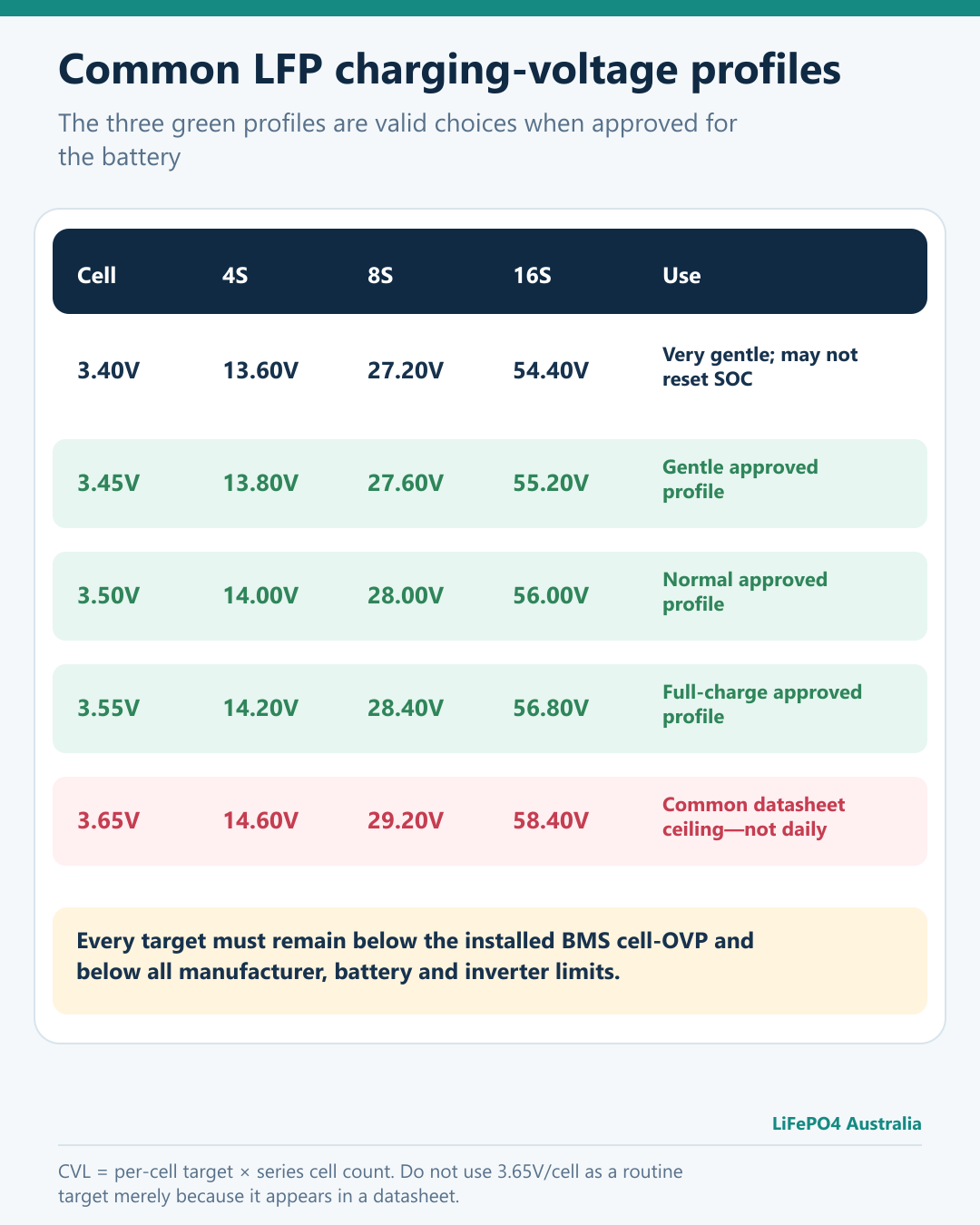
What you will find in the full guide
The guide compares manufacturer charge limits, explains 3.45V, 3.50V and 3.55V-per-cell charging profiles where approved for the battery, and covers temperature control, balancing, SOC synchronisation and dynamic BMS control.
LiFePO4 Australia’s recommended long-life charging profile adds our own optional SOC taper and temperature limits within the manufacturer’s operating limits. Its 12°C charging stop is our selected setting for the enhanced profile, rather than a universal minimum charging temperature for LiFePO4 batteries.
See the manufacturer comparisons, charging-voltage tables and practical Victron and Deye guidance in the complete guide.