
New LiFePO4 Charging Guide: Practical Settings for Longer Battery Life
LiFePO4 batteries can last for thousands of cycles, but staying inside a cell’s absolute maximum limits is not the same as charging it in the gentlest practical way.
We have published a detailed new LiFePO4 charging guide that separates manufacturer limits from our optional long-life recommendations. It brings together published cell data, practical voltage guidance, cold-weather charging, heating, SOC tapering and dynamic BMS communication.
What the guide explains
- Why a manufacturer maximum is a technical ceiling rather than an automatic daily target.
- How charge-current limits can change with cell temperature and state of charge.
- Why the lowest applicable BMS, manufacturer, hardware, SOC or temperature limit must always win.
- How Victron DVCC and compatible Deye systems can follow dynamic CCL and CVL instructions from a communicating BMS.
- When controlled battery heating becomes important for repeated winter charging.
- Practical 3.45V, 3.50V and 3.55V-per-cell charging profiles when approved for the installed battery.
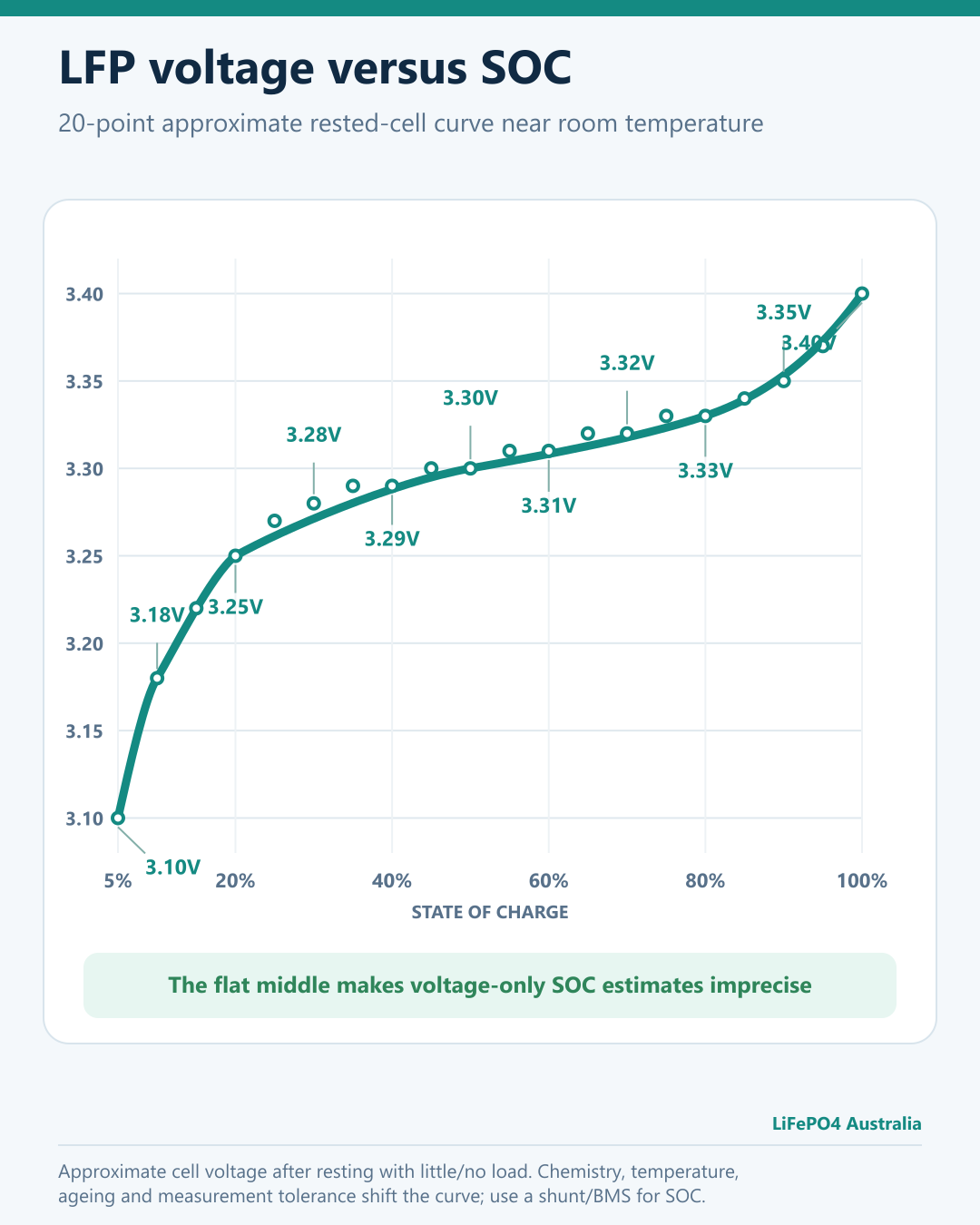
It includes manufacturer comparisons, phone-friendly charts, a large-print SOC lookup and the complete LiFePO4 Australia Long-Life Charging Standard.
Important: Always follow the exact manufacturer specification and completed-battery limits for your system. Our long-life curves are optional recommendations—not manufacturer ratings or a guarantee of service life.