
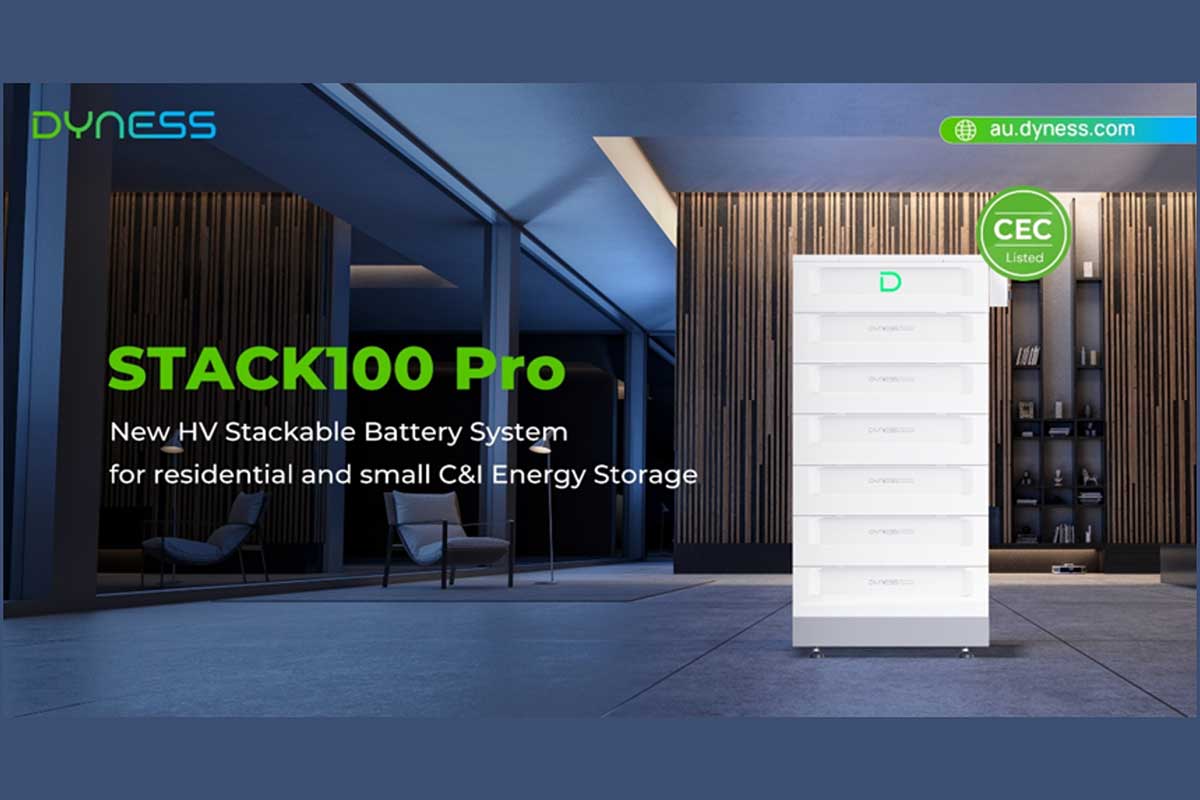
Dyness STACK100 Pro Battery System — Coming Soon to Australia
High-capacity modular battery storage for homes, farms and small commercial sites
LiFePO4 Australia is currently reviewing the Dyness STACK100 Pro as a potential future product for Australian customers who need a serious, expandable battery system with strong safety features, high-capacity options and a weather-resistant design.
The STACK100 Pro is a high-voltage lithium iron phosphate battery system designed for larger residential, rural, off-grid, backup and small commercial energy storage applications. It has recently been listed by the Clean Energy Council, supporting its use in the Australian market and helping installers and project partners meet local certification expectations.
Why we are interested in the Dyness STACK100 Pro
Many Australian homes and businesses are moving beyond small 10–15kWh battery systems. With larger solar arrays, higher daytime energy use, electric vehicles, workshops, pumps, air conditioning, machinery and time-of-use tariffs, many customers now need a battery system that can scale properly.
The STACK100 Pro is interesting because it is designed as a modular stacked system, starting from around 15.36kWh and scaling up to 76.8kWh per cluster, with the ability to parallel up to 12 clusters for larger systems up to approximately 921kWh.
That makes it potentially suitable for:
- Large homes with high energy use
- Farms and rural properties
- Small commercial buildings
- Workshops and sheds
- Solar self-consumption
- Backup power systems
- Peak shaving
- Load shifting
- Energy trading and grid-support applications
Built for Australian conditions
One of the standout features of the STACK100 Pro is its IP66-rated enclosure. This is important in Australia because battery systems are often installed in garages, carports, plant rooms, sheds, covered outdoor areas and sometimes tougher site environments.
An IP66 rating means the enclosure is designed to provide strong protection against dust and powerful water jets. In practical terms, this gives installers and customers more flexibility when selecting a suitable installation location, subject to Australian standards, manufacturer instructions and site-specific electrical design.
Dyness has promoted the STACK100 Pro as suitable for indoor and demanding outdoor environments, with a design aimed at harsh local conditions.
Quality battery chemistry: lithium iron phosphate
The STACK100 Pro uses lithium iron phosphate battery chemistry, commonly known as LiFePO4 or LFP. This is the chemistry we generally prefer for stationary energy storage because it is known for strong thermal stability, long cycle life and good suitability for solar battery applications.
According to published product information, the STACK100 Pro uses 5.12kWh battery units and is listed with a cycle life of more than 8,000 cycles at 95% depth of discharge.
For customers, this means the system is designed for frequent daily cycling, which is exactly what you want from a solar battery used for self-consumption, time-of-use optimisation or backup support.
Scalable from residential to commercial
A small battery system can be fine for basic backup or evening use, but it can quickly become undersized for properties with large loads.
The STACK100 Pro is designed to scale. A single cluster can be configured from approximately 15.36kWh to 76.8kWh, and larger installations can use multiple clusters in parallel.
This gives customers a more flexible pathway:
You can start with a properly sized system today, then potentially expand later if your energy use increases, your solar system grows, or your site adds larger loads such as EV charging, refrigeration, pumps, air conditioning or machinery.
Dyness also states that the system supports module mixing within a three-year window, which may help with lifecycle flexibility when expanding a system.
Fast charge and discharge capability
The STACK100 Pro is listed with 1C charge and discharge capability, making it suitable for applications where the battery needs to respond quickly to changing loads or electricity pricing conditions.
This may be useful for:
- Peak shaving in commercial sites
- Running larger household loads
- Supporting backup loads
- Charging during cheap electricity periods
- Discharging during expensive tariff periods
- Future energy trading or VPP-style applications, where supported by the inverter and retailer
Actual charge and discharge performance will depend on the inverter, site design, grid approval, wiring, configuration and battery sizing.
Quiet, practical and installer-friendly
For residential customers, noise matters. The STACK100 Pro has been described as having fanless natural convection cooling, which supports quiet operation in suitable environments.
The system is also promoted as having a plug-and-play stackable design, with Dyness stating that a single cluster installation can be completed in as little as 30 minutes under suitable conditions.
That does not mean every installation is simple. Australian battery installations still require correct electrical design, compliant isolation, inverter compatibility checks, switchboard assessment, backup circuit planning, DNSP approval where required, and installation by appropriately qualified professionals. But a well-designed stackable battery system can reduce on-site complexity compared with traditional rack systems.
Safety features
Safety is one of the main reasons we are interested in this product. Dyness promotes the STACK100 Pro with a five-layer safety protection system and has described the system as having advanced safety features for indoor and demanding outdoor environments.
The broader STACK100 product information from Dyness also refers to module-level safety features and fire protection concepts, including independent fire extinguishing arrangements in the battery pack design.
As with all battery systems, final suitability depends on the exact model supplied in Australia, the installation location, applicable standards, inverter pairing, battery clearances, enclosure requirements and manufacturer documentation.
Potential applications
Large residential solar battery systems
For homes with large solar systems and high electricity bills, the STACK100 Pro may provide enough storage to shift a meaningful amount of solar energy into the evening and night.
It may be suitable for customers who want more than a basic battery and are looking for a larger, more expandable energy storage platform.
Backup power
When paired with a compatible hybrid inverter and correctly designed backup circuits, a large battery system can help keep selected loads running during outages.
Backup performance depends heavily on inverter capability, battery size, surge loads, wiring design and whether the system is configured for partial-home or whole-home backup.
Farms and rural properties
Rural sites often have high energy demands, pumps, sheds, refrigeration, workshops or unreliable grid supply. A scalable high-voltage battery can be useful where standard residential batteries are too small.
Small commercial and industrial sites
The STACK100 Pro may suit businesses that want to reduce peak demand charges, store solar energy, improve resilience or shift energy use away from expensive tariff periods.
Key features at a glance
| Feature | STACK100 Pro Highlights |
|---|---|
| Battery chemistry | Lithium iron phosphate / LiFePO4 |
| System type | High-voltage modular stacked battery |
| Capacity range | Approx. 15.36kWh to 76.8kWh per cluster |
| Maximum expansion | Up to approx. 921kWh with 12 clusters |
| Protection rating | IP66 |
| Charge/discharge capability | 1C listed capability |
| Cycle life | Listed as more than 8,000 cycles at 95% DoD |
| Applications | Residential, rural, backup and small commercial |
| Cooling | Described as fanless natural convection cooling |
| Australian market status | CEC listed according to public announcements |
Our view
The Dyness STACK100 Pro appears to be a serious battery platform for customers who need more than a small residential battery. The main reasons we are considering it are:
- Strong scalability
- IP66 weather-resistant enclosure
- LiFePO4 chemistry
- High-voltage architecture
- Large residential and small commercial suitability
- CEC listing for the Australian market
- Potential for fast installation
- Compatibility with leading inverter brands, subject to confirmation
Before we offer this product, we will be checking the practical details that matter: inverter compatibility, warranty support, Australian stock availability, service support, monitoring, installation requirements, real-world performance, and how it compares against other high-value battery options.
Interested in the STACK100 Pro?
LiFePO4 Australia is currently assessing the Dyness STACK100 Pro for future supply in Australia.
If you are planning a larger solar battery system for your home, farm, workshop or business, contact us and we can help compare suitable options, including currently available battery systems and upcoming products like the STACK100 Pro.
Contact LiFePO4 Australia to discuss your site, energy usage and battery sizing.