
Battery build reference · Series & parallel
LiFePO4 Cell Configurations for 12V, 24V and 48V Batteries
Explore cell layouts, understand series and parallel, and calculate your battery’s voltage, capacity and energy.
Series sets voltage. Parallel adds capacity.
The letters S and P describe the electrical connections. The physical arrangement can change while the electrical configuration stays the same.
Cells in series
Connect positive to the next cell’s negative. Each cell adds its voltage to the string. The amp-hour capacity stays the same as one cell.
16 × 3.2V, 314Ah cells in series = 51.2V, 314Ah.
Cells in parallel
Connect positive to positive and negative to negative. The voltage stays the same and the cell capacities add together.
2 × 3.2V, 314Ah cells in parallel = 3.2V, 628Ah.
Reading 16S2P: sixteen series groups, with two cells in parallel in each group. That is 32 cells in total. With 314Ah cells, the pack is 51.2V, 628Ah and 32.15kWh nominal.
Three common battery configurations
These examples use one cell at each series position, also written 1P. Each pack below has the same 314Ah capacity; adding series cells increases its voltage and energy.
12V battery
12.8V nominal
314Ah · 4.02kWh
Four series cells with a 4S LiFePO4 BMS.
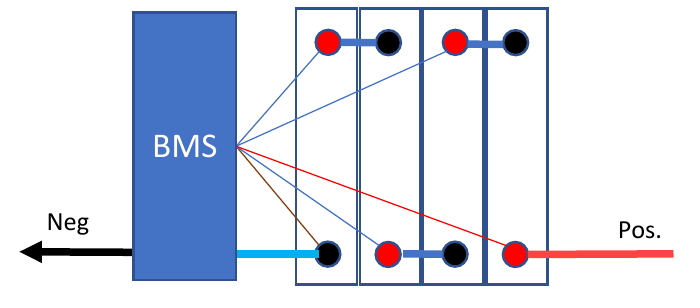
24V battery
25.6V nominal
314Ah · 8.04kWh
Eight series cells with an 8S LiFePO4 BMS.
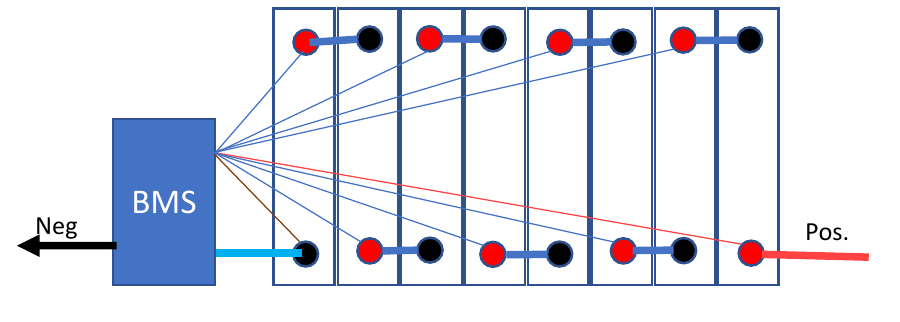
48V battery
51.2V nominal
314Ah · 16.08kWh
Sixteen series cells with a 16S LiFePO4 BMS.

Parallel-first cell layouts
When more capacity is needed within one battery, we favour matched parallel cell groups connected in series. Use one BMS matched to the number of series groups and the full pack current.
The 8S2P, 16S2P and 4S4P busbar breakdowns below are for EVE double-pole cells. Battery output cables and BMS leads are separate. Sense-wire connections are covered in the JK BMS build guides below.
8S2P parallel-first layout
Our preferred 8S2P layout for two rows of eight cells. Eight parallel pairs are connected in series under one 8S BMS.
25.6V nominal16 cells · 628Ah · 16.08kWh with 314Ah cells
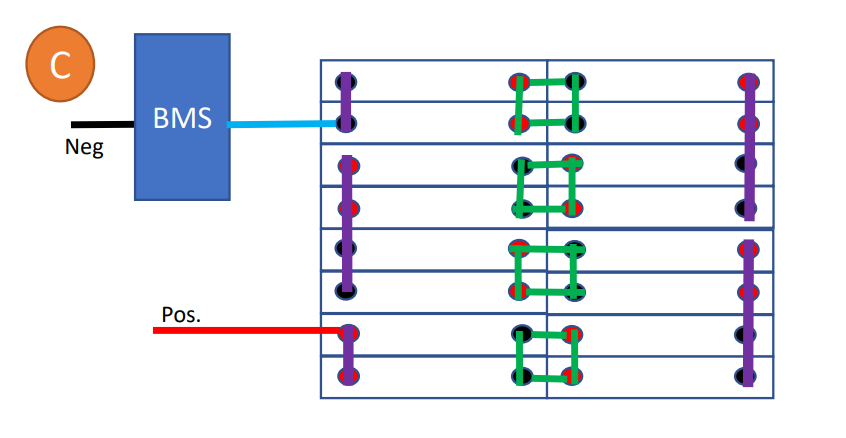
- Total busbars
- 27
View optional layout4 fewer busbars
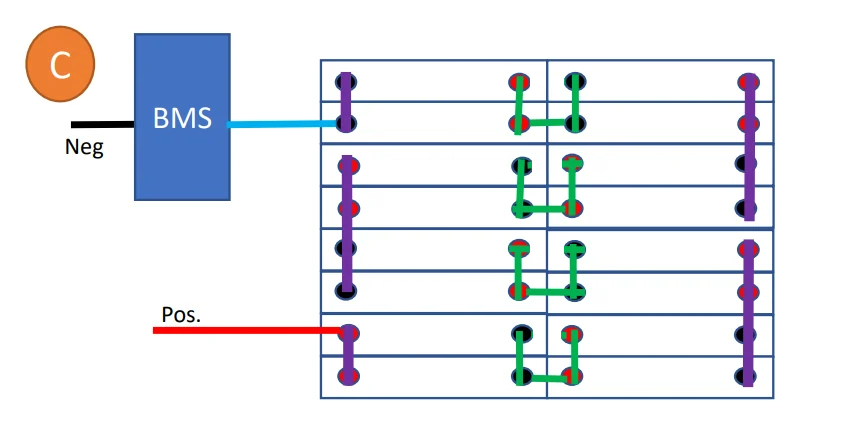
- Normal links
- 19
- Turned joining bars
- 4
- Total busbars
- 23
4 turned joining bars × A$12 = A$48. Saves A$48 in turned joining bars compared with the layout above.
16S2P parallel-first layout
Sixteen groups of two parallel cells connected in series. One 16S BMS monitors the sixteen group voltages.
51.2V nominal32 cells · 628Ah · 32.15kWh with 314Ah cells
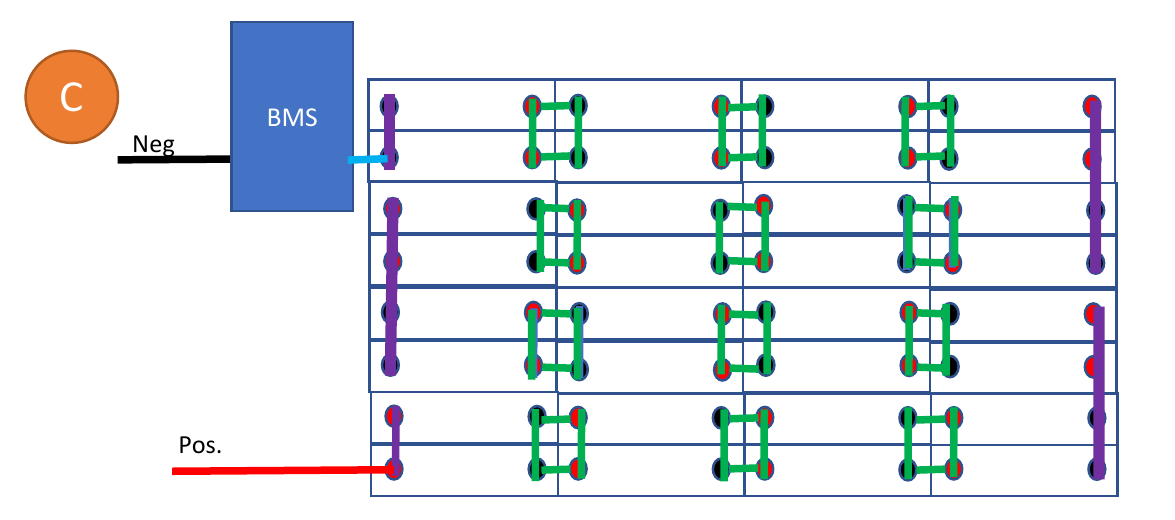
- Total busbars
- 59
View optional layout12 fewer busbars
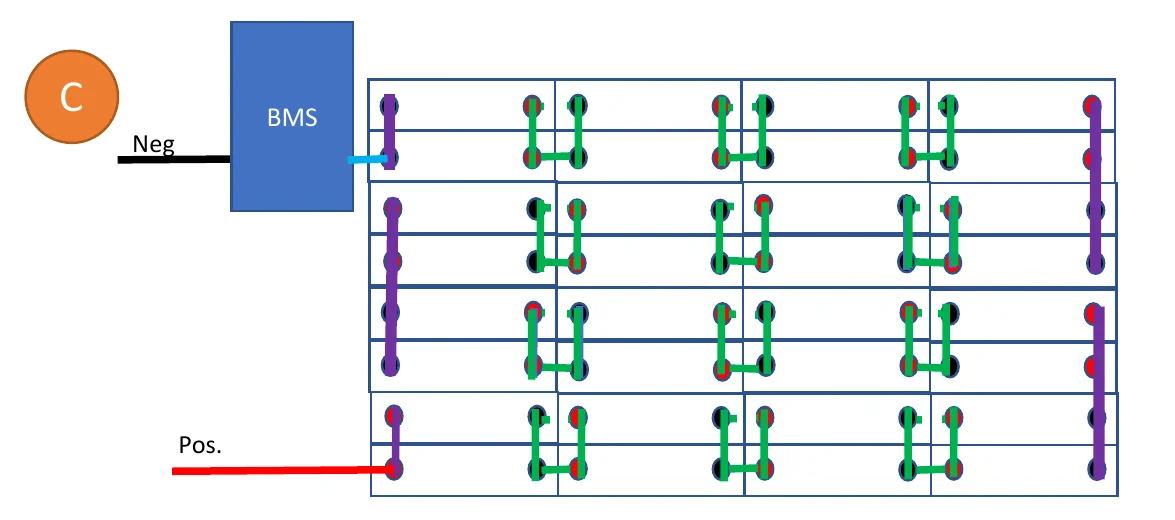
- Normal links
- 35
- Turned joining bars
- 12
- Total busbars
- 47
12 turned joining bars × A$12 = A$144. Saves A$144 in turned joining bars compared with the layout above.
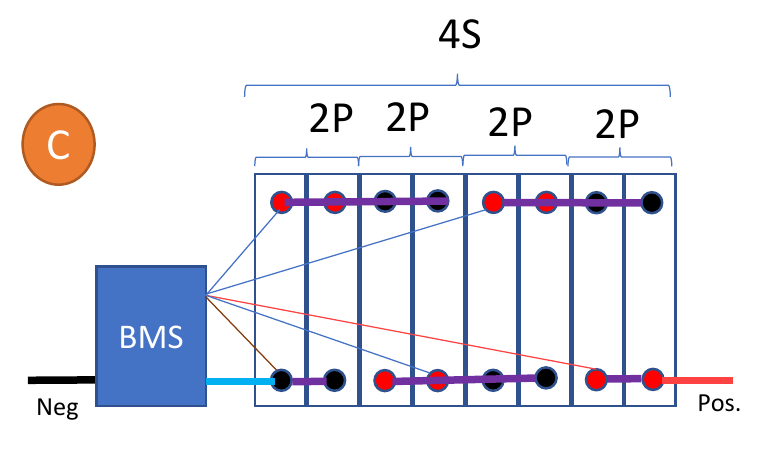
4S2P parallel-first layout
Four groups of two parallel cells connected in series. One 4S BMS measures the four group voltages.
12.8V nominal8 cells · 628Ah · 8.04kWh with 314Ah cells
4S4P parallel-first layout
Four groups of four parallel cells connected in series. The BMS still monitors four group voltages, so this uses a 4S BMS.
12.8V nominal16 cells · 1,256Ah · 16.08kWh with 314Ah cells
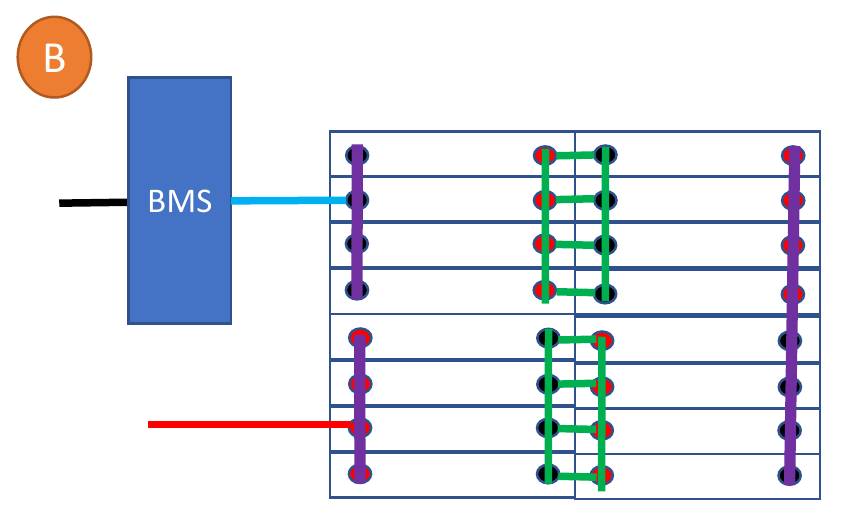
- Total busbars
- 33
Compare the joining busbar cost
These compact parallel-first arrangements use larger turned joining busbars. At A$12 each, those bars cost A$96 for either the 8S2P or 4S4P arrangement, and A$288 for the 16S2P arrangement.
| Configuration |  Normal links |  Turned joining bars | Total busbars | Joining bar cost |
|---|---|---|---|---|
| 4S4P | 25 | 8 | 33 | A$96 |
| 8S2P | 19 | 8 | 27 | A$96 |
| 16S2P | 35 | 24 | 59 | A$288 |
Two separate 8S1P packs normally need 14 normal links in total, seven per pack. Two separate 16S1P packs need 30 normal links in total, fifteen per pack. Compared with those two-pack arrangements, the 8S2P and 16S2P options each use five additional normal links, plus their turned joining bars listed above.
Calculate your battery pack
Choose the series count, cells per parallel group and capacity of one cell. The calculator uses 3.2V nominal LiFePO4 cells.
Enter a cell capacity between 1 and 2,000Ah.
Voltage = 3.2V × series count. Capacity = cell Ah × parallel count. Energy in kWh = pack voltage × pack Ah ÷ 1,000.
Compare voltage, capacity and energy
Use the nominal pack voltage when calculating energy: 12.8V, 25.6V or 51.2V for these LiFePO4 configurations.
| Configuration | Cells | Nominal voltage | Capacity | Nominal energy |
|---|---|---|---|---|
| 4S1P | 4 | 12.8V | 314Ah | 4.02kWh |
| 4S2P | 8 | 12.8V | 628Ah | 8.04kWh |
| 4S4P | 16 | 12.8V | 1,256Ah | 16.08kWh |
| 8S1P | 8 | 25.6V | 314Ah | 8.04kWh |
| 8S2P | 16 | 25.6V | 628Ah | 16.08kWh |
| 8S3P | 24 | 25.6V | 942Ah | 24.12kWh |
| 16S1P | 16 | 51.2V | 314Ah | 16.08kWh |
| 16S2P | 32 | 51.2V | 628Ah | 32.15kWh |
Cell groups and complete battery banks
We favour parallel-first cell groups when building one battery with one BMS. Complete protected batteries can also be connected in parallel as a modular battery bank.
Parallel cells into groups
Make four groups of two parallel cells, then connect those four groups in series. One 4S BMS measures the voltage of each group.
The BMS sees four group voltages. It does not measure each cell in a parallel pair separately.
8 × 314Ah cells → 12.8V, 628Ah
Cell busbars: 11 pieces.
Parallel complete battery packs
Build two separate 4S batteries, each with its own BMS. Join their protected outputs in parallel through the designed DC connections.
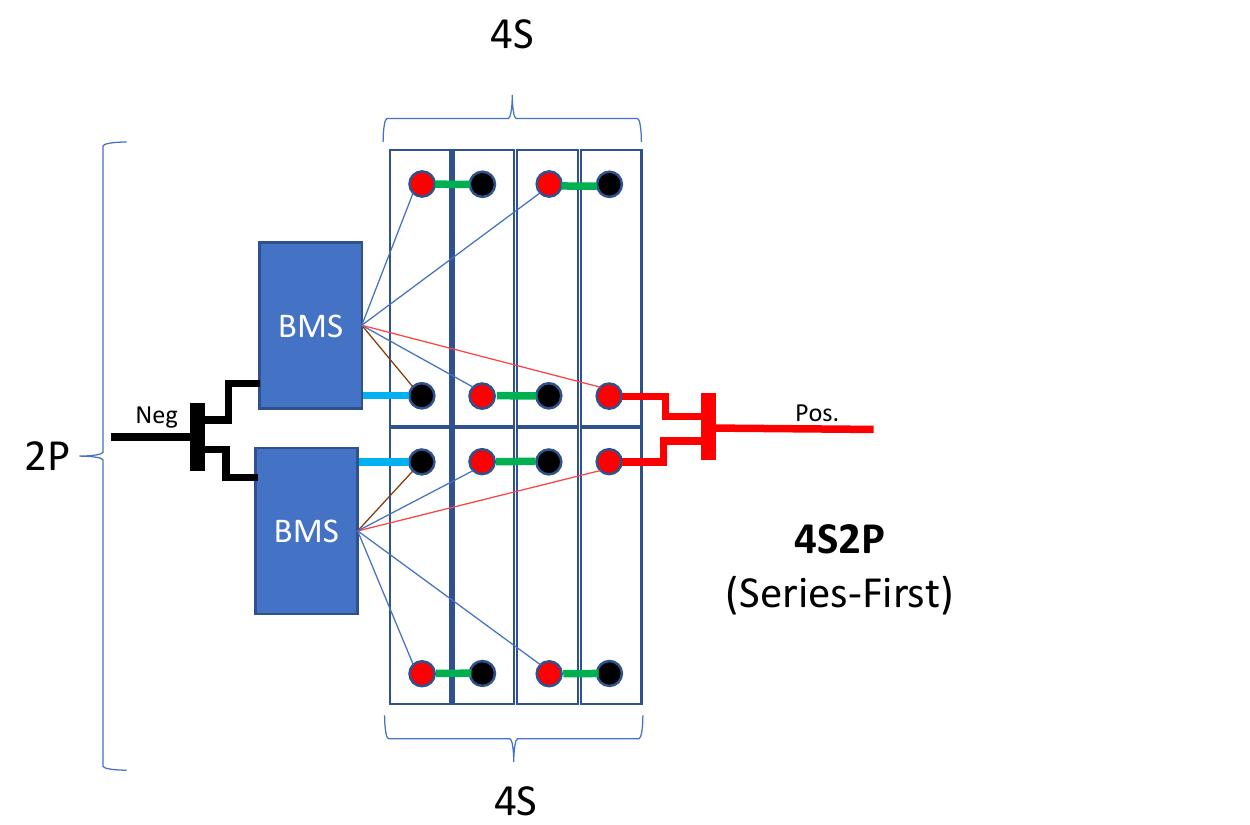
Each BMS monitors its own cells. The BMS balancers do not balance cells between the separate packs.
2 × 12.8V, 314Ah packs → 12.8V, 628Ah
Cell busbars: 6 × 2-hole links, three per pack.
Match the BMS and current path to the design
For cell groups connected in series, match the BMS to the number of series groups and the full pack current. A 16S2P pack uses a BMS that monitors sixteen series groups.
For complete packs connected in parallel, use compatible packs at closely matched voltages, individual pack protection and balanced current paths. Size the system so another pack disconnecting does not overload the packs that remain connected.
Select busbars, cables, fuses and isolation equipment for the designed voltage, continuous current and fault current. Check the cells’ charge and discharge ratings separately from the BMS rating.
Explore the configuration PDF
The original reference includes alternate physical layouts, parallel cell groups and multiple battery packs for 12V, 24V and 48V systems.
Continue with a JK BMS build guide
Choose the guide for your pack’s series count.