
The battery buyer’s guide
The cells are just the beginning.
A good decision starts with the whole picture. Explore what goes into a battery, what sits around it, and how the costs change. Then choose the path that works for you.
- Cells per battery
- 16
- 16-cell example
- —
- Scope of totals
- Equipment only
01 / Your starting point
The workbench
Four stages between a box of cells and a working system
Move through the stages in order, or jump to the one you care about. Selecting a stage changes what you are shown — never what anything costs.
01 Cells
Stage 01
Cells
Cells store the energy. Their price is one part of the picture: the management, protection, enclosure and connections still need to be considered. Compare the specifications, condition and traceability as well as the price.
- Sold by capacity and grade, not by finished product
- Arrive as loose units — 16 cells makes one 48 V-class battery
- No management, protection or enclosure included
Stage 02
Make it a battery
A battery is cells plus the equipment that manages and protects them. A suitable battery management system monitors the cells and provides protection within its specified and configured limits. Around it sit fusing, switching, sensing and a structure that holds everything together safely.
- Battery management system sized to the pack
- Fusing, isolation and disconnection
- Enclosure, compression and mounting hardware
Stage 03
Build the wider system
Storage is one part of the system. An inverter turns stored energy into usable power, and solar or another source puts energy back. Cabling, protection, monitoring and mounting tie it together. Some equipment can be shared between batteries; other parts may need to change as the system grows. Adding a battery does not mean multiplying every cost.
- Inverter and/or charger
- Solar or other replenishment source
- Cabling, protection, monitoring, mounting
Stage 04
Leave room for tomorrow
Households change. An electric vehicle, extra appliances or a shed becoming a home can change what you need. Think about storage, power and charging together. An expansion plan can help you identify equipment that may otherwise need replacing.
- Space and mounting for additional batteries
- Expansion-friendly busbars and cable routing
- Compatibility and limits on future additions
Cost explorer
What does the whole picture cost?
Enter what you know and leave the rest blank. Anything blank is counted as unknown, never as free. Amounts are equipment and materials only.
Restores the amounts supplied with this guide. Your pack selection stays as chosen.
Leave a field blank when you do not know the figure. A blank entry is reported as an unknown cost, not as zero.
Battery subtotal
—
Wider equipment subtotal
—
Illustrative equipment subtotal
—
Catalogue examples include GST and were checked on 20 September 2026. These items are not a verified compatible bill of materials. Equipment and materials only. Freight, delivery and installation labour are excluded, and no rebates are applied.
If things change
Common ways a system stops fitting
Tap a scenario below to see what might change and what to check. Your cost estimate stays the same.
Choose a scenario
Pick whichever sounds most like your household. Nothing here changes the equipment list or the costs above.
- What changes
- What to check
- What may stay
An honest comparison
Which route fits you?
If you enjoy the build
- Work
- Plan for assembly, testing and any work that needs an appropriately qualified person.
- Compatibility
- Check cells, management, enclosure and the wider equipment together.
- Support
- Check the support and warranty offered for each component and for the assembled battery.
- Included scope
- List every included part and identify who tests the assembled battery.
If you want the finished battery
- Work
- Battery assembly is supplied; confirm testing and the remaining installation arrangements.
- Compatibility
- Check the supplied documentation and supported inverter combinations.
- Support
- Check who supports the battery and where the system support begins and ends.
- Included scope
- Everything in the finished product, up to its stated limits.
Building with cells makes real sense when you have the time, the tools and an interest in the result. Buying finished makes sense when you want one accountable product. Both are legitimate; the cost difference is not the whole story either way.
Your next step
What would you like to do?
Tap a pathway below to explore your options and what you would still need to arrange.
Choose a pathway
Each route ends somewhere different. Pick one to see what to look at and what stays in your hands.
Worth reading
The questions that shape real ownership
Cycle counts, charging and real conditions
Before turning a cycle number into years of service, open the conditions behind it. What temperature? What charging power? How much capacity remains at the end? How was the cell supported and monitored?
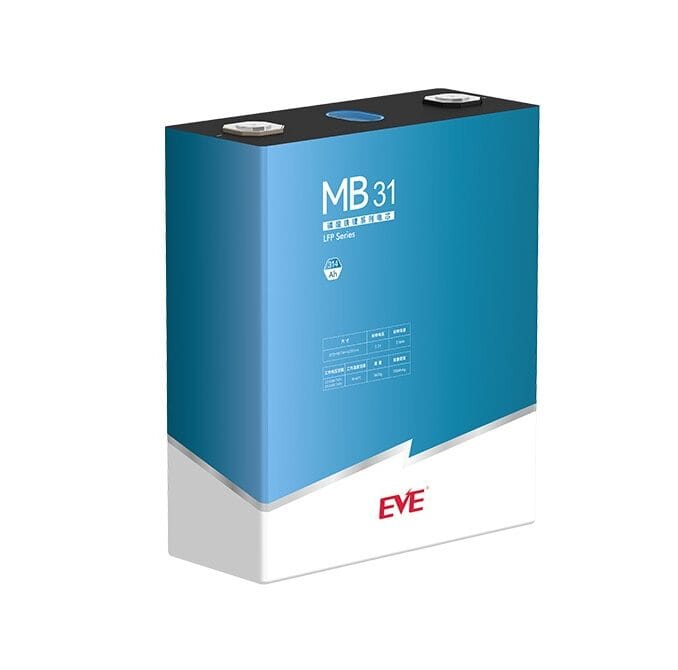
EVE’s November 2023 MB31 specification pairs that figure with a 25°C test, specified 0.5P charge/discharge procedures and 70% state of health. Its test procedure also reduces power as the cell ages.
The useful question: how closely will your finished system follow the conditions required by its own cells—not just their advertised capacity?
Does 8,000 cycles mean more than 20 years at one cycle a day?
That division is arithmetic, not a service-life prediction. Batteries also age with time. Temperature, operating limits, usage, storage and the rest of the system affect the outcome. A cell’s cycle-test specification is not automatically a warranty for your finished battery.
State of health describes remaining capacity relative to its original value. It is different from state of charge, which describes how full the battery currently is. A battery can read “100% charged” while holding less energy than it did when new.
Use the exact datasheet revision for the cells supplied, alongside the actual warranty. Do not assume another model from the same manufacturer has identical limits.
What happens near full charge—and why does the BMS matter?
Picture a pack that is almost full. One cell reaches its limit before the others. Does the system reduce charging appropriately, stop cleanly, or repeatedly run into its protection cut-off?
The answer depends on cell behaviour, balance, the charging method, settings and the information exchanged between the BMS and every charging source. An emergency cut-off is a final protective action; it should not be the only strategy considered for everyday charge management.
There is no universal “start tapering at this percentage” rule for every LFP cell. Follow the model’s prescribed voltage, current/power and temperature limits. A percentage shown on a screen is not a substitute for individual-cell monitoring.
Victron’s documented DVCC system can pass dynamic voltage and current limits from compatible managed batteries to supported chargers and inverter/chargers. The important checks are the BMS’s actual behaviour, supported hardware and correct configuration—not the badge alone. See the Victron documentation.
A real example: the same MB31 cell, different temperatures
The November 2023 MB31 table lists different maximum charging power at different cell temperatures. For example, 0.12P at 5°C and 0.5P at 25°C. “Above freezing” does not automatically mean “full charging power”. Source: MB31 specification, section 2.3.2.
Ask how your system measures cell temperature and applies the exact limits for its cells. These figures are a datasheet-reading example, not recommended settings for your battery. Sensor location, cell age and other limits still matter.
Lithium plating, ageing and safety—in plain English
Under unsuitable charging conditions, lithium can deposit on the graphite anode instead of being stored as intended. This is called lithium plating. It can reduce useful capacity; certain growth patterns can also contribute to internal short circuits. Low temperatures and demanding charging conditions are important concerns.
The separator is the physical barrier between the electrodes. The SEI is a different thing: a protective interfacial layer on the electrode. They should not be treated as the same component. Technical background: US Department of Energy.
This does not mean every DIY battery will catch fire after a set number of years. It means charging limits, temperature management, monitoring and end-of-life decisions deserve attention. A reassuring dashboard is useful; verified protection behaviour is more useful.
Warranty, insurance and support
Possibly not. Compare what is covered, under what conditions, and what happens when you actually need help.
What performance is promised?
- Years, energy throughput, cycles—or whichever limit arrives first?
- What remaining usable capacity is warranted, and how is it tested?
- Which temperatures, operating limits and installation conditions apply?
- Are registration, connectivity, updates or records required?
What happens after a fault?
- Who diagnoses the problem: you, the installer, retailer or manufacturer?
- Is the remedy repair, replacement or a calculated credit?
- Who covers testing, removal, labour and dangerous-goods freight?
- Are the cells, BMS, inverter and installation covered separately?
A warranty example: one failed component, several suppliers
Imagine a system assembled from cells, a BMS, an enclosure and an inverter bought from different businesses. A charging problem develops. Before anyone replaces anything, someone may need to establish which component—or interaction—caused it.
Compare that with the documented support arrangement for a packaged system. Is there genuinely one accountable support path, or are there still separate hardware and installation responsibilities? Ask both sellers the same question: “Who takes ownership of diagnosing a system-level problem?”
Neither example guarantees an easy or difficult claim. The aim is to understand the arrangement before you need it.
What about home insurance?
Ask your insurer about your actual equipment, location, installation and any disclosure or documentation requirements. Keep their written response with your installation records.
Do not assume DIY automatically means uninsured, or that a branded battery automatically guarantees cover. Insurance, manufacturer warranties, installation warranties and Australian Consumer Law rights are separate topics.
A manufacturer’s warranty is additional to applicable Australian Consumer Law rights; its conditions do not remove those rights. ACCC: warranties and consumer guarantees ↗
Going beyond four packs
The four-pack view in the calculator is a working range, not a limit. Larger systems deserve a separate design review covering distribution, protection, cabling, enclosures and inverter or charger limits. These checks also matter within the one-to-four-pack range.
If you expect to grow past four packs, treat the shared equipment as the thing to plan properly. Whether batteries can be added later depends on compatibility, manufacturer limits and the original system design.
Heat, cold, weather and everyday safety
Weather, curious children and wildlife do not follow your project plan. Open a scenario and ask three questions: what detects it, what responds, and what happens if that protection fails?
A cold morning. The sun comes out.Does charging wait, reduce or warm the cells first?
Check temperature-dependent charge limits, low-temperature protection and where the sensors sit. If heating is included, ask what it heats, when it operates, what powers it and when charging is permitted.
Some SigenStor models document automatic battery heating in cold conditions. That is a feature to verify for the exact model—not a promise that every branded battery has it, or that heating is needed in every climate. See the SigenStor installation guidance.
Heatwave. Afternoon sun. Heavy demand.Can it reduce output before a limit becomes a fault?
Ask about operating limits, derating, direct sun, ventilation, clearances and the chosen installation location. Check both battery and inverter requirements. “Outdoor rated” does not answer all those questions.
Consider the room, shed or cabinet on its hottest day, not just the local weather forecast. Temperature management is a design question, not an invitation to modify a sealed product.
Wind-driven rain, a leak or floodwater.What does the enclosure rating actually cover?
Check the exact enclosure rating, mounting instructions, cable entries, drainage, condensation risks and site flood exposure. A rain-resistant enclosure is not automatically suitable for submersion.
If equipment is flooded, damaged, smoking or unusually hot, keep away and seek professional help. Do not touch it, open it or re-energise it. For an immediate danger or fire, get people clear and call 000. Read Australian battery safety guidance.
Children, pets, rodents and everyday clutter.What stops access, damage or an obstructed escape route?
Look at access to live parts, terminal covers, protected cable routes, enclosure openings and whether animals can damage wiring. Keep the required space around equipment clear. A garage changes over time: bikes, boxes and pet bedding can arrive long after commissioning.
Ask your installer about suitable placement, impact protection and pest exposure. Do not block ventilation or add improvised screening that conflicts with the manufacturer’s requirements.
A sensor fails. A cable loosens. Communication stops.What is the safe fallback?
Ask what happens if temperature data disappears, the BMS disconnects or a charging source stops receiving instructions. Who checks protective devices, connections and compatibility during commissioning?
Detection, isolation, enclosure design and installation location are different layers. A fire-suppression feature, where provided, does not replace the other layers or make a system fireproof.
Five years on. Different usage. Less capacity.Who notices, and what changes?
Check what is logged, how faults are communicated, what maintenance is required and how end of life is assessed. Is there a support path if a component fails or is discontinued?
An older pack may need a different approach from a new one. Adding new cells or modules is not automatically acceptable: obtain the manufacturer’s permitted expansion or replacement procedure.
Your questions checklist
Tick a question when you have reviewed it—not when you think you have “passed”. Keep the answers, documents and any unanswered questions with your quotes.
0 of 8 questions reviewed. This is not a safety assessment.
Import costs, cables and the wider comparison
Why can a local carton cost more than a factory quote?
A factory price and an Australian delivered price are different starting points. Compare equivalent cell models, grades, quantities and sales terms, then include freight, dangerous-goods handling, insurance, customs clearance, applicable import charges and GST. Small shipments can have a very different per-cell freight cost from large consignments.
Locally stocked pricing also supports warehousing, handling, picking, packing and customer support. A direct import can still be a sensible choice; establish the full landed cost, responsibility for damage and the practical process for a return or claim.
Ask for the exact cell specification, production/traceability information and written warranty terms. A grade label by itself is not a complete quality specification.
Low-voltage losses: why do cables keep coming up?
For the same power, a lower-voltage system needs more current. Resistive heating in a particular cable rises with the square of current: P = I²R. At the same resistance, doubling the current means four times that resistive loss.
This is why voltage, cable length, conductor size, connections and protection need to be designed together. It is not proof that every higher-voltage system is better; those systems bring different hazards and installation requirements. Compare the efficiency and cost of the actual finished designs.
Rebates, VPPs and payback: useful, but check the conditions
Australia’s Cheaper Home Batteries Program has equipment, installation and other eligibility requirements. A collection of individual cells should not be assumed to qualify. Confirm the exact proposed system and current rules with the installer and the Clean Energy Regulator before including support in your budget. Check official eligibility.
For a virtual power plant, ask about supported equipment, tariffs, how the battery may be operated, any reserved capacity, participation conditions and the warranty implications. Eligibility is not a promise of earnings.
Payback depends on your energy use, tariffs, solar generation, system losses, available capacity and how you operate it. This guide deliberately does not turn an advertised cycle count into a guaranteed financial return.
Sources, product examples and further reading
Written from LiFePO4 Australia’s experience supplying cells, supporting DIY customers and comparing complete systems. Scenarios are illustrative, not customer testimonials or failure-rate statistics. Technical examples are model-specific; product features, warranty terms and program rules can change.
Open the source shelf
- EVE MB31 Product Specification, November 2023, revision A (manufacturer document hosted by NKON) — charging limits, temperature dependence, cycle-test conditions and system-design responsibilities. Confirm the revision supplied with your own cells.
- Victron: Distributed Voltage and Current Control — supported managed-battery limits and configuration dependencies.
- Sigenergy: SigenStor Home site-selection requirements — installation conditions and documented cold-weather heating. Check exact regional model and current manual.
- US Department of Energy: Energy Storage Safety Strategic Plan — lithium plating, separators, degradation and system-level safety context.
- ACCC: warranties — the difference between additional warranty promises and consumer guarantees.
- Queensland Electrical Safety Office: battery energy storage systems — installation, commissioning and safe ownership. Requirements depend on the system, location and jurisdiction. See also Fire and Rescue NSW’s residential battery guidance and the Australian Government’s battery buyer guidance.
- Clean Energy Regulator: solar batteries — current program requirements; no eligibility or rebate amount is promised by this guide.
What this guide can—and cannot—do
It helps you compare scope, features and questions. It cannot assess your home, select protective devices, validate BMS settings, certify compliance, determine insurance cover or replace an installer’s design and commissioning work.
LFP examples do not automatically apply to sodium-ion, LTO or other chemistries. A kit is not automatically a complete or compliant installation. A recognised brand is not a guarantee that every model has every feature discussed here.
We welcome a useful correction. Contact our team with the model, document and detail so we can review it.