Cheaper Home Batteries Program Australia 2025
Step-by-step summary of the Cheaper Home Batteries Program policy paper and some rough cost comparisons to help you work out the best option for you:
1. Introduction and Context:
- The Challenge: Australia leads the world in rooftop solar panel installations. However, the adoption of small-scale battery systems (which store solar energy for later use) is lagging. The primary reason for this is the high upfront cost of purchasing and installing these batteries.
- Why Batteries are Important:
- They help secure renewable energy resources by storing excess solar power.
- They improve the overall reliability and stability of the energy system.
- They allow households and businesses to maximize their use of self-generated solar power, reducing reliance on the grid and potentially lowering electricity bills.
- Purpose of the Policy Paper: This document outlines the Australian Government’s plan to support the uptake of battery systems by making them cheaper. It details the key features of the “Cheaper Home Batteries Program,” focusing on who is eligible and how the program will work. It’s important to note that some details might change before the final regulations are approved.
2. The Cheaper Home Batteries Program: Core Details
- Program Name: Cheaper Home Batteries Program.
- Primary Goal: To significantly reduce the initial purchase and installation cost of small-scale battery systems for Australian households, businesses, and community facilities.
- Start Date: The program is scheduled to begin on July 1, 2025.
- Delivery Mechanism:
- The program will be implemented by expanding the existing Small-scale Renewable Energy Scheme (SRES).
- The SRES currently provides incentives for installing small-scale renewable energy systems (like rooftop solar panels) through the creation of Small-scale Technology Certificates (STCs).
- The program will extend this STC mechanism to include eligible battery systems.
3. Financial Incentives (The Discount):
- Target Discount: The program aims to reduce the upfront cost of an eligible battery system by approximately 30%.
- Discount Value in 2025:
- This 30% discount is estimated to be equivalent to $372 per kilowatt-hour (kWh) of the battery’s usable capacity.
- In terms of STCs, this translates to 9.3 STCs per kWh of usable capacity in the year 2025.
- Progressive Reduction: The level of discount (and therefore the number of STCs) will gradually decrease over time. By the year 2030, the discount is planned to be half of what it is in 2025. This is designed to encourage earlier adoption.
- Funding the Discount: The Australian Government will purchase the STCs generated by the battery installations from the STC Clearing House. This government purchase effectively covers the cost of the discount provided to consumers.
4. Eligibility Criteria for Battery Systems and Applicants:
- Who is Eligible? The program is open to:
- Households
- Businesses
- Community facilities
- Battery System Size:
- Eligible battery systems must have a usable capacity between 5 kWh and 100 kWh.
- However, the discount (STCs) will be provided for a maximum of 50 kWh of usable capacity per system.
- Solar PV System Requirement:
- The battery system must be installed in conjunction with a new or existing solar photovoltaic (PV) system.
- Accreditation Standards:
- Both the battery itself and the inverter (which converts DC power from the battery to AC power for household use) must be accredited by the Clean Energy Council (CEC). This ensures they meet certain quality and safety standards.
- On-Grid vs. Off-Grid Systems:
- On-Grid Systems: Batteries connected to the main electricity grid must be Virtual Power Plant (VPP) capable.
- VPP Capability: This means the battery system can be controlled (with the owner’s permission) to work in coordination with other distributed energy resources (like other batteries or solar systems) to provide services to the electricity grid. This can help with grid stability, managing peak demand, and integrating more renewable energy.
- Off-Grid Systems: Batteries not connected to the main electricity grid do not need to be VPP capable.
- On-Grid Systems: Batteries connected to the main electricity grid must be Virtual Power Plant (VPP) capable.
- Relationship with Other Incentives: The support provided under this federal program will be in addition to any rebates or incentives offered by state and territory governments. This means consumers may be able to “stack” incentives for a greater overall discount.
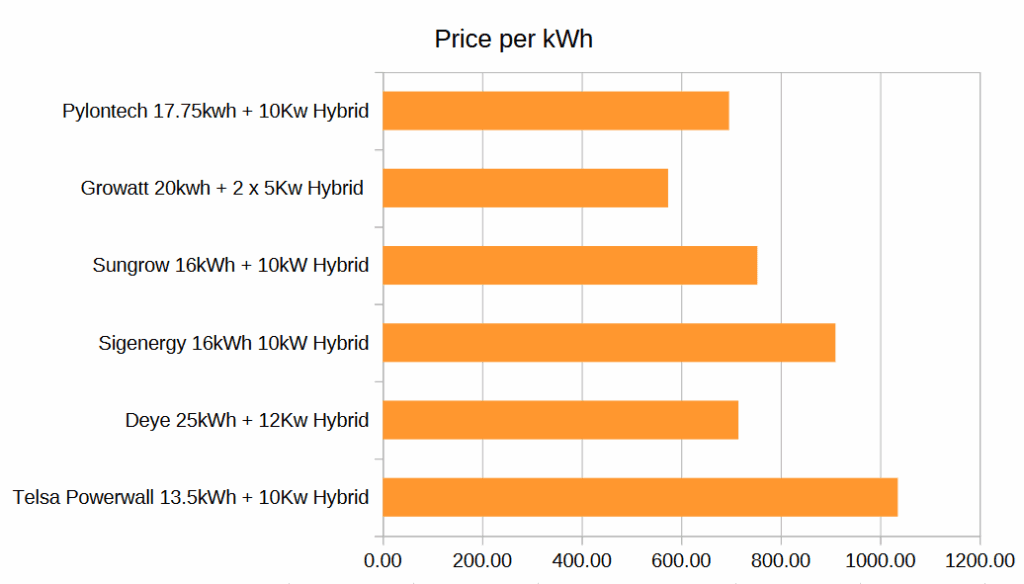
5. Some Battery and inverters that may be eligible at estimated costs based on national averages
| Battery | Usable kWh | Retail Price | Average Install Cost | Subtotal | Rebate | After Rebate | Price per kWh |
| Telsa Powerwall 13.5kWh + 10Kw Hybrid | 13.5 | 14000 | 5000 | 19000 | 5022 | 13978 | 1035.41 |
| Deye 25kWh + 12Kw Hybrid | 23 | 21000 | 4000 | 25000 | 8556 | 16444 | 714.96 |
| Sigenergy 16kWh 10kW Hybrid | 15.6 | 15000 | 5000 | 20000 | 5803.2 | 14196.8 | 910.05 |
| Sungrow 16kWh + 10kW Hybrid | 16 | 14000 | 4000 | 18000 | 5952 | 12048 | 753.00 |
| Growatt 20kwh + 2 x 5Kw Hybrid | 18.4 | 13400 | 4000 | 17400 | 6844.8 | 10555.2 | 573.65 |
| Pylontech 17.75kwh + 10Kw Hybrid | 16.85 | 14000 | 4000 | 18000 | 6268.2 | 11731.8 | 696.25 |
6. Regulatory Framework and Administration:
- Primary Administrator: The Clean Energy Regulator (the Regulator) will be responsible for administering the Cheaper Home Batteries Program as an expansion of the SRES.
- Responsibilities of the Clean Energy Regulator:
- Ensuring overall compliance with the program’s rules and regulations.
- Validating applications for STCs related to battery installations.
- Issuing the STCs once applications are validated.
- Managing a system of inspections for installed battery systems to ensure they meet requirements.
- Educating the industry (installers, suppliers) about the program.
- Taking compliance and enforcement action if rules are broken.
- Role of State and Territory Regulators:
- State and territory government bodies will continue to be responsible for aspects related to:
- Electrical safety of battery installations.
- Ensuring installations comply with local electrical codes and standards.
- Consumer protection issues related to the sale and installation of battery systems.
- State and territory government bodies will continue to be responsible for aspects related to:
In summary, the Cheaper Home Batteries Program aims to significantly boost battery adoption in Australia by making them more affordable through an expansion of the SRES. It sets clear eligibility criteria focused on system size, solar integration, product accreditation, and VPP capability for on-grid systems, with the Clean Energy Regulator overseeing its implementation.
For up to date information contact us and we can send you a copy of the policy.